The musings of the Pastor from Good Shepherd Lutheran Church, Regina SK

Welcome. If you're a member at Good Shepherd, welcome to more thoughts and discussion of the week that was, and some bonus thoughts throughout the week. If you're not a member, welcome, and enjoy your stay. We are happy that you're here.

If you like what you see here, consider joining us for worship at Good Shepherd Lutheran Church. Sunday mornings, at 8:30 and 11:00. You can also follow us on Facebook.

Monday, April 29, 2013

Yellin' like Magellan


I always feel bad when I have to yell at the congregation.

I'll rephrase that.  I always feel bad when I have to preach the law to the congregation.

We Lutherans have this awesome thing going on, which we call 'Law and Gospel.'  It was really popularized by Walther.  Put into its simplest possible terms, if you're comfortable, you should be terrified, and if you're terrified, you should be comforted.  This was the basic building block of the teaching of Jesus when he was here on earth with us.  When he was doing his teaching and preaching, what you've noticed is that he was nice to the sinners, the tax collectors, the prostitutes, the various bad eggs who were around, but he was harsh to the pharisees, the saducees, the chief priests and elders of the people.

And why was that?  The understanding these days seems to be that Jesus is the friend of the plucky underdog, that he is around as some sort of galactic socialist, designed to redistribute wealth and so on.  And the reason that we like this, is because we always view ourselves as the plucky underdogs in our own stories.  We view ourselves as facing the wind, taming whales, all that stuff.  That's how you and I see ourselves.

And because we see ourselves in that light, the modern church heads into some trouble when it comes to preaching law.  When it comes to preaching law, most people want a nice 'fire and brimstone' sermon, in which I, or a pastor like myself, preach damnation about those who aren't in our church, and probably never will be.  Honestly, I've had a few people come to me and ask for more preaching on the law, ask for a little more hellfire, ask for a little more promise of damnation, which at first caught me by surprise, until I figured out what was going on.

If I was to preach a sermon on attendance, everyone who heard it would be saying 'yeah, right on!'  As well they might.  Because, by definition, if you're listening to a sermon on attendance, you're at least there to hear it!  And you can get rather smug, and think to yourself 'yes, those other goofballs out there should really go to church more.'  And yes, they probably should.  But why oh why would I bother telling the people who are there that the people who aren't should be?

This last Sunday, I preached the law on a particular hobby horse of mine.  That is, I preached about the reading from Acts regarding cornelius.  This particular passage is a passion of mine, particularly because it is related to the way our churches function in the real world.  And when I say our churches, I mean our Lutheran Church-Canada churches, legit.

The whole deal with Cornelius, in case you didn't know, is the blowing of Christianity open to the world outside.  Even though Christ our Lord had told his disciples that they were to preach his message to the ends of the earth, the disciples didn't think that Jesus actually meant it. The idea that the disciples had is that if people were going to be Christians, then they would have to be Christians like them.  In other words, the disciples kept kosher, they went to the synagogue, they spent time dealing with the temple and everything related to it.  And they kept kosher.  It's a reality so nice I said it twice, but it's important for this conversation.  When the disciples get together, they do so as Jewish Christians.  They're Christians, obviously, but they're Christians as an off-shoot of their Judaism.  And this, this is the beginning of a problem that will plague us from the first century to the present day.  The idea is that in order to be a Christian, you have to be like us first. Who is us?  It's whoever happens to be running the congregation at the time.

For us, in Lutheran Church-Canada, we happen to be overwhelmingly German.  Yes we do.  And we tend to say things like 'Lutheran last names' 'Lutheran pop', all sorts of other stuff that is entwined with German culture.  And this makes it difficult to do any kind of reasonable outreach beyond our immediate community.  Our favourite target is German catholics, but that stopped being a fertile ground about six hundred years ago.  The real fertile ground for outreach is honestly going to be either Canadian atheists, or failing that, people who don't look all that German.

And this is why I preach on the law in this manner.  The big threat facing the Christian church, the big panic, the big problem that we face down all the time is not the homosexuality, it's not the abortion, it's not the gambling, or the drug addiction, it's not murder or rape.

It's that you're a bunch of Pharisees.

That was the problem with the synagogue and the temple back in the New Testament days, and it's the problem in churches today, and don't think that it's a problem only in LC-C churches.  It's a problem with all churches, more pronounced with in churches that have a sort of National background (Anglicans, Lutherans, Dutch Reformed, etc).  Your church has a problem, in that it's not about making you more like God, it's about making other people more like you.  And if you think I'm making this up, I'm not.  This is a problem plaguing churches these days.  The idea from the beginning was that we were made in God's image, and we have taken this in later days to mean that we are supposed to make other people in our image.  When it comes time to discuss food or drink or worship times, or prayers or anything like that, we turn into Pharisees remarkably quickly, saying 'well, if you're going to be a Christian, you're going to have to go to church at 8:30 in the morning, and use p.158 out of the hymnal.'  As though Jesus, when he was walking on God's green earth, was setting up Lutheran churches, placing organs in them, and signing off on the only true hymnal, the blue hymnal.

None of that happened.  We get confused so quickly because we're so silly.  We're silly silly people.  We feel as though we are the barometer of holiness, and everyone else should be judged through our lens.  If we don't drink alcohol because we have a problem with it, we usually think that nobody else should either.  And that gives us the awesome sense of security, it lets u s look at everyone else, and say that they have a long way to go to catch up with us.  Our way is the best way, even though it is just useful for us, and has nothing to do with scripture at all.  But that was never the idea - all things are lawful, says the scripture, but not all things are profitable.  It's up to you, and what is driving a wedge between you and God.  And for most of you, I doubt very much that it's the same things as it is for me.  That's because we're all sinners, but all pulled in different directions.  We each have our own strengths and weaknesses, and that's fine.  But the big danger is when we assume that there is a simple, easy to follow standard for holiness that involves haircuts, not wearing jeans, jello salad, cabbage rolls, and German music.  Because it doesn't, and it never did.

I'm in the business of preaching law sometimes, not often, but sometimes.  And when I preach the law, what should I preach about?  The demon liquor?  The rampant adultery that is constantly happening?  The gambling addictions that tear families apart?  Maybe.  But if I was hungry, I'd talk about food.  Our churches aren't full to the brim with gambling addicts, or alcoholics, or abortion providers, or murderers, but they are full of cold, self-righteous prigs.  And if I'm going to preach the law, what do you think I'm going to preach about?  What did Jesus preach about?  It was, and always has been, about opposing the proud, and giving grace to the humble.

PJ.

Tuesday, April 23, 2013

The science of the lambs

Aha, sheep.  This was Good Shepherd Sunday, and what better time to be at Good Shepherd Lutheran church, than on Good Shepherd Sunday?  Well, none, really.  But with all the readings being about sheep, it was good for us to get to thinking about what on earth sheep are all about.

The point I made on Sunday (which was a grand one), is that sheep require shepherds.  They need to
have a sort of alpha ram that they will follow around.  They crave leadership, which we do as well.  The funny thing about the global (new) atheism movement is their insistence that they can live a life free of shepherds.  The claim is that you don't need anyone to tell you where to go or what to think. 

The entire movement is structured around the notion of 'freethought,' and members call themselves 'free thinkers' amongst other things.  Now, this isn't to tar all atheists with the same brush, but it does bear thinking about, when it comes time to define your worldview. 

I find it to be quite frankly astonishing how many free thinkers have the same thoughts.  It's strange how many of them come to the same conclusion, and have the same worldview on a lot of things.  It's almost as though they all read and were informed by the same book...

Now, that's not to say that you, as an atheist, have all read these books, and have abandoned your previous thoughts on the world and our place in it because of that.  Not likely.  But in the same way as most Christians haven't read the entire Bible yet have a worldview shaped and informed by it, so too do most atheists have their worldview shaped and informed by a few key texts.  And free thought leads you, as usual, to remarkably restricted thought.

Part of the breakdown with the conversation at this point is usually geared around the notion that someone like myself is tempted to say that 'atheism is just another religion,' which generally gets called a bit of a canard, and that's fine.  But I'm not going to say that today.  What I will say, though, is that free thought gets remarkably dogmatic in its liberty.  It's free, but only in incredibly restricted parameters.  You can think whatever you want, as long as it's within a very limited range of topics, pretty much.  So, it's not a religion per se, but it does speak to our desire to have shepherd who lead us and guide us.  It's a matter of which shepherd you follow.

The notion of the good shepherd is one that comes up in the Christian faith.  And once you understand and realize that you, as a sheep (and I know, you're a radical freethinker, but at least acknowledge your desire to have your worldview informed by people whom you respect), have a need for a shepherd, you can start to work out what kind you want to have. 

All shepherds do the standard 'follow me'.  If they didn't, they'd be sort of bunk shepherds.  But here's the juice.  The difference between a shepherd and a Good Shepherd is the question of do they let it go from there?  Jesus classically says to his disciples when they're out fishing 'follow me' and they do.  They leave everything they have, their boats, their nets, their everything, and follow him. 

And then they desert him . And so does everyone else.  Look at the history of Christ in the Gospels.  His disciples, his followers, go through many various stages of following him with extreme enthusiasm, and then disregarding him with frustration when he makes the outlandish claims that he
does.  But where does Jesus go after that?  He goes right back to them.  He follows them.  The irony of the call of Christ is that after he tells us to follow him, he seems to do nothing but follow us around.  The story is the one of the Good Shepherd, who leaves the 99 and goes off in search of the one who is lost.  And if you haven't understood this story, you haven't understood Christianity.

As I said on Sunday, Christianity is incarnational.  Always has been, always will be, and it's what sets Christianity apart from the majority of other worldviews, etc.  You say it in an almost breathless whisper on Christmas Eve as you turn to the person next to you, and say to them 'Christ the light of the world has come to you.'  The Good Shepherd is notable in his leaving his comfort and coming to you.

Contrast that with the dogmatism that engulfs freethought at present.  This is an older quote, but it still checks out, and was made by Virginia Woolfe on the subject of T.S. Eliot's conversion to Christianity.

"I have had a most shameful and distressing interview with poor dear Tom Eliot, who may be called dead to us all from this day forward.  He has become an Anglo-Catholic, believes in God and immortality and goes to church.  I was really shocked.  A corpse would seem to me more credible than he is. I mean, there’s something obscene in a living person sitting by the fire and believing in God.”


Freethought is pretty much only allowed to go in one direction.  From belief to atheism.  That's freethought.  And if, like TS Eliot, you happen to arrive at the conclusion that there is a loving God in
heaven who cares for us, calls us by name, and cherishes us, then you don't fit in with the free thinking ethos of the society.  Then you are abandoned, like a corpse, essentially.  The freedom of thought in freethought is an illusion, not actually occupying reality.  You are free to think freely as long as you come to a very set series of conclusions.  What does all this mean?  It means that our quest for a shepherd is not just a choice between two voices saying 'follow me.'  It's a journey between two voices, one saying 'follow me,' and the other saying 'let me follow you wherever you go, and be your source and strength.'

PJ.
 

Tuesday, April 16, 2013

Get your fish on

Many many years ago, back in a time before time, when dinosaurs ruled the earth, I played the part of James (big stretch, right), in my church's adaptation of this particular reading.  Yes, the reading in which Jesus reappeared on the beach, and asked his disciples if they had any fish.  It's a fun story, isn't it?  I know I mentioned this on Sunday, but for the benefit of those of you who weren't there on Sunday, here's the reading and my analysis.


21 Afterward Jesus appeared again to his disciples, by the Sea of Galilee.[a] It happened this way: 2 Simon Peter, Thomas (also known as Didymus[b]), Nathanael from Cana in Galilee, the sons of Zebedee, and two other disciples were together. 3 “I’m going out to fish,” Simon Peter told them, and they said, “We’ll go with you.” So they went out and got into the boat, but that night they caught nothing.
4 Early in the morning, Jesus stood on the shore, but the disciples did not realize that it was Jesus.
5 He called out to them, “Friends, haven’t you any fish?”
“No,” they answered.
6 He said, “Throw your net on the right side of the boat and you will find some.” When they did, they were unable to haul the net in because of the large number of fish.
7 Then the disciple whom Jesus loved said to Peter, “It is the Lord!” As soon as Simon Peter heard him say, “It is the Lord,” he wrapped his outer garment around him (for he had taken it off) and jumped into the water. 8 The other disciples followed in the boat, towing the net full of fish, for they were not far from shore, about a hundred yards.[c] 9 When they landed, they saw a fire of burning coals there with fish on it, and some bread.
10 Jesus said to them, “Bring some of the fish you have just caught.” 11 So Simon Peter climbed back into the boat and dragged the net ashore. It was full of large fish, 153, but even with so many the net was not torn. 12 Jesus said to them, “Come and have breakfast.” None of the disciples dared ask him, “Who are you?” They knew it was the Lord. 13 Jesus came, took the bread and gave it to them, and did the same with the fish. 14 This was now the third time Jesus appeared to his disciples after he was raised from the dead.
John 21:1-14
 
As I said on Sunday, it's a nice story.  It's a story of Peter, waking up early in the morning, and going out on a fishing trip with the rest of the like-minded disciples.  No problem there, right?  Well, hold on Charlie, because there is a slight problem with this setup.  Peter, Andrew, James, John, the rest, they're all out there fishing, partially because it's a nice morning to go out on a boat, but partly because they are going back to their former lives as fishermen now that this whole Jesus thing is all wrapped up.  They followed Jesus around for a while, but then he had to go and get himself executed, and then the fun rapidly dries up. 
 
But hold on, because there Jesus is on the shore, and after they've spent an enjoyable morning catching nothing, he tells them from the shore to let down their nets.  And this mirrors pretty much exactly the calling of the first disciples from the Gospel of Luke, in which Jesus tells some rather unsuccessful fishermen to let down their nets after a day of catching nothing.  See a theme there?  You should. 
 
Anyhoo, in Luke's Gospel, they let down their nets, and all of a sudden they are pulling in so many fish that the nets are strained to their breaking point, and the boats begin to sink.  Wow!  Great, right?  Well, only if you're in the business of catching fish.  Which fishermen should be. 
 
Hold on, I'll explain.  You know that they're out there to catch fish, obviously, because why on earth would you be on a fishing boat, with nets, if you didn't want to catch fish?  Why indeed.  As I said on Sunday morning, the thing about boats is that they're not all for the same thing.  They really really aren't.  A paddle boat is not a canoe, and a kayak is not a fishing boat.  Boats are all for different things, and one would assume, naturally, if you're in a fishing boat, with nets and all the trappings, that you're there to go fishing.
 
I mentioned this on Sunday, but the space that we commonly call the sanctuary in the church is also
known as the nave.  What is the nave?  I'm glad you asked, I really am.  The nave is the space in the church where everyone sits, and it's supposed to evoke, for you, the feeling of being in the hold of a boat.  And as I say many many times, nothing in a church is there by accident.  And the layout of the church is no exception.  Have you ever wondered why we have pews and not easy to move, multi-purpose single seat chairs?  Probably because you're in the nave of the church, and as such, you're not supposed to be sitting by yourself.  You're all supposed to be on the same oars, pulling in the same direction.  To what end?  Well, you have the same mission as Peter, who is told by Jesus 'follow me, and I will make you a fisher of men.'
 
The nave of the church isn't just a boat, like a generic boat.  It's a working boat.  It's a fishing boat.  It's a boat equipped with nets and rods and all that stuff.  The church is that boat, and the funny thing is, we don't really feel as though it either is or should be for about 90% of the time.  We feel as though pulling on board fish would be difficult or complicated, or that they'd be a-cluttering the place up a bit if we hauled them on board. 
 
The nave isn't a generic boat, though we may want it to be.  We want it to be all sorts of boats, a paddleboat, a canoe, usually a speedboat filled with supermodels made of champagne flutes, but usually the gist is the same for each and every single intended boat: we want it to be like most boats we would normally go onto, filled with us, and people we like.  People who are just like us.
 
But fishing boats are designed to haul fish on board.  They're going to be messy, smelly, loud, covered in guts, all that.  They're going to be awash with trouble sometimes, and smelling a little salty.  If you are on board the fishing boat, you have to work, you're not just there for a pleasant cruise.  You're there to pull fish on board.
 
You may not like that.  You may get a little bit sulky when you consider that the church may end up filled up to the brim with people whom you don't like, and who are not like you.  And any of us would be a little bit put out if someone other than our sweetheart hopped into the passenger seat of our paddleboat.  But in a fishing boat, you have work to do.  You've got a job before you.  You have work to do.  And do you know what it means when the boat gets so full that it starts to sink?  Do you know what it means when the nets are straining, and when the boats can't haul the nets on anymore?  Do you know what it means for a fishing ship to be struggling under that burden? 
 
 
It means that the fishing boat is successful.  That it's doing the right thing.  It's realizing the purpose for it existing.  When Jesus commanded the disciples to let down their nets for a catch, and they did, they brought on more fish than they could have possibly expected, and more fish probably than they wanted to bring in . But that's the deal.  You and I, as people who work on board these boats, we feel like complaining when we have fish to bring on. We feel like complaining when we have work to do, as any of us would.  Fishing boats, though, are only doing well if they're hauling fish on board.  That's why they exist.  That's partially why the church exists, for us to fulfill the great commission, for us to be part of that legacy of Peter, being fishers of men.  That's why these boats are around. 
 
It's not just that it is a boat, it's what kind of boat it might be.  And the kind of boat it is, is a fishing boat.  A working boat, a boat that you were pulled into as well, lest you forget.  You are part of what makes the boat noisy and smelly and covered with barnacles.  You are part of what makes the boat so full that it sinks, part of what strains the nets to breaking point.  But believe it or not, that's actually a remarkably good thing.  It would be bad for a paddle boat, but it's exactly why fishing boats exist. 
 
PJ.


Tuesday, April 9, 2013

The first rule of Good Friday is do not talk about Good Friday!

...............

And then there was life.  Oh goodness me.  The real deal about Easter is and always has been life.  It is, to my knowledge, the most life-affirming celebration that there is on the planet.  It is the affirmation of, the celebration of life itself, of promise, of future, of potential, of possibility, of eternal, well, possibility.  Sorry if I'm getting too technical. 

Now, the reason that Easter is such a big deal is that it undercuts the entire understanding that we have about each and every single day that there is.  We have an idea about time as being essentially
linear - each day you wake up, and each night you go to bed, and there's some stuff in the middle, but time only progresses in one direction.  To quote Tyler Durden from Fight Club:

This is your life.  Good to the last drop. 
It doesn't get any better than this.
This is your life, and it's ending one minute at a time.
 
 
When Fight Club came out, oh WOW was it ever a big deal.  It was a big deal because it said, maybe for the first time out loud, the truth that we all secretly knew about the way the world worked, and about the futility of all of our lives.  Yes, we all lived each and every single day like this, but nobody ever TALKED about it.  And there it was, on the big screen (or in novel form), and you had this stuff confirmed.  The growing, gnawing unease that there was in your life, you were finally getting it writ large for you.  It was a serious issue.  You'd spent your life filling it with Swedish furniture, and khakis, and coffee and routine, but it was all to do with trying to forget that you were dying one minute at a time.  And Tyler Durden rudely reminded you of that.  And with every tooth that fell out, with every punch thrown, it was a desperate attempt to reclaim life.
 
 
But here's the problem.  You can eschew the khakis, the swedish furniture, the coffee, the cancer meetings, all of it, and what are you left with? Beating each other up, anarchy, death, and war.  Just insane, impotent rage, dedicated at overthrowing the government, the banks, the businesses, making soap, all that, anarchy reigning, but not really getting you anywhere.  You're just replacing Khakis with soap, but not getting at the core issue, which is that this is your life, and it's ending on minute at a time. 
 
Now, on the internet, as I usually do, I've been seeing lots of pictures about the pagan origins of Easter.  This is the picture I've been seeing:


Yes, this is the issue


Easter's pagan origins.  But this too, doesn't really get to the heart of what we're talking about as Christians, not really.  Sex and fertility are good things, don't get me wrong, but it's more replacement.  It's more replacing Swedish furniture and khakis with sex and fertility.  You're dying, your life is running out, so let's make requests to the gods to give us sex and many children and all this.  And when you look at Easter as celebrated by Christians, you may get a little bit suspicious.  Hey wait a minute, we might say, what's the deal with the bunnies and the eggs and all that. 
 
My answer?  Nothing at all.
 
G.K. Chesterton, with whom you might disagree with quite a bit, said something remarkably astute about the various faiths, and I'll included this paganism business here too.  He said that according to the world, the various faiths all say the same thing, but differ in terms of their robes, their rituals, their various trappings and so on. 
 
But the world is wrong on that.  The various faiths are remarkably similar in their rituals, in their trappings, in their robes, all that, but they differ remarkably in what they actually say.  And this is where the Christian faith in their greatest celebration, in their biggest day of the year, differs so vastly from the pagan celebration.  You may have eggs at home (but not at church), you may have bunnies at home (but not at church), but what is the celebration about?
 
It's not about fertility.
 
It's not about sex.
 
It's not about bunnies or eggs, or anything like that.  It's about life.  It's about real life.  Life that undercuts the assumption that you've had for the entirety of it that things only go in one direction.  Life to death.  Intact to broken.  You've thought your entire life that the second law of thermodynamics was in effect, and that things, including the universe, were running down over time.  And that everything is just going to run out and break own over time, and will fall apart.
 
 
Including you.
 
But the Christian celebration of Easter, the real one, takes all that, and breaks it.  It shows you, in the person of Jesus Christ, that this is not the end.  That life is not going in one direction, to destruction and death and that's it.  In the person of Jesus Christ, for the first time, but not for the last, there could be life.  And not just fertility, not generations, not more children on this planet that will eventually die.  Not more khakis, not more Swedish furniture, not more chaos not more fights.  But more life. 
 
Part of the way through Fight Club, Tyler Durden informs his disciples that they have to give up, and they have to realize that they too will die.  Until then, they are nothing.  Sure enough.  But the overall question that we as Christians have, is that once you realize that you too will die, once you realize that you will die, so will your children, your parents, your pets, everyone you ever cared about, and everyone ever, then what?  Where is any confidence at all?
It's in Christ.  It's in the empty tomb.  It's in the promise of life, even in the face of death, even as the world spins to destruction. 
It's in life.


PJ.


Monday, March 25, 2013

Facepalm Sunday


Nah, it wasn't facepalm Sunday it was just regular old palm Sunday.  You know that story, right?  The story of when Jesus rides into Jerusalem, humble, on a donkey?  Yes, that story. 

Jesus Comes to Jerusalem as King

12 The next day the great crowd that had come for the festival heard that Jesus was on his way to Jerusalem. 13 They took palm branches and went out to meet him, shouting,
“Hosanna![a]”
“Blessed is he who comes in the name of the Lord!”[b]
“Blessed is the king of Israel!”
14 Jesus found a young donkey and sat on it, as it is written:
15 “Do not be afraid, Daughter Zion;
    see, your king is coming,
    seated on a donkey’s colt.”[c]
16 At first his disciples did not understand all this. Only after Jesus was glorified did they realize that these things had been written about him and that these things had been done to him.
17 Now the crowd that was with him when he called Lazarus from the tomb and raised him from the dead continued to spread the word. 18 Many people, because they had heard that he had performed this sign, went out to meet him. 19 So the Pharisees said to one another, “See, this is getting us nowhere. Look how the whole world has gone after him!”

Jesus Predicts His Death

20 Now there were some Greeks among those who went up to worship at the festival. 21 They came to Philip, who was from Bethsaida in Galilee, with a request. “Sir,” they said, “we would like to see Jesus.” 22 Philip went to tell Andrew; Andrew and Philip in turn told Jesus.
23 Jesus replied, “The hour has come for the Son of Man to be glorified. 24 Very truly I tell you, unless a kernel of wheat falls to the ground and dies, it remains only a single seed. But if it dies, it produces many seeds. 25 Anyone who loves their life will lose it, while anyone who hates their life in this world will keep it for eternal life. 26 Whoever serves me must follow me; and where I am, my servant also will be. My Father will honor the one who serves me.

John 12:12-26

No no, not writing IN the wall....
If you were at Good Shepherd on Sunday, you would have heard me talk at great length about the writing on the wall.  And I'm glad that I did.  Part of the glory and wonder of the Palm Sunday story is the situation that Jesus himself is riding and moving towards.  It's one of the most poetic things that we have in the Scriptures, really.  And this is part of what makes holy week such a crazily tense time, is the presence of the disaster lurking in the background.  All the way through the New Testament, we hear about how the disciples don't quite understand what has to happen when Jesus rides into Jerusalem.  We hear about how the disciples miss what Jesus is all about, how they miss that Jesus means that he's going to die there, and be buried.  He is going to be executed, and they all seem to miss it.  In fact, the only person who knows that Jesus is going to die, is Jesus. 

In this way, it's the polar opposite of the film 'the wicker man.'  No, not the dreadful Nicolas Cage remake, the really really good original, staring Edward Woodward, and Christopher Lee.  A very very good film, and it hinges on one key point.  It's the reverse of the Palm Sunday story.  It's the story of a man who comes to a community to be killed for the community, but he is the only one in town who has no idea that he's the sacrifice.  And that's why it's a horror movie.  It's a horror movie because if you don't know you're the intended sacrifice, and the entire community is colluding against you, it's a problem.

But Jesus, as he rides into town, knows more than anyone else about this.  He knows that he will be slain when he gets into town.  But he rides into town anyway. 

It's the most foolhardy thing in the entire world, really.  It's ensured and guaranteed martyrdom.  Jesus is well aware that he will be killed, but he rides into town anyway.  He rides directly into the heart of the lions' den, into the gaping maw of those who kill and destroy, knowing that those who would kill are going to kill.  That sense of self preservation that accompanies everything we do, the sense that calls us to get the heck out of bad situations, the sense that encourages us to run away from anything dangerous, the sense that makes us avoid bad neighborhoods, that makes us stay far away from dark alleys, that sense kicked in for Jesus, big time, but he overrode it.

This is what it means to be fully human and fully divine.  This is why the sacrifice of Jesus is as intense as it is.  I know I know, usually when you find out about something, you find out that it's not as bad as you thought it might be.  And that applies mainly to stuff that you've never experienced.  You go through it, you try it out, and you think to yourself 'huh.  That wasn't so bad.'  That's not possible, though, if you're Jesus.  Then you know exactly what you're getting into.  You know fully well what your actions will bring with them.  You know not just what might happen, or what is likely to happen, but what will happen.  And the weight of the issue is that his death becomes more and more inevitable with everything that he does.

I've heard a great many people, mainly atheists, who seem to think that because Jesus was divine as well as human, that his suffering didn't mean anything.  That he was just momentarily inconvenienced for our sins.  Well, I'd like to put that to bed.  Nothing hurts as much as a disaster, a penalty, a problem that you could easily avoid, yet you chose not to. For whatever noble reason, for whatever necessity that was kicking around, you chose to stay behind, and take it on the chin.  And there's a good chance that when you get caught in something, that the matter might spiral out of control.  It's along the same lines as when you step off the high diving board.  But can you imagine if the only thing that would keep you rushing towards the water wasn't gravity, but your willpower?  Gee whiz.  Now imagine if the pool was full of nails instead of water, and you have a better idea.  Would there be any chance that you'd actually keep on falling if you didn't have to?

The ride to Jerusalem on palm Sunday, surrounded by people who would be sure to betray you, being cheered on by crowds whom you know for sure are going to betray you, deny you and leave you, would be an intensely difficult thing.  Possibly the most difficult thing.  People will betray you, they will turn their backs on you, they will deny you and walk away from you.  But if you could see it happen before it did, if you could know for sure, for certainty, that you would be denied and betrayed and stepped all over, if you know for absolute certain, would you ever go into that situation?  Probably not.  But Jesus did.

What you as an individual Christian need to know is that the situation that Christ rides into, full of people who are guaranteed to deny him, to betray him, to hate him, and to spurn him, you need to know that that's exactly what you expect Jesus to do on a weekly basis.  You expect him to do this every Sunday.  You expect him to come to your church, full of people who welcome him in with hosannas and praise, and stick around like it ain't no thing.  And you know, and I know, and dogs know that at some point in the week, you're going to deny Christ.  You're going to turn your back on him, you're going to betray him, you're going to wish him dead.  You're going to curse his name by the end of the week, and if you don't then you're doing it wrong, and you haven't been listening to what he says.  But if you have been paying attention, then after a week of Jesus telling you what you should be doing and reminding you that you're not doing it, then you may or may not be ready to kill him yourself.

But that's the poetry of Palm Sunday, and of your faith in general.  Jesus only ever associates with people who love him and who are planning on betraying him alternately.  Have you noticed that?  You are, essentially, part of that Palm Sunday crowd, greeting Christ with joy and love, and then turning your back on him and spurning him by the end of the week.  And as bemusing as it is for you to see Palm Sunday, and the rest of Holy Week, remember that every week is essentially holy week, in that way.  Every week is that poetic rollercoaster, of Jesus coming to people who love him, but who will end up hating him and denying him, only to cling to him when he rises again.  Our weeks are laced with anger at God, shame at spurning him, and needing his love and care.  It's the same as it always has been, and that's why it remains so poetic and so meaningful.  When Jesus rides into Jerusalem, he rides towards those who will betray him.  When he rides into Regina, or Saskatoon, or Edmonton, or London, or, gosh, anywhere else, he does the same.

But that's what he does.  Rides on, rides on in majesty, in lowly pomp, rides on to die.  To die for whom?  To die for you.

PJ.


Tuesday, March 12, 2013

Don't tell me how to play with my toys

I've preached sermons that people have ignored.  It's true, I'm sure.  And I've worked hard to preach sermons directly targeted at certain people in the congregation (flagrant sinners, mainly), and they got nothing out of it, but someone else, someone totally unconnected to the situation got something totally great out of it.  Something I'd never even thought of.

And this is how preaching works. Once the words leave my mouth, then they're just sort of our there.  And it doesn't do me much good to say to someone "Oh, that really helped you in thinking about your son's addictions?  Sorry, it was actually about sexual immorality.  You lose."

That's sort of the way that the Spirit is supposed to work.  It's supposed to do what it's supposed to do.  The Spirit does not return to God void, it accomplishes its task.  And that's what happens on Sunday mornings, when people get all sorts of stuff out of what I say.  And that is primarily the spirit working on them, on their hearts, and all that.

But here's the other thing.  As much as it wouldn't do for me to tell everyone how to interpret my particular object lessons, to tell them how they weren't supposed to get that out of my sermon, so too do our Bibles get into a bit of trouble sometimes when they get all interprety for us. 

To wit, study Bibles that don't just give you hot tips, but tell you what everything means.  And that's a bit more problematic.  It gets problematic because of parables like this one.  The parable of the prodigal son.

Seems legit


As I mentioned on Sunday, this parable is one of the best known parables of all time.  When Jesus speaks, when he teaches using parables, he explains them very rarely.  More often than not, he ends his parables with 'He who has ears, let him hear.' In other words, pay attention, if this is about you, pay attention, find out how you fit in with this parable, and apply it. And the reason that the parable of the prodigal son is so great, is because it's so BIG.  And what do I mean when I say big?  I mean that it's all encompassing, it's massive, it's perhaps the biggest of his parables, because it has so many layers.  You can see yourself all over the place, you can see people you know, you can see God himself, it's so big!  And what does the study Bible say?

 
The Father represents God, the prodigal represents a sinner, and the older brother
represents those who consider themselves to be 'righteous persons who need no
repentance'
 
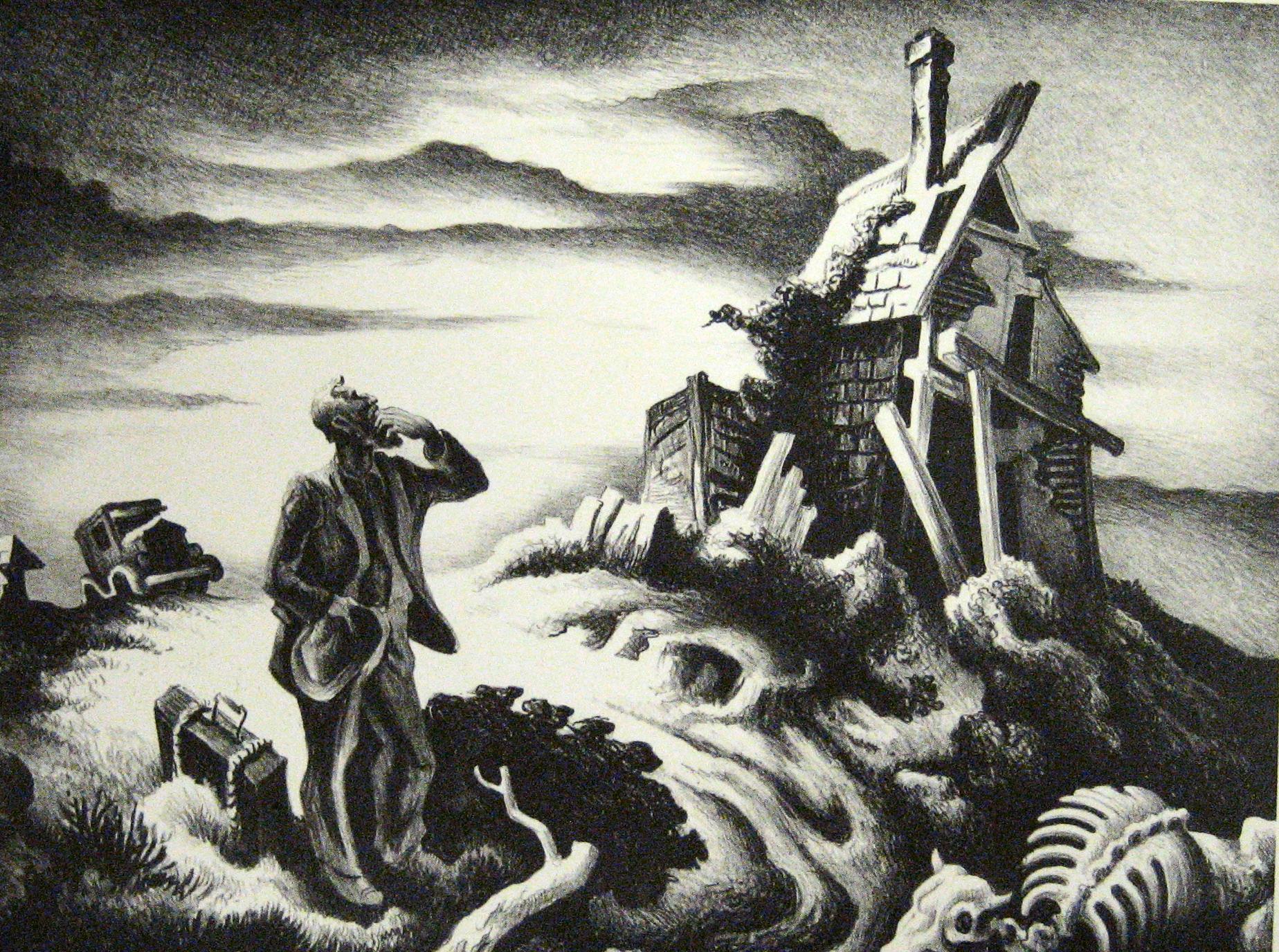
Thanks, Study Bible, I was almost getting interested.  I was almost beginning to see myself in this parable.  Where in the parable?  Man, all over it!  And not just in the place that I'm supposed to see myself.  Yes, it's easy to see myself as the younger son, who blows his inheritance on all sorts of nonsense.  It's easy to see myself as the one who has realized and recognized his sin, and who is coming back to beg for the Father's forgiveness. 
 
Thomas Benton's "The Prodigal Son"
But more often than not, even though I parrot the confession and absolution during the service, it is wildly contingent on nobody actually bad showing up.  And Christmas and Easter are the two big testing grounds for this.  They're the big testing grounds, because that's when the prodigals show up, and that fires you and I, John and Jane churchgoer, into insane levels of older brother syndrome. We look around and grumble at those who show up to ostensibly throw themselves at God's mercy.  How dare they just show up now, when we've been serving on boards and committees, when we've been doing the hard work of running the church ,and they just show up now?  For shame!  
 
Yes, we can be cruel and spiteful.  And the strange thing is, we end up being both brothers at the same time.  Or, more accurately, we begin as the younger, and end up as the elder.  It's real easy to come and confess your sins in God's holy church until someone faithless shows up and sits in the same pew as you.  Then, all bets are off.  It's when you come in from working in the fields, and hear the celebration that you start to get a little bit peeved.  You were all ready to take part in a standard church service, but when you see the people who just sort of casually show up, who have no involvement in running the church, who use it when it's convenient, then we get a little bit upset.  Then we talk to God, and say 'I know I'm a sinner, but look at these guys!  They're unbelievers to the max, who just show up twice a year!"
 
Feeding these dudes would be okay, though.
Here's the thing.  Strangely enough, we've got this whole parable flipped around, for the most part.  The word prodigal goes with son like good goes with Samaritan, and we're so used to the idea of the younger son, that it's almost a badge of honor to be that son.  It's the expected outcome that we might be the younger son, but our problem is that we always ALWAYS skip to the end of the parable.  We skip to the part where the repentant son comes back.  We never dwell on the devouring the property with prostitutes bit, we never think about the wild living that would get the son to realize his sin.  We skip this stuff because we Christians live beneath the thin veneer of respectability.  We live in a world, in a worldview at least, of mild perfection, in which we and people like us are actually not too terribly bad.  Yes, we're repentant sinners, but what are we repenting from?  Anything vaguely like the wild reckless living of the younger son?  Not likely. 
 
But the big sin that we inside the church need to deal with, and the one that we don't seem to see, is our priggishness. Oh, sure, we may claim that everyone is welcome in our churches, but how do we actually feel about that?  Do you, as an individual Christian, feel as though you should be spending time with someone who was just out feeding the pigs?  Or do you feel as though God should be giving you a young goat for you to feast with your friends?  
 
Be honest.  Be honest about how you feel when all the prodigals come back.  Is it anything like the father in the parable, or is it more like the elder son?  As with the rest of the parables of Christ, he who has ears, let him hear.  Stop looking for yourself only in the part where someone comes off looking good.  That is gospel, and it's supposed to give comfort to the repentant sinner, which might be you.  But it may very well not be.  The real work of this Christian life is to look deep into the eyes of the elder brother, the one covered with the veneer of respectability, the one who is wrapped in a cloak of good deeds but inside is filled with self-righteousness, to look deep into his eyes and realize that there is your mirror right there.  You, within the church, you who have gotten comfortable, you who have beaten back all the unacceptable sins, like devouring property with prostitutes, like reckless living, that's probably you.  All you have left is the cold-hearted acceptable sins.  The ones where you honestly and sincerely believe that you are right, always have been, and that these sins of reckless wild living are far worse than anything else you may be up to.
 
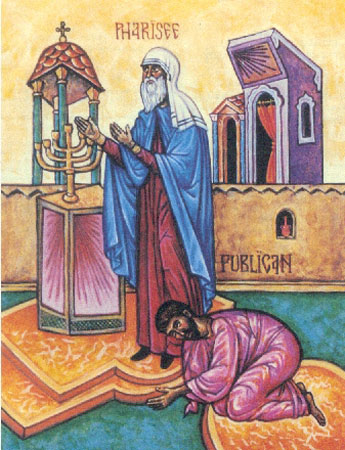
But the real difference between the sons is that one, who is up to his elbows in pig slop that he would want to eat but can't, realizes that he is a sinner, that he has messed up, that he needs help.  The elder son, who stayed behind, who helps, who is working hard, he sincerely believes that he is owed feasts and celebrations.  He has forgotten something key.  Whether you're leaving and coming back, or staying around for a long time, you're still living off of your father's wealth.  It's not as though the elder son was buying a young goat for himself out of his own wealth.  He was still reliant on his father.  You and I who are Christians, who are deep in the heart of the church, we need to look at ourselves, and how we see ourselves in the church, and in the kingdom of God.  Is it like the tax collector, or the pharisee?  Is it like the younger, repentant brother, or the elder self righteous brother?

 
Heck, 90% of the time, you're going to be a pastiche of both.  The great skill in Christian faith, though, is recognizing when you are being one or the other.  It's in realizing when the money is gone and you're feeding pigs, and it's in recognizing when you're sneering at those who are coming back to God's grace, who honestly look as though they've been up to their elbows in pig slop all day.  But whether fatted calf or young goat, you're all benefiting from God's goodness.  You're all reliant on God's grace.  Don't worry about the younger, repentant son traipsing back in after hard living, and don't worry about the sneering gaze of the older brother from the fields.  Just think about how the father treats the two children.  Robes and rings and fatted calves for one, and for the other, the truth of the sentence 'all that I have is yours.' 
 
Aw shoot.  Maybe the study Bible was right after all.
 
PJ

Monday, March 4, 2013

Simul Luther et Anti-Semite


I talked at length on Sunday on the subject of examples, and I'd like to do so a bit more here, because I think it's important.  You see, on the internet (that medium through which you are experiencing my words right now), there is a fun argumentative tool that goes as follows:

Reductio ad Hitlerium.

i.e. if an argument goes on long enough on the internet, it will eventually have Adolf Hitler dragged into it.  Someone will use him to make a point, usually by comparing their adversary in said argument to the aforementioned Nazi.  And this happens seriously all the time.  If you haven't noticed it, then you haven't been paying attention.

But a curious subset of this argumentative strategem is the attempt to fool other people into agreeing with Hitler.  This is something that comes up all the time, and is used by both sides in a great many debates, including but not limited to religious debates.  The argument usually goes as follows:

Subject A posts this quote:

Spock? Your national socialism is illogical.
"Secular schools can never be tolerated because such schools have no religious instruction, and a general moral instruction without a religious foundation is built on air; consequently, all character training and religion must be derived from faith."

Subject  B reads the quote, and thinks to himself 'gosh, that sounds reasonable.  I agree with and identify with that statement.

Subject A then drops the bombshell - that quote was by ADOLF HITLER!  YOU AGREE WITH HITLER!  CLOSET NAZI!

Subject B then realizes that his views on faith are identical with those of Adolf Hitler, loses his faith, then goes and joins the merchant marines.

Or that's how it's supposed to go.  And this argument goes both ways.  Often, that quote above is sneakily snuck into conversations to undermine your religious beliefs.  i.e. if Hitler was religious, heck, even potentially Christian, what does that say about YOU?  But in the other sense, people bring up parts of the Bible, or quotations from otherwise famous Christians, and use them as fodder against those of us in the pew.  They bring up the fact that St. John Chrysostom was an horrendous anti-semite, or that Paul was a misogynist.  Or, for those of us who are in the Lutheran faith, they bring up a curious pamphlet that Martin Luther wrote, called 'on the Jews and their lies.'

Oh boy oh boy. This one's fun.  Because, you see, as Lutherans, we believe in what Martin Luther set down in the Lutheran confessions, found in the Book of Concord.  The large and small catechisms, the Smalcald Articles, the Formula of Concord, and I'm sure I'm forgetting something here.  That's all well and good.  We hold fast to these things because they are a correct and true exposition of the word of God.  But this good stuff was written by a guy who penned an incredibly anti-semitic pamphlet.  How can we believe in and hold fast to the teachings of someone who was able to speak plainly about justification by grace through faith, but at the same time was writing horrendous anti-semitic screeds?

Welp, I would have you know, as Lutheran Christians reading this, that the original Lutheran, the reformer himself, was a bit anti-semitic.  But that doesn't mean that YOU have to be.

Crazily enough, and please brace yourselves for this, Luther himself may have been a sinner.  He may have been an anti-semite.  And that's not okay.  And I happily condemn his antisemitism in the strongest possible terms, because I find it to be unacceptable, and in violation of several of the commandments.  And yet I remain a Lutheran.

How?  How can I hitch my wagon to this guy whose views on several points I radically disagree with? Well, it's actually astonishingly simple.  It works because I do with Luther what most of us say we would do with sinful people in general.  I understand that he has been forgiven for his sins, however grievous they may have been.

Martin Luther doesn't get a free pass on everything he ever said just because he happened to say some stuff that was wildly controversial and bad.  But how do you as a Lutheran Christian (and believe me, I happen to be well aware that most of you are not Lutheran, and perhaps not Christian either.  But pretend that you are, or better yet, convert for the sake of this conversation), how do you deal with Luther's whopping great antisemitism?  Do you say:
a) Luther's antisemitism was just a product of his times, and people were all sorts of racist back then, so how was he to know any different?
b) Pretend that it was ghost written by Melancthon, Elvis, or Francis Bacon.
c) Blissfully go back to ignoring that it ever existed in the first place.
d) Agree with him on the topic (author's note: don't do this one)
or e) Apply his own words to himself, the way you apply his words to you so easily.

'Simul justus et peccator.'  A fancy Latin term for saint and sinner at the same time.  Which is what Luther was.  Which is what you are.  When confronted with the dreadful antisemitism of Luther, the cowardice of Peter, the wrath of James and John, the doubt of Thomas, the drunkenness of Noah, the incest of Lot, and the adultery of David, what do you do?  Do you explain it away as you would your own sin, as a product of the time, or not really that important, or not enough to outweigh all the good things they did, or do you do what you ought to do.  Do you look at these people as examples, good and bad.  As examples for us, as Paul says.

"Now these things happened to them as an example, but they were written down for our 
instruction, on whom the end of ages has come.  Therefore, let anyone
who thinks that he stands take heed lest he fall.  No temptation has overtaken you that is 
not common to man.  God is faithful, and he will not let you 
be tempted beyond your ability, but with the temptation, he will also
provide the way of escape, that you may be able to endure it."
1 Corinthians  10:11-13

Everyone in the scriptures is an example, both positive and negative.  Moses was an amazing spokesman for his people, led the Israelites out of slavery and into the promised land.  He was also a murderer who buried his victim, and a doubter of God's promises which led to him dying outside the promised land.  Was he a saint, or a sinner?  Or was he both?  Just like you?  You can learn from everything these people do and say.  The Bible presents to you real people, not characters in a book who are either good or bad.  The Bible presents to you real human beings, and the story of their interactions with God and with each other.  They have examples of righteousness, and examples of sin. Just like everyone else.  Just like you.

The only exception to that is Jesus Christ.  And thanks be to God himself, that Martin Luther is not Jesus.  His words are good and solid, but they aren't all perfect.  We can hold fast to the words of the catechism, and reject the words of 'on the Jews and their lies,' and it doesn't denigrate the one or elevate the other.  Because he's a saint and a sinner at the same time.  Like you.  And the same robe of righteousness, the perfection of Christ, applies to Luther the same way as it does to us.  If you're looking for someone perfect, don't look to Luther, don't look in the mirror, don't look anywhere but in the pages of the New Testament, to the person of Christ.  And thank him that his righteousness applies to you now as well.  That you can be a saint even in the midst of your sin, that no matter how ridiculous the things you say and do, that you are a saint even while you are a sinner.

Simul Justus et Peccator.  Saint and Sinner all at the same time.

PJ.