The musings of the Pastor from Good Shepherd Lutheran Church, Regina SK

Welcome. If you're a member at Good Shepherd, welcome to more thoughts and discussion of the week that was, and some bonus thoughts throughout the week. If you're not a member, welcome, and enjoy your stay. We are happy that you're here.

If you like what you see here, consider joining us for worship at Good Shepherd Lutheran Church. Sunday mornings, at 8:30 and 11:00. You can also follow us on Facebook.

Thursday, August 8, 2013

Where do you find a pair of sailors?

It's a passable joke.  Where do you find a pair of sailors?  A paradox.  Say it fast and it works.  But paradoxes can be fun!  Especially, for the purposes of this week's readings, Zeno's paradox.  If you're not familiar, I'd like to paint you a picture, because it's really important.  And to talk about Zeno's paradox, I'd like to talk about the way Kari's father taught it to her.  It's a little more straightforward than the method I used on Sunday morning.

Let's say you shoot an arrow at a target.  Given that your aim is reasonably good, you may be very well able to hit said target.  But how long is it going to take the arrow to get to the target.  Well, Let's say it takes one second to get half of the way there.  No problem so far.  And then it takes half a second to get half of the remaining way there.  And then a quarter of a second to get half of that remaining distance.  And then an eighth of a second to get half of the remaining distance after that.  And do you know what happens eventually?  The arrow never gets to the target.  Why not?  Because the space is infinitely divisible.  That may seem like a strange thing to be talking about, but that's what makes it a paradox, isn't it?  Yes, if you shoot an arrow it will get to the target, obviously, but if you subdivide the distances for an eternity, the space between you and the target is infinitely divisible.

It always reminds me of the wildly philosophical ending of 'the incredible shrinking man.'  Great movie about a guy who shrinks.  You wouldn't think that a movie about a guy who gets smaller would have a whole lot of stuff to say, especially given [spoiler alert] he doesn't get better.  He just keeps shrinking.  Please to humor me and watch the closing monologue of this film, don't worry, it's only two and a half minutes.

Okay, do you see what's going on here?  The guy is shrinking, yes, he is getting perpetually smaller.  But he himself is infinitely divisible.  There is no limit to how small he can get, but even as he shrinks down to smaller than you or I could possibly imagine, he is still him, and to God there is no zero.

Why am I bringing all this up? Mainly because the Gospel reading was one about coveting, and it included on the cover of the bulleting the most egregious of all possible images for the purposes of discussing the topic, which is an image very much like this one over here:

Sorry for the stock photo, but here we are.  And this is a great image, because for you and me, average joe Christians, we end up thinking about us as the 99% being kept down by the awful 1% of corporate fat cats, with their private planes, their convertibles, their sliced bread, and goodness knows whatever else.  That's the problem over there somewhere, and we, we with our three bedroom homes, our two cars, our two dogs, our three televisions, we're struggling vainly to get by, while the fat cats take it all.

That's the way the story is supposed to go.  And we desperately want Jesus to rail against the fat cats, and to call them out for their avarice, and to give them the business while you and I in the pew get to relax, and get comfy that Jesus is coming to put to right on the earth, which usually means in our heads that he is coming to redistribute the resources to make sure we get a bigger piece of the pie.

But hold on there, campers.  If Jesus really came to raise the valleys and to bring low the hills, the great levelling, where do you think you'd actually factor into it?  My guess?  Not as favourably as you might like.  I know it's typically the 99% vs the 1%, heck the entire occupy movement was predicated on that, but globally, who is the 1%?  Just the fat cats?  You wish.

Globally, anyone who earns over $35000 a year is in the 1%.  Is that you?  Very likely.  It might not be, but there's a good chance that it is.  What does that mean?  It means that the avarice and greed and coveting and love for possessions of the 1% isn't someone else's problem.  It's your problem.

As I said on Sunday, realistically, when you covet, what do you think about?  Is it the sports car with a private plane?  I doubt it.  I'd be much more likely to believe that you covet the same things that I do.  If you've got a 1000 square foot house, you probably want a 1200 square foot house.  Nothing crazy like a mansion in the hills, but just a little bigger, just a little nicer, just a little newer than the one you've got.  It's the same thing with  your cars.  Odds are none of you lie awake at night and seriously contemplate the purchase of a Ferrari.  But you might have a few sleepless nights contemplating the purchase of a 2012 civic to replace your 2006 Focus.  Sure, it was great then, but now it's starting to show its age, and who needs that.

But that gnawing hole of your coveting, it doesn't ever go away.  It's never satisfied.  It's a funny thing about coveting is that it's never full.  You can't sort of complete the set, then take in a big deep breath and say 'whew, I made it.  I have everything I want.'  At some time you've probably wondered why the richest men in the world, the Gates, the Buffets, the whoevers, why they don't just stop one day and say 'that's enough, I have enough money.'  Well, why don't you?

The fact is, like Zeno's paradox, there's never an end to your coveting.  You want and you want and you want.  No matter what you buy, no matter how great it is at first, the luster will wear off eventually.  Heck, most of what we buy is only good until you bring it home and unwrap it.  And then you sigh, and get on to what you want next.  Zeno's paradox.  Just when you think you've bought the one thing that'll make you happy, then you are disappointed when you get it home.

Why is this?  Because you, like everyone else, has eternity stamped on your hearts.  You want things to last forver, you crave it.  And more than that, you feel as though that is the way things should be.  You want that rest, that satisfaction, that comfort, we all do.  It's built into us.  Because behind everything else, we crave paradise again.

That's why the target moves so rapidly, that's why we can never keep up, because the weak frail breakable things we buy here are never going to satisfy, because they're not perfect, they're dust, one way or another.  They will break down, they will wear out, they will fall apart, eventually.  This is what Augustine means when he says that our hearts are restless until they find their rest in God.

So, let's say that you're a Christian and your heart is satisfied in God.  Are you 'done?'  Will you be satisfied?  Well, get ready, because I'm about to blow your minds, because you're never supposed to be done.  Not this side of heaven.  You are never finished.

Zeno's paradox applies to two more things.  First of all, to your sin and shame.  You come to church, confess your sins, get forgiven, partake in the body and blood of Christ for your salvation, and then what happens?  You gotta come back again.  Think of it like Zeno's paradox, in that no matter how completely you are forgiven, you are still a sinner.  That part, your sinful nature, your brokenness, that's what is indivisible.  Not that you're not totally forgiven in church, which you absolutely are.  But think of it like needing kidney dialysis.  If you go, you get your blood cleaned, so to speak, but that doesn't mean that your kidneys are fixed. You're healthy, but not repaired. There's still a flaw in you, that is going to require constant care.

But there's another paradox that's good for us to know.  Jesus, when someone had dumped a lot of expensive perfume on him, said that we would always have the poor with us.  And believe it or not, that's true.  No matter how many people you feed, no matter how many people you house or clothe or look after, you will always have the poor with you.  Jesus talks about how there are hundreds and thousands of opportunities to do service, not just to the poor, but also to Jesus himself, by looking after those who are disenfranchised, or less fortunate than ourselves.  Jesus is clear when he says that when we feed or clothe or visit or minister to any of those, we do it for him too.  And that work is never ending.

Don't use the never-ending-Zeno's-paradox nature of that task as an excuse to never start.  That's our initial thought, to say 'since there will always be the poor, and we're never going to make a dent in it, we'd better just do nothing.

Okay, but if that's how you approach interminable tasks, how is God supposed to approach you?  You continue to be a backslider, you continue to be a mess, you continue to make the same mistakes, commit the same sins, week after week.  If that's you, and you expect God to continue to forgive you and continue to work on your paradox, how can you look at an interminable task he's placed before you, and decline to do it?  Believe it or not, having the poor with us is a good thing.  It means we will always be able to serve God and serve others.  It means we will always be able to respond to our salvation with joy, and use our gifts wisely. You're never 'done.'  You're never all finished with your work that God has given you to do.  The rivers flow to the sea, as says Ecclesiastes, but the sea is not full.

PJ.

Monday, July 15, 2013

Van Gogh, Malchus, Mick Foley. Lend me your ears.

Back in the day, I took a girl to a movie.  And I didn't like one of those things. 

Turned out it was the girl.  But I liked the movie, so it wasn't a total wash.  The movie itself was office space, and that movie was sort of a rallying cry for the disenfranchised culture of office workers in the 90s.  Disposable, replaceable, forgettable, working a dead end job with no chance of progress, and working an hour at a time for the benefit of a company that would grow richer as the worker stayed static.  As I say, a bit of a rallying cry for those people, and it included in it a particularly great sendup of restaurants like applebees, tgi friday's, all those.  The reason it was such a great sendup was because of the scene in which Jennifer Anniston (who was really popular back in the day) got into a fight with her manager over how many pieces of flair she was wearing (flair being buttons, badges, etc).

If you've seen it, you get it.  But the idea was that the restaurant mandated a minimum of 15 pieces of flair to be worn while on shift.  Anniston only wore the 15.  Her manager then told her that she should have more flair, to which Anniston responded that if he wanted the staff to wear more flair, then he should have made more flair the minimum.  

He replied by asking her what she'd think of someone who always did the bare minimum.

That exchange always reminds me of the parable of the Good Samaritan.  It does so because of the exchange that the lawyer has with Jesus in the Gospel of Luke.

25 On one occasion an expert in the law stood up to test Jesus. “Teacher,” he asked, “what must I do to inherit eternal life?”
26 “What is written in the Law?” he replied. “How do you read it?”
27 He answered, “‘Love the Lord your God with all your heart and with all your soul and with all your strength and with all your mind’[a]; and, ‘Love your neighbor as yourself.’[b]
28 “You have answered correctly,” Jesus replied. “Do this and you will live.”
29 But he wanted to justify himself, so he asked Jesus, “And who is my neighbor?”


Luke 10:25-29

Oh yes.  Who is my neighbor?  In other words, I'd like to inherit eternal life, but what's the absolute bear minimum I can do in order to get it?  We all know that it's the right thing to do to love our neighbors, but that's real hard.  So if we can't get God's laws relaxed based on content, we should at least be able to get them relaxed based on scope.  That is, if God is going to be inflexible on the notion that it's the right thing to love our neighbor, then he should at least be flexible on who that actually includes, right?  

The vision that we have of God's rules is that he wants us to be nice to the people who are nice to us.  He wants us to be good to those who are good to us, and to reciprocate in kind when people are helpful.  But there's a slight problem with that: You don't need any instruction in doing that.

The story of the Good Samaritan, and the discussion of neighbor that goes along with it reminds me of the topic of free speech, which in its simplest terms boils down to the idea that popular speech doesn't need to be protected.  That is, if you have something that people love to say and love to hear, that doesn't need protection under free speech laws.  Free speech laws exist to protect the speech that you or I or perhaps anyone don't want to hear.  And that's the point.  Popular things, good things, safe things, they don't need to be protected, because they will protect themselves.  Jesus says as much when he asks people what they expect from morality:  

27 “But to you who are listening I say: Love your enemies, do good to those who hate you, 28 bless those who curse you, pray for those who mistreat you. 29 If someone slaps you on one cheek, turn to them the other also. If someone takes your coat, do not withhold your shirt from them. 30 Give to everyone who asks you, and if anyone takes what belongs to you, do not demand it back. 31 Do to others as you would have them do to you.
32 “If you love those who love you, what credit is that to you? Even sinners love those who love them. 33 And if you do good to those who are good to you, what credit is that to you? Even sinners do that. 34 And if you lend to those from whom you expect repayment, what credit is that to you? Even sinners lend to sinners, expecting to be repaid in full. 35 But love your enemies, do good to them, and lend to them without expecting to get anything back. Then your reward will be great, and you will be children of the Most High, because he is kind to the ungrateful and wicked. 36 Be merciful, just as your Father is merciful.


Luke 6:27-36

Do you see what's happening here?  Jesus is well aware of our natural human desire to love those who love us - to form groups around each other, to share with those who share with us, to cherish those who cherish us, to be generally involved with those who are good to us.  That's the idea.  And that's the way of natural human progress, so we would think.  There has been a good amount of research recently into both humans and the great apes, suggesting that altruism is not what we originally thought.  That is, the concept of altruism has largely boiled down to:

Kin altruism - doing nice things for your family / tribe / community
Reciprocal altruism - doing nice things for people from whom you expect to get something eventually.

That's about it.  But those things are themselves a far cry from the altruism expected of us in the words of Christ.  He is very specific - that if you love those who love you, if you bless those who bless you, if you just spend a whole pile of time making sure that you like people who like you and that you do nice things for each, other, then what is that ?  Seriously, who cares?  That's not anything especially important, or anything that you'd need the son of God to show up in the flesh for.  Can you imagine it if Jesus showed up one day out of the clouds and told his disciples 


You should totally be nice to people who are nice to you. 


That's altruism though.  Not reciprocation, not exchange, not a system in which everyone profits, but a situation in which you give and give and give until you're used up.  And who do you give to?  Anyone who may be in need.  Not just your friends and family and neighbors, but everyone.

Now, you may very well disagree with this, but know that if you do, it's your trouble, not that of Christ.  His rules and law are good and proper.  The problem is with you, and always has been.  And if you're trying to justify yourself like the lawyer did, trying to get Jesus to say that it's not actually about loving everyone, just a select few, if that's what your next action might be, then I hate to disappoint you, but it's not going to happen.  Jesus is not going to be that guy.  Instead, he tells us to be perfect, just as God is perfect.  What does that mean?

It means, quite frankly, that Jesus knows what it's like to do the right thing.

Think about it.  Jesus really REALLY put his money where his mouth is.  Do you remember Malchus from 
the New Testament? He was the servant of the high priest who came with the rest of the Temple security to arrest Jesus in the garden.  And when the moment came for the arrest of Christ, Peter pulled out a sword, and sliced off Malchus' ear.  And not only did Jesus call for an end to the violence, he put the man's ear back on.  Wow.  That's what it means to love your neighbor as yourself.  That was the last thing that Jesus did as a free man, and he spent his last seconds before being led away in chains putting a man's ear back on who had come to arrest him.  


That's the golden rule writ large, and the good samaritan in bold type, loving your enemies, and doing what is good and right for them.  Someone shows up to take Jesus away to a kangaroo court on trumped up charges so that he might be executed, and what does Jesus do?  Puts the man's ear back on.  


If Jesus could do that for that enemy that he had, you can understand who the Good Samaritan actually is in the parable.  It's not you.  It's not me.  It's Jesus himself.  Think about it - you and God are natural enemies.  You don't want the same things out of creation and so on.  You are worlds apart on a great many things, and don't think you're not.  Your sinful nature makes you a natural enemy of God, and its consequences leave you beaten and lying in a ditch.  You have nothing to offer except wounds to bind and thirst to slake.  And who shows up first to take care of you?  Who stops by to heal you and care for you?  Not the pastor, not the parishoner, not the people who should know better, not your friends not your family.  God himself.  Jesus Christ.  He's the one who picks up his enemies, you and me, who have been beaten down by the world, and carries them to safety, and promises to care for us no matter the cost.  


The golden rule is the gold standard.  It is the standard by which all other morality is measured.  And we are found wanting.  But as with any law in the Bible, it's not about what you do for God, it's about what he does for you.  He doesn't act like the priest or the levite in the parable, walking by the battered and bruised members of his people.  He doesn't pass on by, and he doesn't wait for you to get better.  He picks you up, and carries you to safety. 


And what did he die for?  All those times you refused to care.  all those times you walked right on by the beaten, the bruised, the bedraggled, the depressed, the poor, the weak, all that.  That's what he died for, that's your sin.  Each and every single time you walked right on by someone who was clearly suffering and in need of help, and you walked on by, that's what God's grace covers.  All the times you chose to ignore the golden rule, all those times you figured that knowing what the golden rule was equaled doing it, that's what Jesus Christ died for, and that's what his grace is all about.  It's about the golden rule, and why it's good.  Because it gets applied to you.

PJ.


P.S.  Sorry about the underlining.  I tried to include some words in comic sans, and it messed up the formatting for one time for all time.  So, uh, yeah.  Lesson learned.


Tuesday, July 2, 2013

Don't look back.


Do you know John Landy?  You probably don't. Do you know Roger Bannister? You might not either. But regardless of whether or not you know either of these two men, they have a lot to do with the readings from Sunday.  In a particular race, Landy was ahead, and Bannister was behind, and at a crucial moment, Landy looked behind him to see where Bannister was.  Apparently, you never do this.  You never do this because you change your focus, you spend time looking at what you've already passed.  And then it's too late.  You've been passed, you've been overtaken.  So taken up were you in what had already passed that your focus was elsewhere.  You see, the readings for Sunday are all about not looking back, and coming from Jesus Christ, they seem a bit harsh.  Jesus' words, in particular, are grating to our modern ears, who feel as though Jesus exists to make us happy, and to butter us up.  But then he drops stuff on us that we find to be frankly offensive.

 'As they were walking along the road, a man said to him 
"I will follow you wherever you go."
Jesus replied, "Foxes have holes and birds of the air have nests, 
but the Son of Man has no place to lay his head."
He said to another man "Follow me."
But the man replied, "Lord, first let me go bury my father."
Jesus said to him "Let he dead bury their own dead, but you go
and proclaim the Kingdom of God."
Still another said "I will follow you, Lord, but first let me 
go back and say goodbye to my family."
Jesus replied "No one who puts his hand to the plow
and looks back is fit for service in the Kingdom of God."

Luke 20:57-62


Wow, Jesus, thanks a lot.  Thanks for that bit of kindness and compassion.  There are people talking to him saying 'Jesus, I'm on my way to follow you, but first let me get my affairs in order,' and Jesus tells them to get lost.  He is essentially actively discouraging them from following him.  He is telling them to take a powder, to get lost. That they're not up to it.  

But they aren't unreasonable requests, are they?  Jesus, I'd like to follow you, but I need to bury my father, and say goodbye to my family.  And Jesus says, with no mistake possible 'absolutely not.'

It's borderline unbelievable, isn't it?  That Jesus would be so cruel and heartless.  People have reasonable requests, and Jesus flat out denies them. But it's stuff like this that brings to mind all the other difficult, dangerous stuff that Jesus says.  You remember when he says stuff like 'Do not think that I have come to bring peace.  I have not come to bring peace, but a sword.'  Stuff like 'Unless you hate your father and mother, your wife and children, and even your own life, you cannot be my disciple."  I'm paraphrasing from Luke 14, but not much.  And this is all stuff that gets conveniently forgotten, doesn't it?  It gets forgotten, lost in the shuffle, and disappears, beneath a cloud of grace alone, doing the right thing, and so on.  But there is Jesus, large as life, on a couple of occasions, telling people that they have to prize him above everything that exists.  They have to hate their family and themselves if they're planning on being disciples today.  

Do you hate your family?  No?  then forget being a disciple of Christ.  Oh, and while I'm at it, don't assume that if you haven't spoken to your brother Jerry for twelve years that you're doing some kind of holy work, because you're not.  

But why oh why would Jesus Christ ask you to hate everyone you know?  I thought Jesus was all about love, man! So why the command to hate?  Well, it's quite simple, and it's locked into the story from 1 Kings 19.

The story there is of Elijah calling Elisha to service, and Elisha asks to be allowed to kiss his father and his mother goodbye, which he does.  But he also has to leave his oxen that he was working with behind.  And he does, in spectacular fashion:

So Elisha left him and went back.  He took his yoke of 
oxen, and slaughtered them.  He burned the plowing equipment to cook
the meat, and gave it to the people and they ate.  Then he set out to follow
Elijah, and became his attendant.

1 Kings 19:21

Do you see what's happening?  Elisha is leaving it all behind, absolutely all of it.  He's killing his oxen, he's burning the plows, he's putting it all behind him, and he's leaving his family.  Why? To follow Elijah, and to take on his mantle.  And why is this theme of leaving and hating your life so important?  Because God is a clever God, and he understands who you are.  He understands something about the human condition, and understands something about who we are and how we operate.  Here's the juice: as you know, there are far more Christians in this country than Christians.  That is, a majority of people in this great nation of our identify themselves as Christians, and yet are never in church.  At all.  Well, perhaps once a year, at best.  And this is the issue: God is wise enough to understand how your brain works, and how your relationship with him works: As soon as something becomes more important to you than the Lord your God, then everything will.  As soon as something works its way into your life, everything else will as well.  It could be as simple as work, or family outings, or brunch, or whatever, but when that happens (and it does happen), then something peculiar happens.  You realize that nothing happened.  You didn't burst into flames, the ground didn't swallow you up, life just continued.  And you kept on being a Christian, right?  

Sure you did.  And as the years go on, you start to tell yourself that you don't need to go to church to be a Christian, and that you can keep on quite happily with how things are, and nothing will change.  You love your family, you love your house, you love your car, you love your home, all that. But then the unthinkable happens.  Your parents die.  Your child loses a leg, the house burns down or washes away,  things go badly for you.  And then what happens?  You end up cursing God, you end up forgetting about him completely, or getting mired in despair.  Because something very strange happens if you manage to forsake everything for the sake of God.

You get everything else thrown in, too.

God is the only permanent in this universe.  He's the only sure and certain thing that we've got.  All other ground is shifting sand.  This entire universe is grinding down, it's running out.  There will come a time at which the universe will cool, and all the heat will be gone. There will be essentially nothing left.  If it's just us, then nothing we have achieved will ever matter in the slightest.  And if this fills you with despair, as well it might, then there is only really one choice - to throw your hat in with Christ our Lord, who offers one big important thing - permanence.  He is forever.  And if we worship him in Spirit and in Truth, then that permanence is ours, too.  If we love something more than Jesus, we will lose both, no question.  We will lose Christ, and we will lose the object of our affection, because it isn't permanent at all.  That's the funny thing about the Christian faith: if we love something more than Christ, we lose everything. If we love Christ above all else, we keep it all.

That's why Jesus is so keen on you not looking back.  He knows you.  He knows what you're all about.  He knows that if you start by saying 'Jesus, I'll follow you, but first let me....' you're lost.  If there is one higher priority, then there will always be a higher priority.  As soon as something becomes more important than God, then any and everything else will be as well.  And there will never be an end to it.  But if you seek first the kingdom of God, and his righteousness, then all these things will be added unto you.  It's a matter of priority.  

Instead of looking back, instead of looking over your shoulder always, instead of saying 'yes, I'll follow you but first...,' instead of any of that, keep your eyes on Jesus, the author and perfecter of your faith.  He is the alpha and the omega, the first and the last, and has promised unto us life everlasting. If we prize his truth and his love above all things, then we will receive all things - our family forever, our friends forever, love and peace and justice and truth and righteousness forever. But if we love any of those things more than Christ, we lose it all, and lose it for all time.  Jesus is the permanence, if we love him for his own sake, then we will be given all things.  Salvation, truth, justice, family, companionship, joy and peace.  

This is most certainly true.

PJ.

Monday, June 17, 2013

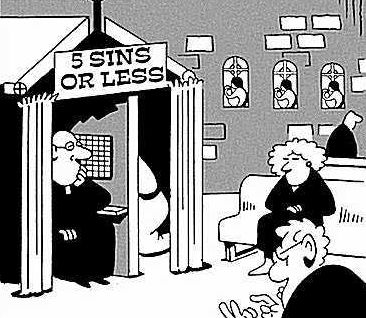
Making a concession about confession


Folks have all sorts of ideas about what their favourite part of a church service is.  Most people, when I ask them, usually say 'the end'.  Yeah, tee hee, the best part of a church service is when it's ending.  Bart Simpson said it best when he said that the best time of the whole week is right after church ends, because that's the maximum time between church and more church.


But beyond pithy, glib remarks about how much you hate boring old church, there are parts people like more than others; maybe it's the music, maybe it's the excellent sermon, maybe it's the fellowship, maybe it's the comforting liturgy that fits like a very familiar sweater, it could be anything.  But I think we can all agree that the most important part is the confession and absolution.
Can't we?

Probably not.  That's the funny thing about confession and absolution, in which it is extremely important, but very few of us actually think it's too terribly necessary.  In fact, if I was to run a service without music, and one without confession and absolution, which do you think would bother people more?  I'll give you a hint: music.

If we take seriously the entire point of the scriptures, they talk at great length about forgiveness of sins.  It's a central issue, before there were musical instruments, before there was a church, before there was anything that we would recognize as part of worship, there was sin and forgiveness.  When people transgressed that first rule, way back in the garden, there was sin.  And when God made his promises to them about a redeemer, there was grace.

Given that this is of such central importance, and given that the Christian church has nothing to offer EXCEPT forgiveness, really, why is it downgraded to such a low matter of importance in the life of the everyday Christian?  Primarily because nobody really genuinely believes that this applies to them.

I'll elaborate.  The law of God, as you know, is good and righteous.  It is perfect in every way.  But the trouble is in the way that you and I use said law: we use it very selectively.  We use that law of God to comb through the activities that other people do, we use it to check out what other folks are up to, and we are typically delighted when they collapse around us.  Most of us have a pretty basic knowledge of the Ten Commandments, and what is located therein.  We have a passing familiarity with the rules and laws that God has set up for us, and we are pleased with them because they point out the failings of others.  And this is what we're generally all about.  We are perfectly able to read through the scriptures, to check out the various laws of God, and to find in them where people have failed God.

And that's what we Christians absolutely love to do.  This is precisely why Christians have a reputation as being judgmental instead of humble, of being proud instead of meek, and of generally being pills about a lot of stuff - the trouble is we know the law of God really well, we know the ten commandments, we know the statutes that God has in mind for his people, but we generally just see how that looks in other people.

The readings from this last Sunday were pretty appropriate for this, most especially the one from 2 Samuel concerning Nathan and David.  You see, David had in mind to wed and to bed Bathsheba, whom he saw bathing on the rooftop.  But Bathsheba was already married to Uriah the Hittite, meaning that she was off limits.  But David was the king! He could do whatever he wanted!  He could be in charge of everything!  And most importantly, he had no earthly power telling him what he could and couldn't do.  So he went to the max, and had Uriah killed.  He had him put on the front lines of his army, with the full and complete desire to have him become arrow fodder.  Which he did.  And when Bathsheba was done with her period of mourning, David took her as his wife.

Wow, class act, David.  Well played.

But hold on just a second.  What I just did with David is exactly what the problem is - we read through the Bible and look for stuff other people are doing.  And this is no exception! There's David, being a murderer, and adulterer, a terrible reprobate, and living high on the hog because of it.  He is free to wallow in his own crapulence, and nobody is possibly ever going to catch up with him on it, because he's the King.  And it's good to be the king.

 And it was into this situation that the prophet Nathan entered, to show David his sin.  But you and I both know how well that would go.  How well does anyone react when you point out their failings? How well do you react when someone points out your failings?  When someone shows up to you and says 'you know, you probably shouldn't have been such a jerk,' your reaction is rarely to say 'oh, wow, you're right.'  Whether it's a total stranger, or your spouse, or anything in between, if someone points ou t to you that you're a mess, you probably react poorly. And that stands to reason.  Nobody wants to hear about how they're a disaster, or a scumbag.   You want to go to a church and be told that you're right, that you have the truth, that you're in good shape, and that the reason that the world isn't working the way it should is because other people are doing things wrong.


And knowing that, Nathan, God's prophet, did something very clever. He told David a hypothetical situation involving people who didn't really exist, but who were standing in for people who did.  He told the story of a rich man who stole a poor man's sheep, and had it killed so that the rich man, who already had an abundance, could have more.  And at this, David's anger burned hot, and he said that the rich man deserves to die, and he must pay back everything he owes to the poor man in spades.  And it is then that Nathan says 'You are the man!'  And no, not in the way that we throw around these days, but in the way that says 'this story is about you.'  And all of a sudden, David, King David, King David who had been in charge of so much, who had been responsible for such a great kingdom, who was untouchable in the extreme, that David had to be humble. He had humility pressed onto him by the story Nathan told, because Nathan had gotten to the heart of what David was all about - able to see sin in others, but not in himself.

You see, God is smart enough to know that this is how we saunter through life, and he's smart enough to know that we are unlikely to just sit there and listen if he berates us for our bad behavior.  And so when you hear the teachings of Jesus, they're typically in parables.  Why?  So that you'll listen.  The idea is that you listen to the teachings of Jesus, understand that they're good and righteous on their own,  and then see how they apply to you.  That's the real trick.  That's how God's word works, though, is that it points out to you your flaws, and offers you forgiveness.  And as usual, if you read through the scriptures and find only where everyone else has to improve, then you've missed the point, and you need to start over.  Why am  I so keen on pointing this out?  Because unless you get this rather mundane point, then the religion has actually nothing to offer you.  Christianity is about justification, and if you think you don't really need any, then the faith is empty for you.

The Gospel reading is great for this.  The reading is that of a woman and of a Pharisee, and the woman is a sinner.  And the idea that the Pharisee has is that Jesus should be pushing her away when she washes his feet with her tears and wiped them with her hair, because she's a bit of a scumbag.  And if Jesus was a prophet, then he'd know that she was a mess, that she was a sinner, and that she deserved nothing.

And so Jesus teaches him with a parable, talking about, what else, the forgiveness of sins.  He mentions that this woman is grateful because she has been forgiven much.  She has been forgiven of a great many sins, and those sins, which had been weighing heavily on her, have been lifted.  And what a great and wonderful feeling it must have been, because she was certainly aware of what she had done.  She was certainly aware of her own condition, she was certainly aware of her own failings, of her own problems and difficulties, and when Jesus promised to take care of that, she could not have been happier.  The only reason that the Pharisee was not there right along with her was because he really understood his own sin as not that big a deal.

He who is forgiven little loves little.  And that's where we Christians are.  Not that God won't forgive more sins, and not that he won't forgive all your sins, but he won't forgive what you retain.  If you come to God only with something minor, as Christians tend to do; if you come to God with the following list of sins:

coveting sometimes
saying 'damn'
skipping church one Sunday
not eating fish on Fridays.

If that's your list of sins that you have, then you will love little, because God has nothing to offer you.  All he has to offer you is holiness and righteousness through the forgiveness of sins, and if you bring him nothing for him to forgive, then why do you care about any of this?

But Luther was onto something when he told us to sin boldly.  Don't hide your sin from God, don't pretend you don't have any.  Don't be like the Pharisee at that dinner party and smugly assume that you're okay because you're not as bad as the next lady.  Sin boldly, so that the grace of God may be apparent in you.  Bring God your actual sins, not just a list of safe sins that it's okay to commit, because what's the point?  Bring him your lust, your desires, your greed, your pride, your gluttony, your sloth, your shortness with your friends and family, your dreadful bigotry.  Bring him all of that and be forgiven of that.  Can you imagine how much more you'd love God if he actually forgave your real sins?  Can you imagine how much closer your relationship with him would be if you let him do what he's here on earth to do, to forgive sins?

We are justified by faith in Christ.  Our sins are forgiven, we are redeemed, we are given grace beyond all measure.  The only thing is, what do you do with it?  Do you love little because you are forgiven little, or love much because you are forgiven much . Jesus promises to forgive pretty much everything, it's just a matter of what do you turn over to him?  This was the question that many of us had in Catholic school growing up, which was, when it was time for confession of sins, we all asked 'what if you don't have any sins to confess?' It seems funny now, but we all earnestly thought that was going to be a problem - that we'd get to the confessional, and have nothing to say.  But sin boldly.  Sin boldly, and know your sin - not the 'I haven't read my Bible enough' or 'I don't pray as often as I should,' but 'I love internet pornography' or 'I can't stand my inlaws.'  If you take stock of your sin, for real, you'll realize how big it is.  And when you realize that Jesus promises to take away all those sins, you probably won't be able to stop kissing his feet and wiping his feet with your hair.  But if you, as a typical Christian, only give to him small sins for him to forgive, acceptable sins, then you will love him little.

But remember this - He promises to forgive everything.  The only thing preventing your forgiveness is you.  Sin boldly. Give him your sins, and be absolved.

PJ.

Monday, June 10, 2013

Sunday Sunday

What if I told you that the Sabbath wasn't Sunday?

Would it blow your mind?  It blew my mind.  I always thought that the week was arranged with Monday at the beginning, and Sunday at the end.  And that made sense!  It made sense that the weekend was the end of the week (simple, right?) I always assumed, naturally, that the Sabbath that God took off was Sunday. Why wouldn't it be?  Why would it be any other day?

And then imagine my surprise when I found out that the Sabbath, in the Bible, was Saturday.  God made light on Sunday, and then continued to create all the way through that week and then He rested on Saturday.  So where do we get off going to church on a Sunday?

Well, this is a very interesting topic of conversation, and it's worth asking ourselves some serious questions about why we do what we do.  Because again, it's not set in stone that we should worship on a Sunday, and indeed, if we were to rest on a day set by scripture, it wouldn't be Sunday.

So what was Saturday for?  Well, if you take the story of creation seriously (and you should, because it's a matter of faith, don't you know), then you'll know that God created everything that there is, and nothing that there isn't, in a six day period.  On day one, he spoke light into existence.  On day two, God divided the waters from the waters, and created dry land.  On day three, the earth brought forth vegetation, and then on thye fourth day, the stars all showed up and stuff.  And then on the fifth day, living creatures from the sky and land showed up.  And then on the sixth day, living creatures on the earth (including people) showed up.  And that was a Friday.  And then came Saturday, when all the work of creation was done, was wrapped up, and was finished.  And then God looked at all the work he had done, and saw that it was good, and he rested.

The Sabbath, and the insistence on not working on the Sabbath, was bound to that concept: that God rested on the seventh day, and set aside his Sabbath as a time when people should rest.  Moses passed that along to the people of Israel in the ten commandments, the decalogue, saying to them:

Remember the Sabbath day and keep it holy.  For six 
days you shall labour and do all your work.  But the 
seventh day is a sabbath to the Lord your God.  You shall not
do any work - you, your son or daughter, your male or female slave,
your livestock, or the alien resident in your towns.  For in six days, the 
Lord made heaven and earth, the sea and all that is in them, but rested on the 
seventh day; therefore the Lord blessed the sabbath day, and consecrated it.

Exodus 20:8-11


Seems simple enough, doesn't it?  But as with everything else, you need to ask yourself why.  The Christian life should never be as simple as saying 'God says so, so I say okay.'  As I've said before on the blog, something isn't wrong because God forbids it:  God forbids it because it's wrong.  And that's a vital distinction.  A very very important distinction.  And all the commands of God in the Bible, you need to find out why God was commanding this sort of stuff, or the Bible will end up being a rather closed book.  Or if it's open, it'll be bad stuff.  

And when you start poking around in the Old Testament, you'll find a bunch of stuff.  You'll find a bunch of strange commandments from God, and you probably won't know what to do with it.  You'll get a bit cross, because a great deal of things that you find in the Old Testament seem to be a little bit strange or offensive.  The commands of God seem to be abrasive and difficult for us to keep.  Have you ever read Leviticus?  If not, you're not going to like it.  Nor are you going to like Deuteronomy, or the back 9 of Exodus,The reason that you're not going to like any of this stuff is because it all settles disquietingly on our ears.  And there are two reasons they settle disquietingly on our ears:

1 - what's the point?
2 - seems like a lot of work.

But all this stuff in the Old Testament, it was designed for a couple of things - first of all, to set Israel apart, and secondly, to bring about the messiah.  The Christ.

If you read through the Old Testament, you might get the idea that God is in the real estate business, or that he likes Israel for arbitrary reasons.  But he doesn't, and he isn't.  He's into Israel because Israel is going to be the source of the messiah, the savior of the entire world.  And stuff like Jonah, which is a story that stands perfectly well on its own, is also a story about Jesus.  The sign of Jonah, where he was in the belly of the great fish for three days, it's a story about how Jesus was in the belly of the earth for three days.  And the story of the Sabbath, where God rests, it's also a story about Jesus.  When he rested.

No, Jesus didn't take Saturdays off all the time, as he did a lot of healing on the Sabbath, and made people upset, but what he was doing was restoring God's joy and blessing to people on the Sabbath.  And the story of the Sabbath is intricately linked to the story of the death of Christ.  Because Jesus did quite prominently take one Saturday off.  Can you think of which one?

Give you a hint.  It's the day between Good Friday and Easter Sunday.

That was the day when God rested again.  He rested in the week of creation, and he rested before the resurrection.  Why was there that time between the death and the resurrection?  To fulfill the Sabbath.

Observant Jews today still observe the Sabbath, still observe the Sabbath on Saturday, and still do no work (or as little as possible).  They won't cook, won't take elevators, won't , well, won't do too much of anything.  Nothing resembling work, and they do that because they recall the rest that God himself took on that day.  And what do we as Christians celebrate on Sunday?  We celebrate the Lord's day.

Again, this is still completely linked to the story of Easter.  We Christians celebrate something pretty important on Sundays, something tied into the readings for this last Sunday.  The Old Testament reading was of Elijah and the widow's son from 1 Kings 17.  The Gospel readings was from Luke 7, about the widow's son at Nain.  And what are these passages about?  They're about resurrection.  The widow's son in 1 Kings was dead.  No breath left in him (or in Hebrew, no spirit left in him).  And in Nain, the widow's son was also dead.  These young men were both brown bread, and in the scriptures, with the Lord's activity, we see them restored to life.  We see God's power over life and death, we see him not just performing CPR, but putting the living spirit back into these young gentlemen.  And in this activity, what do we see?  We see death itself being worked backwards, and life, real life, being restored.  how is that done?  It's done in Elijah's case by praying to God, and asking God to restore the young man's life, which God does.  But in the case of Jesus Christ, Jesus himself speaks to the deceased young man of Nain, and calls him to life.  Jesus does the same thing with Lazarus, not asking permission from God, but essentially ordering him, speaking him, back to life.  Much in the same way that God spoke the universe into existence ten thousand years ago, Jesus, the word of God made flesh, speaks life into people.

And then comes the Sunday, the day we celebrate because that was the day that Jesus rose from the dead, when Jesus raised himself.  This is why we celebrate on Sunday, and why we worship on Sunday, and why anything on Sunday - because we're celebrating the Lord's resurrection.  We're celebrating the moment when God quite visibly declared in the world that death is not the end, and that there is hope for the future - there is always hope for the future.  No matter how bedraggled or worn out we are, even if we're actually dead, there's hope for the future.

Every Sunday then, is a mini-Easter.  You see that in lent, which is 40 days plus Sundays, because each Sunday is like Easter all over again.  On Sundays, we celebrate not that God rested, but we celebrate that he did work.  The big work.  The work that restored life and peace to us all.  The work that undid death, and granted us salvation

PJ.

Monday, June 3, 2013

Why does PJ wear those 'God Clothes?'


Am I seeking the approval of God, or of man?

That's the question that Paul asks in the reading from Galatians for this last Sunday, and it's a funny thing to ask, because of what we've done to Jesus over progressive years.  That is, we've made those two things into the same thing.

I'll elaborate.  Over successive generations, the presence of Jesus in the world, that awesome lion of Judah and consuming fire, he's been a bit of an interesting customer - fully human and fully divine.  The savior of the entire world, and of all of creation.  And that's a heavenly mantle for him to bear, and a heavy mantle for us to see on him.  And when he lowers the boom on us (as he frequently does), he says something like 'be perfect, therefore, just as your heavenly father is perfect.' And we get a little upset with it.

Perfection is not something we feel comfortable in grasping.  It's a frightening thing to even consider, so when the possibility of it coming up arrives in our consciousness, we rush to knock it down.  And when Jesus shows up with perfection of his own, we get a little leery of the whole thing.  And we know that he commanded us to be perfect just as God is perfect, so we have a couple of options.  We can either be perfect as God is perfect, or we can, mentally at least, make God a little less perfect in our heads all the time.

And that's what it's turned into.  It turned into that quite some time ago, in which God became a bit of a convenient vessel for us to see ourselves in.  As usual, we conform him to us, rather than us to him.  And believe it or not, that is classic Pharisee operation.

Now I'm well aware that calling someone a Pharisee in a religious debate is the equivalent of ye old reductio ad hitlerum, but in this case, it happens to be valid.  The trouble with the majority of Christianity today is that nobody wants to look at the Pharisee in the mirror.  But why do you think that Jesus spent so much time opposing the Pharisees?

Because if he was hungry, he'd talk about food.

The major opponents to Jesus, and the prime target for his anger was the Pharisees, the chief priests, the scribes, the elders of the people, or in other words, the people who had gotten so close to God that they had no need for God.  To use a sort of coarse metaphor, but bear with me, it's sort of analogous to being in a marriage.  Why do you think affairs happen?  Well, for a wide variety of reasons, but part of the deal is that we get really complacent in our relationships, and we get bored and tired of it all.  For gentlemen, it's the same centerfold every month.  And what happens?  Guys (and ladies too) end up getting very relaxed in their relationship, and no longer feel the need to work on it.  After a while, you get so close to your spouse that you no longer need your spouse.  You two are in a relationship, so you get reallly slack with trying to impress your spouse, and you stop being as active in the caring department as you should be.  And as time wears on, you start to think much more that your spouse should be meeting your needs, rather than you meeting theirs in any real meaningful way.

It's the same with God, for the Pharisees as well as for us.  Oh, sure, it all starts out with the best of intentions, but we realize quickly that if we please God, he's awfully quiet about it.  It's the same as pleasing your spouse.  Part of the problem that my wife and I have is that I expect praise for accomplishing mundane tasks, and my wife feels as though that's just part of the married expectations as far as running the house goes.  That is, I regard it as a herculean accomplishment to keep my socks off the floor, whereas my wife would view that as just part of what you do when you're married, and you have a home together.  It's the same way with God.  He has an expectation for you as a Christian, and when you do what you do, what response do you get?

Will any of you who has a servant plowing or keeping sheep say to 
him when he has come in from the field:
'Come at once and recline at table?' 
Will he not rather say :
'Prepare supper for me, and dress properly, and serve me while I 
eat and drink, and afterward you will eat and drink?'
Does he thank the servant for doing what he was commanded?  
So you, also, when you have done all that you were commanded say:
'we are unworthy servants, we have only done what was our duty.'

Luke 17:7-10

Oh, what?  Is this for real?  After a lifetime of Christian service, you're supposed to just acknowledge it as your duty, and carry on?  Wow.  You're not supposed to make a big deal about it, you're not supposed to make a production over how much of a great neat guy you are.  You're supposed to just do what you're commanded to do, without any thought of how it might get you ahead.

But that flies against everything we want.  We want to be recognized, we want to be seen, we want to be lauded and appreciated, we want to be admired.  We live for the pats on the head.  And part of the reason that Jesus was so harsh on the Pharisees, again, was that they really felt as though they had earned the snuggles, the cuddles, and the love of God, by where they were born, and what they had done.

Now, it's into this world that I as a pastor walk.  Do I seek the approval of God or man?  Well, have you seen me dress?  If you're at church only on Sunday mornings, there's a good chance that you have no idea that I own other shirts.  You may have only ever seen me in one particular type of shirt, the clerical collar.  And what in the world am I doing wearing such a thing? And where do I get them?

Well, to answer the last question first, I get the shirts from Burns Hanley here in Regina, a Catholic store.  Don't tell them I'm a protestant!  That's all except for the shirt that my wife made for me as a wedding gift.  I wear that one when I perform weddings.

Now, it may surprise you that I do own other shirts.  A lot of other shirts.  And ties.  A magnificent array of ties.  And ascots, and bowties, and all that.  And with men in the business casual world of today, the tie and the suit, although largely similar, do allow for some degree of personalization.  But the idea with the shirts I wear, and with the robes I wear on Sunday morning as well, is that I'm supposed to be indistinguishable from all the other pastors you've ever met.  You're not supposed to see me, you're supposed to see Christ.  When I speak the absolution to you, you're not supposed to feel as though you're listening to Jim Chimirri-Russell, you're supposed to be listening directly to Jesus your Lord.  When I preach the word of God, you're not supposed to hear me speaking law and pronouncing Gospel, you're supposed to hear it from God Himself.  I'm supposed to be getting out of the way of the Gospel as much as humanly possible.  And that's tough to do, especially for a guy like myself, who likes to get nice compliments and have people tell me that I changed their lives and somesuch.  I want to hear that I did a good job, and I crave hearing that I did well, and that I was useful.  And when I get into thinking that way, it's good for me to remember that Jesus essentially requires humility.
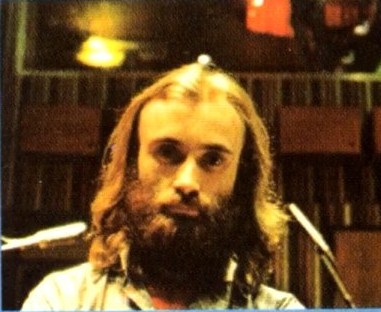
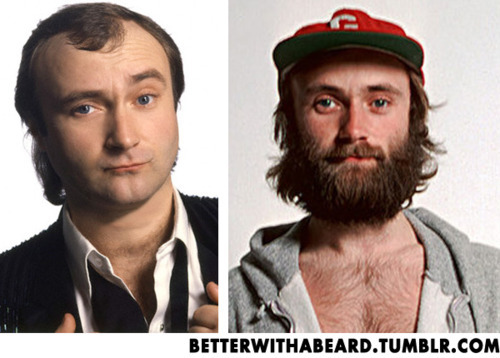
This isn't Jesus. It's Phil Collins
As I quoted earlier, don't think that I was quoting from the scriptures just for you, I'm quoting for me, too.  I'm quoting for me, saying that Jesus Christ requires us to be humble.  Requires me to be humble.  He requires me, after I've done what I thought I had to do for the day, to get dressed again, and serve at his table.  He requires me to be as concealed as possible in the line of what I do, so that people don't see me, and so that they see Christ behind me.  It's as John the Baptist said about Jesus Christ "He must increase, and I must decrease."

That's true for me, and it's true for you, too.  It's a real thing that you, as an individual Christian, need to be aware of how you have to decrease, and Christ needs to increase.  That sounds bad, again, but it's actually a good thing, for a couple of reasons.  Firstly, for the right and proper reason that Christ's righteousness is what gives you grace.  If you're the big noise in the situation, you're never going to earn God's love.  You're too much of a mess!  And if you don't believe that, then you haven't looked closely enough, and the Christian church has nothing to offer you.

A real Phil Collins would never have a beard.
The other reason is a little bit more practical - if you decrease and Christ increases, then the world won't see you when it sees the church, and its worth.  Here's a simple test: have you ever found yourselves having to explain your way, as a Christian around someone like the Westboro Baptist Church, or abortion clinic bombers, or what have you, and told the people whom you were speaking to 'yes, but they're not real Christians.  Real Christians would never do anything like that.  Well, that's the great thing about this topic - by that definition, you're not a real Christian either.  And nor am I.  Would real Christians go around with malice in their hearts?  Would real Christians be smug or wrathful? Would real Christians be smug and proud of themselves?  Would real Christians be ardent pornographers?  Would real Christians deny Jesus Christ three times before breakfast, would real Christians call down hellfire on towns that didn't like them very much, would real Christians call into question the validity of the resurrection?

Oh, right, they totally would.  They did.  The last three did in the New Testament.  But when we look at the New Testament, we don't see that Peter was a coward, or that the sons of thunder were out for blood, or that Thomas flat out thought that the resurrection didn't happen.  We forget that, because we see Christ, and anyone else fits in around him.  Thanks be to God, that that's what can, and should happen today too!

Are you here to please God or man?  If you're here to please man, then you are going to have to be the single most moral, upright person on earth, because you stand alone.  And by the measure you use, by that measure you will be measured.  But if you're here to please God, then he must increase, and you must decrease.  Then you won't get the pats on the head from human beings that you want, but that's a good thing! Instead, you'll get covered over with the robe of Christ's righteousness, in the same way that my robes hide my individual clothing choices, as well as my big ol fat gut.  I'm covered up, and then it's not about me, it's about Christ.  It's the same way with you, although it'll be less obvious in your daily life.  But you absolutely cannot and should not claim to be a better person because of your Christian life.

You're just a forgiven person.  Would a real Christian do all the stuff you do in secret?  Not a chance.  Would a real Christian be forgiven of all his sins?  He or she absolutely would.

PJ.

Monday, May 27, 2013

The Trinity, or the Dogma is the Drama

Ah, dogma.  We Lutherans get charged quite frequently with being overly dogmatic, which is like being overly dramatic but without all the table flipping.  But this is the trouble, is that Lutherans are so dogmatic that it gets in the way of Jesus Christ, or so people think.  The usual charge is that Jesus of Nazareth had some good ideas about social justice, nuclear weapons, greenpeace, and that the church has just gotten in the way of that with its dogma.  The idea was that Jesus preached a simple message of peace, love, goodwill and fun times, and then his disciples got in the way of it, and ruined it for everyone.  They added all the stuff about divinity, about holiness, about belief, and then St. Paul really got his teeth into things, and absolutely ran roughshod over the whole thing.

So what happened to the simple Jesus of peace and love, man, and how did the church manage to hide him behind so much dogma?  Well, sensibly enough, it's a good time to talk about this this week, because it's Trinity, and never has the dogma been laid on thicker than it is this week.  Because you know what creed we used on Sunday?  Sure you do.  The Athanasian Creed.  The Athanaisan creed is long, it's long-o.  It is about two pages in the hymnal, and we only use it twice a year.  But why do we use it at all?  Well, we use it because it's never been more necessary.  Probably in the twelfth century, most people who were in western civilization (the aptly named Christendom), would have been right up on their knowledge of just who this Jesus fella was, and they would have known full well that he was fully God and fully Man.  He was both, at the same time, all the time.  No problem so far there, I suppose.

But then something strange started to happen.  People began to do on a huge scale what they accused the apostles of doing - making Jesus into something that he clearly isn't.  You see, Jesus Christ is less of a polarizing figure, and more of a Gordon Freeman, if you catch my drift.  The reason that he has been so uncontroversial lately is for the same reason that Dr. Freeman remains so popular - he has no personality of his own.  That is to say, as Gordon Freeman stands for whatever you want to place on him, so too does Jesus Christ - he is whatever you want him to be.  He is the ultimate tabula rasa, the ultimate blank slate upon which you can project whatever your wants, needs, and desires.

That's how you can have George W. Bush praising Jesus Christ even while bombs are dropping on Iraq, and you can also have Jimmy Carter praising Christ while denouncing Bush's foreign policy.  It's how you can have Jesus simultaneously being on side with warhawks and doves, those in favor of disarmament and deterrence, capitalists and socialists, Christians and Muslims, Atheists and believers, and all points in between.  In fact, if you poll a room, 99% of people will be fundamentally convinced that Jesus Christ agrees with them on pretty much everything.  He loves who they love, and hates who they hate.


It helps that Freeman is the savior of the whole world, and you can essentially take over for him, without all the nagging existing personality getting in the way.  Unlike controlling Fenix, or even Master Chief, you really put yourself in the shoes of the silent Gordon Freeman.

There's one small problem with this, though, and that is that Jesus certainly is not a blank slate.  Gordon Freeman is, because he never speaks, and you can imagine yourself taking his place.  It also are Freeman, and he does exactly what you want him to do.  And everyone loves him.  But Jesus does talk.  A lot.  And when he does, as he did in the reading on Sunday, people find that he doesn't agree with them.  At all.


When Jesus talks about serious stuff, the people who are there break into tears because of their own sinfulness, or they hide their faces, they fall to their knees in worship, they disappear altogether, or they pick up rocks to stone him.  Nobody sort of rubs their chin and is vaguely thankful that Jesus agrees with them.  No, if you love Christ and you've never picked up rocks to throw at him, then you haven't listened to a word he said.  For example, and this is a movie moment that has stuck in my head for years.  Skip ahead to 1:11 of this trailer if you're easily bored, and watch an incredibly brief encounter between Mark Whalberg and some girl.  Go ahead.  I'll wait.

Yeah, she claims that Jesus is never mad as long as we live with him in our hearts. Marky Mark replies that he most definitely is.  And you know who you should believe?  Marky Mark.  He has a funky point.  And the point is this - If you live long enough, Jesus Christ will denounce you.  And that's what a lot of the Bible is for!  It's for you to not read through and find the points that you agree with, it's for you to read through and find where it is you are weak.  When you think you're doing a great job, if you read through the Scriptures, it'll point out that you aren't.

If you were paying attention to the news this week, you would have seen that Pope Francis spoke to the media, and somehow or another, he mentioned that atheists could be saved as long as they do good.  And all the atheists on Reddit exploded with delight - Finally, a Pope who tells us that we will all be saved!  We will all be saved because we all do good all the time!

Well, here's the juice.  If you heard Francis' words, and were elated, because it means that you can be saved by what you do, then I have some crushingly bad news for you.  Francis is right - as long as atheists did good, they could be saved.  But it comes down to the notion expressed in the scriptures, that there is none righteous, not even one, and that all have sinned, and fallen short of the glory of God.  Or, if that's a bit esoteric for you, then ask yourself this - why do you lock your cars and doors and bikes up constantly, because petty criminals are prowling?  Or is it because everyone is one temptation away from being a total scumbag.

The one thing missing is an open stocktaking of one's own life, looking seriously at what you've done, and what you've failed to do.  If you're that great, then how come the world is still a mess, how come nobody trusts anyone else, how come the world is heating up, children are dying in Asia from simple diseases to cure, and everyone hates everyone else.  Why does that happen?  Because other people are jerks?

No.

You have a Bible.  Pick it up.  Open it once in a while.  Put yourself in the shoes of the rich young ruler, who asked Jesus what he had to do to inherit eternal life, and Jesus gave him a laundry list of commandments, and the rich young ruler said he'd done all of those.  And what did Jesus say?  Not 'well done,' but 'then sell everything, give it to the poor, and follow me.'  If you think that Jesus would honestly approve of your life, then you haven't been paying attention.  And, to quote Marky Mark, I hate to break it to you, but Jesus is most definitely mad at you.  And if you dare to disagree with me on this one, or you figure that this doesn't apply to you, then my answer to you is to let the man talk.  Let Jesus say what he say.  Don't put words in his mouth, don't talk for him or over him, don't make him agree with you, let him speak.  If he does, he'd be critical of you.  And he'd be critical of me.  I'm a pastor in God's holy church, and I mess up worse than anyone.  Actually, I probably don't, but I only see my own failings, and I know that they're a bit of a problem.  If I let Jesus speak, instead of speaking for him, he has a lot to say about why I'm a mess, and about why I disappoint people.

That's the bad news.  But if I let the Dogma speak, it says something wonderful.  If I let the creed speak, instead of me speaking it like a robot, if I let the dogma be what it is, it says something amazing. It says that everyone is a failure.  That's why the world is as bad as it is.  It says that the problems in the world are not just of my making, but we all make them.  It says that my failings are part of a bigger pattern, and that we all have work to do.  But if we know that we have work to do, if we admit that we have dug ourselves into a big ol' hole.  And that's a problem.  And here, I am speaking to whom?  To all of you, but most especially to those of you who believe that the problems in the world are the fault of everyone else.  Whether Atheist or Christian, you both think the same way - that you are righteous, and that heaven is a given.  And as long as you believe this, sincerely believe this, you're damned. 

Damned.

Go ahead, pick up the rocks, but that's the issue.  Your choices are to either become numb to God and his goodness, or to look through the scriptures, and find out where it speaks to you.  Don't worry about the parts that speak to someone else, they're not for you, and you don't need to worry about them.  But if you get through the entire New Testament, and Jesus never skewers you once, go back, and read it again.  And yes, you can go through and say that Jesus' words don't apply to you, and then it doesn't matter at all.  But if you respect Jesus, love him and cherish him, if you think he was a neat guy, and he had something important to say, then listen to him.  Because he's going to skewer you with his words, if you'd listen.  And if you notice that, then take heart.  Because the dogma tells you something else.  You're a scumbag, I'm a scumbag, we all know that, of course.  And if you know that, it's wonderful, because the big promise of the Holy Scriptures is that you don't have to be perfect.  You just have to know how imperfect you are, turn to God, and apologize to him, and to each other.  It's the greatest gift of all that was given - it frees you from yourself.

And that's what we all want to be freed from.  You seek out friends, a mate, a spouse, God himself, a family, a community, because you don't want to only be with yourself for forever.  And that's where God comes in.  He removes all those things that separate you from each other, and from him.  You get laid bare by Christ, and he restores you.  He puts you back together where you have gone wrong.  Jesus is most definitely angry with you, but he doesn't stay that way.  As long as you let go of your nonsense, he'll take it away.  If you let Jesus speak, he'll speak to you in words of both Law and Gospel, and ignore either of those at your peril. Let him speak, and he'll point out your sin, and give you his grace.  Let him speak, and he'll be more than a silent protagonist - he'll be a savior.

PJ.