The musings of the Pastor from Good Shepherd Lutheran Church, Regina SK

Welcome. If you're a member at Good Shepherd, welcome to more thoughts and discussion of the week that was, and some bonus thoughts throughout the week. If you're not a member, welcome, and enjoy your stay. We are happy that you're here.

If you like what you see here, consider joining us for worship at Good Shepherd Lutheran Church. Sunday mornings, at 8:30 and 11:00. You can also follow us on Facebook.

Monday, June 24, 2019

Demons

I'm afraid that demons have gotten a bad rap lately.

If you've been paying attention to the world of streaming video lately, there has been a very mediocre attempt to shut down the new Amazon Prime series 'Good Omens.'  20 000 people have petitioned Netflix, the company that doesn't carry Good Omens, to shut the series down.  Which I'm sure Netflix would love to do if they could, which they can't because they don't own it.  It's a lot like telling Dominos Pizza to stop the manufacture of Wingstreet Wings.  If that's too cerebral for you, then it would be like telling Bread of Life Lutheran church to stop handing out books of Concord.


Now, even though Netflix can't cancel the series, why are people upset about the show? They're upset because the show, in their opinion, normalizes the Devil and Satanists.  It makes the Devil, demons and Satanists into something cuddly, who just have a 'difference of opinion' to God and his glory.  I haven't seen the show, as I've been too busy watching children's flag football, but I would imagine that the theology is total bunk, but there's no surprise there.  What I have noticed, even without watching the series, is that the world has now moved towards taking demons, the demonic, even the devil himself as largely a figure of fun rather than a matter of vital importance.  We do that thing where we figure that because we don't see any evidence of demonic activity now, that there never was any.  We get to thinking that any idea or notion of demonic activity through the ages was just a manifestation of some kind of mental illness, be it schizophrenia, psychosis, or something else, and that what Jesus was doing was essentially giving the possessed some lithium.  Assuming that everyone displaying any sign of demonic possession was just mentally ill, though is short-selling the accounts from the Bible that talk about demonic possession, especially the account that we had from the Gospel from Sunday.

The key thing that draws a distinction between mental illness and demonic possession comes in the interplay between Jesus and the man who is possessed.  If someone is mentally ill, they may very well make assertions of matters that do not exist.  They may speak of things that most certainly are not happening, and that never were.  When you talk to people who are suffering from mental illness, who have all manners of hallucinations or delusions of any nature, you expect them to talk of things that don't exist, but you as the person engaging with them don't act as though these things were true.

As a practical, real world example, when I go and visit people suffering from some manner of dementia, they will frequently talk about a situation different from the one they are actually existing in.  People will talk about the one room schoolhouse that they attended as though they were still in it, instead of the institution that they are currently living in.  Even if you were to humor said people, to talk to them as though their perceptions were true, you wouldn't behave in yourself as though they were true.

Instead of being dismissive, or talking about mental illness, Jesus deals with demonic possession as though it was actually happening as described.  That is, Jesus speaks directly to the demons.  He commands them, and they do what he commands. Jesus doesn't say to the person afflicted in any of these passages that they have a mental illness, he acts always as though it was a spiritual problem that needs to be addressed spiritually.  As I'm fond of saying, if Jesus were to think something was important, he would address it.  He had the space in the book to do it (The Lutheran Study Bible is sitting at around 2500 pages).  If this was a mental health issue, and Jesus is God, he could have said something about it.  But he didn't.  In fact, he says of another evil spirit that it can only come out by prayer, suggesting very powerfully that this is a spiritual issue more than it is anything else.

Our big weakness right now is to think that spiritual problems, spiritual sicknesses just straight up don't exist.  Every problem that we have, every malaise, every ennui can be corrected by means physical not means spiritual.  We have the idea that we don't have to cure spiritual sicknesses because they just straight up don't exist.  And if they don't exist, they can't be cured.

The comparison that I made on Sunday morning was that years ago, people didn't know how the cold virus spread, and they assumed that you got a cold by being cold.  That, of course, is wrong now, and we all know today that the common cold is caused by a virus, and the best way to avoid it isn't to stay warm, but to wash your hands, and to wash them often. That will go a long way towards avoiding the spread of the virus towards your face, and keeping it out of your cells.  The cold virus likely spread a lot more virulently when people didn't know about germ theory, and were trying to avoid getting it by doing things that wouldn't stop its spread.


  This seems obvious now, but think about it in terms of spiritual sickness as well.  If you were just trying to stay warm, to avoid getting a cold, that would make the cold virus very happy indeed, because you were trying to fight a problem through means that wouldn't work. Now think about the demonic forces that are trying to split you from God, to drive you away from him, to convince you that what is right is wrong, and what is wrong is right.  Now think about how you're trying to treat that.  Are you turning to God for aid? Are you working with prayer? Or are you assuming that spiritual sickness just doesn't happen, and doesn't need to be treated.

Not washing your hands doesn't help you.  It helps the cold virus.  Staying absent from worship, from prayer, from scripture, that doesn't help you.  It helps the demonic forces that you would like to think don't exist.  But Jesus thinks that they exist, and he behaves in every way as though they were real.  And if he does, who are we to question that approach? Almost always the best step forward is to look towards Christ.  If he takes something seriously, then we should too. If he can isolate a problem, then we should look towards his solutions as well. And we should be always mindful of what he recommends - understanding that our spiritual sicknesses can only be treated with prayer.


Wednesday, June 19, 2019

Trinity

Okay, here's where we talk about the trinity.  And the trinity is something that people say is hard to explain, because it is.

Blog over.

Nah, I can explain the Trinity.  And I can explain it in a way that you can understand.  Watch me work.


There's a great bit right at the beginning of Star Trek 4, the voyage home, in which McCoy and Spock are talking about Spock's death.  McCoy asks Spock what it was like to be dead, Spock replies 'I'd like to discuss it with you, doctor, but I'm afraid you lack the necessary frame of reference.'  McCoy retorts 'So you mean I'd have to die to discuss your position on death?'  Sure enough.  But all sorts of things are relative.  They're relative in a way that doesn't make sense outside of their relation to you.  All sorts of things work like that.  I can't discuss colours without talking about colours that you see.  I can't talk about smells except in relation to things you've smelled before.  Things that are part of your senses can't really be experienced unless in relation to other things you've experienced. Make sense so far?  Good.  Now, let's talk about the Trinity.

God the Father, the creator of the universe, is the first thing that we perceive about God.  That is, the creative work of God the father can be seen and perceived by almost everyone.  This is something that should be relatively clear, even among the most hard hearted atheists.  For everyone who stands at the edge of a cliff and gazes out at the great salt sea will have an experience of the divine.  Everyone who looks up at the sky, at the milky way or at the sunset, will be awestruck by the majesty of it.  This is something that can give you an idea that all these things are made by the Lord our God who created heaven and earth.  Now, this is something called the natural revelation of God.  That is, you can see that things are made by God, but that's all that you can or will ever know about him.  You can know that God made things, but you can't know anything about him beyond that from just seeing the natural world. And this will lead you, almost inevitably to the conclusion that the crowd Paul was speaking to in Acts 17 as well as an awful lot of people that I get stuck talking to at parties. They all came to the conclusion that we could be 'spiritual but not religious.'  That is, they have an idea of a God out there somewhere, out that in the greatness of the void, but figure that they can't know anything about him.  And surely, if all you can do is to look at the vastness of the cosmos, you'll only get to an idea that there is a God, but you can never know him.  You will know that there is a God, but not anything about him in the slightest.

So, thus Jesus.  I understand that you may have an idea of Jesus as a person, or as the son of God, as a man who lived a couple of thousand years ago, and that's all true.  But there is more to the story than that.  Because the story of Jesus is the story of how we understand God.  You can know that there is a God out there by gazing at the vastness of his creation, but like with everything else, if you want to learn about someone, you'll have to do something every specific. When Jesus speaks, people frequently get upset, sometimes angry enough to kill.  And when he does this, it is because something very familiar to you is playing out. Have you ever witnessed an argument proceed like this:

"When you go to the store could you get some milk?"
"Yes, fine, I'll get the milk."
"Could you make sure that you get the 2%..."
"Yes, yes, I get it, 2% Milk, 4 litres, I got it.  Gosh, get off my case!"

And sure enough, when person B comes home, they do so without the 2% milk.  But they'll insist the whole time that they have the right thing.  Now, if they'd just listen, they would get things figure out, but we don't like listening, even to relatively straightforward conversations.  Think about things like this.  How often is more communication expected in collapsing relationships?  How many times have you heard someone complain about a friend, a lover, a co-worker or a boss, and then have the response come forward 'why don't you just talk to them?'

I can't talk to them!  If I do, then I'll know what they want, and they'll know what I want, and then things might work out properly between us!  Sure!  That's the idea!  And in the case of God, Jesus is the means through which we know the unknowable God.  Jesus Christ, the word made flesh, is the way we can understand the incomprehensible.  Because God exists outside of our immediacy, outside of time, outside of frailty, we can't wrap our heads around his enormity or his grandeur.  But we can absolutely understand Jesus in the real world.  We can understand God because we can understand Jesus.  I know we're used to understanding Jesus crucified, and that's going to come up later, I promise, but here's the deal:  the only way you are ever going to get past the unknown God is to understand Jesus as God.  The word of God made flesh.  The one whose job it is to make God understandable to us.  The massive God who formed and fashioned the milky way, that God is a bit too distant for us to come close to, to understand or arrive at.  But Jesus, we understand him.  His words are simple, succinct, and straightforward.  Sometimes too straightforward for people.  They may not like it at all when Jesus is as plain as he is.  They resist his words, as they do in the Gospel reading for today.  They hear his words, and pick up rocks to throw at him, to stone him to death, because he told them the truth about God, and about themselves.

Eventually they kill Jesus, they put him to death for this reason.  He tells the truth.  He is quick to let people know that they have the potential to be liars, to say that they understand God when they don't.  But Jesus is extremely truthful.  The word of God is always truthful, it is always accurate.  It cannot and will not deceive.  Even if the truth of it is too acute, and too severe for us.  Even if the word of God cuts us too deep, and we want to be rid of it.  And so they take Christ and have him crucified.  But the Christian faith, which rests on Christ and him crucified, is not the same as just knowing about what happened.  The crucifixion is a fact of history, and it is something that we can know about in the same way that we know about the murder of Julius Caesar on the ideas of March.  We can know about Jesus and his death in much that same way, but God works on us another way.


God the Father is what we perceive in the universe.  God the Son is how we know that God, but God the spirit is the way in which we experience God.  This is the presence of God in the world, working to sanctify the church.  It's what changes our understanding of the crucifixion of Christ from a thing that happens, to a thing that happens for you.  This is different than just historical knowledge, for even the demons know there is only one God, and they tremble.  This isn't historical fact, it's the working of God in your life.  Creator, redeemer and sanctifier, Father son and Holy Spirit.  God, his word and his spirit.  And the thing is, we can only really explain it in relation to you.  You are living in a world, in a creation that God made.  God came into this world to save you.  And thanks to God the spirit, you know and experience that it was all done for you, on your behalf.

The trinity isn't just a part of your faith, it is your faith.  This is what the catholic faith is, as the Athanasian creed tells us.  Your faith is the father, the son and the holy spirit.  The dogma is the drama.

Tuesday, June 11, 2019

Blow the doors off

Sometimes, it may be hard to see the practical application of a given day.  Think about the feast day that we just had, that of ascension.  I had to do a bit of work explaining the ascension and how it fits into your life, and so on.  Pentecost doesn't work like that though, it works a little bit differently.  The way Pentecost works is that the reading from Acts that tells the Pentecost account has the reason for its existence built right into it.

Pentecost is one of those days that almost nobody wants to read for.  Nobody wants to get right up in front of everyone and read out the names of the places in that reading.  Ordinarily, reading in public isn't on a lot of people's list of things they most want to do, as public speaking, public reading, it's a lot even on a good day.  But Pentecost isn't a good day for that.  It's one of the worst.

Pentecost isn't a bad day, of course, but the readings are rough.  I'll show you what I mean:  The reading from Acts about Pentecost has the list of peoples and nations that are hearing the words that disciples speak:  "How is it that we hear, each of us in his own language?  Parthians and Medes and Elamites and residents of Mesopotamia, Judea and Cappadocia, Pontus and Asia, Phrygia and Pamphylia, Egypt and the parts of Libya belonging to Cyrene, and visitors from Rome, both Jews and proselytes, Cretans and Arabians - We all hear them telling in our own tongues the mighty works of God."  This passage alone is the one that strikes fear into the heart of the most well meaning lector.  And when you look at this passage, you may very well say 'gosh, wouldn't it be nice if these were all familiar names?'  Sure it would.  It would be convenient if all those names were to be replaced with 'Paris and Miami, and Estevan and residents of Manhattan, Jersey and Calgary, Peoria and Alabama, Pawtucket and Providence, Esterhazy and the parts of Las Vegas belonging to Colorado, and visitors from Rome both Jews and proselytes, Canadians and Alaskans - we all hear them telling in our own tongues the mighty works of God!'  It would be much easier to read, as well as much easier to understand.  After all, which of you, without opening another tab to look, can tell me where Cappadocia is? Who can tell me much about the Elamites, Phrygia?  I'd suspect almost none of you.  And if you've ever been up in front of a crowd and had to read words that are essentially foreign to you, then you'll understand, and understand a lot, why it is that Pentecost is a big deal.


Pentecost contains within its own readings evidence for why it is necessary.  It's necessary because we don't speak all the languages of the world.  We don't know all the ins and outs of all the cultures.  We are divided, and have been since the tower of Babel, and therefore, by design, have been prevented from hearing or understanding each other.  This has been a problem ever since God said to human beings 'if you're only going to work in your own interests, then I'm going to make sure that you can't get the job done.'


Now, when we get to Pentecost, that problem gets largely resolved. Or more accurately, the differences stop being a problem.  Part of the great thing about Pentecost, is that it reminds you of why it is necessary itself.  That is, when you read through the readings for Pentecost, you get reminded of how strange and foreign the first century disciples would be to you, and hopefully you think about how strange and foreign you would be to them. You think of yourself as not having an accent because the people who live all around you speak in the same way, and essentially conduct themselves in a similar manner.  But it's only normal to you because you're used to it, not because it's essentially normal to everyone.  Pentecost shocks us out of the idea that middle class English is the inherent language of the Lord.  The language that he would have been speaking would have been so foreign to us that we couldn't possibly understand it.  And were it not for Pentecost, there would be a good chance that we would forever be facing a certain direction for prayer, dressing a certain way, eating certain foods, and speaking a foreign language.  Forever.

What Pentecost did was to blow the doors off of the idea that the faith could ever be a regionally contained thing.  The work of the Holy Spirit was to open the church up to all people, to have the words of God known in the language of all the people of earth. The work of the Holy Spirit on Pentecost was to fundamentally change the church away from what it was to what it was always destined to be.  The disciples had been staying in Jerusalem according to Christ's command, waiting for the arrival of the Holy Spirit, and then after that, the doors of the church would be blown wide open to the outside.  The insular nature of the Hebrews that had been there to set them apart from their neighbors was to be changed at its very base, into a faith that would reach out into the world to find, seek and save the lost.  Jesus made a promise that faith in him would be to go out to the ends of the earth.  He told his disciples in the last chapter of Matthew that they should baptize all nations in the name of the Father and of the Son, and of the Holy Spirit.  If ascension is the fuse being lit on the church, then Pentecost is the explosion, no longer a small insular Jewish sect, the Christian faith was now for everyone.


God "selected one particular people and spent several centuries hammering into their heads the sort of God He was -that there was only one of Him and that He cared about right conduct. Those people were the Jews, and the Old Testament gives an account of the hammering process." (C.S. Lewis, Mere Christianity, Book 2, Chapter 3)


This does bring some pain to the disciples.  It's hard to hear about how you were holy, set apart for thousands of years to all of a sudden be told that the love of God is for everyone, but that's something that Jesus had made clear from the beginning.  But it's still something that people find hard to deal with.  The idea that the Holy Spirit of God is bestowed in and through baptism, that it provides for our needs, sanctifies us, and makes us holy.  But this is the natural extension of the story of the Bible. It is the natural conclusion, the realization of the promises that run right the way through scripture.  Everything in the Old Testament points towards the incarnation, the entire nation of Israel was set apart for the arrival of the word made flesh, the coming of the messiah.  You had a tiny island of monotheism in the middle of an ocean of polytheism, in order that a space may be prepared for the arrival of the Lord.  And once the Lord had arrived to the place that had been prepared for him, had suffered and died for the sins of the world, then the time came for the bestowal of the Holy Spirit on the believers.  And this is the natural continuation of everything that the scriptures are all about.  The coming of the Lord to his people whom he loves.  He created, he came, and now he lives and dwells with us.  Not as a means to keep us set apart from the world, but as the means through which we are driven into the world with a message of salvation on our lips.  A message of salvation, of good news of great joy that will be for all people.  But if you're a bridge builder, you have to go where the rivers are.  If you want to reach the world, you have to be in the world.  That's hard to do if you're isolated in Israel, set apart from the world.  It is much easier if God, the Holy Spirit, goes with you. Which he does, thanks to Pentecost.

Tuesday, June 4, 2019

Windshields

On Sunday morning, everyone who attended the 11:00 service had a bit of a surprise on their windshields.  That is, someone had gone through the parking lot and placed a message on every windshield, with the intent that we would all read it, and know what it is that this (unidentified) person wants us to think.

Firstly, I want to assure everyone that this communication was not from Good Shepherd Lutheran church.  In case you may have though that this was from us, know that the odds of me leaving notes on everyone's windshields on a Sunday morning are zero.  Secondly, to the person who left such messages, on the off-chance that you are reading this post, I would encourage you to, instead of leaving things on windshields, to come and talk to either myself, or to attend the Bible study group on Sunday morning to get an idea about what it is that we believe, teach and confess, before you start papering vehicles in our parking lot.

Now that that's out of the way, let me address the content of the leaflets for anyone who may be confused or perplexed about what they found there.  The essential core of these leaflets would appear to be that the entire Bible should be read through from Genesis to Revelation.  I would assume that most of you reading this today would agree so far.  Where you probably wouldn't agree is with certain things in this letter that are factually incorrect, as well as what we would call theologically incorrect.  I will begin with the things that are factually incorrect, or otherwise flawed, then will move on to the theological inconsistencies.  I will do my best to give links for everything that I am talking about, that you may not take my word on things.

Firstly, we need to talk about the nature of Hebrew and Aramaic.  The letter is correct in stating that knowledge of Biblical languages is important in order to come as close as possible to the intended meaning of any passage (any translation also being an interpretation).  But it is curiously ironic to talk about mistranslations and to also say that the English word 'Jesus' was "translated from the Greek word 'Lesous,' which was translated from the Hebrew word 'Yeshua'."  When we're talking about translation and precision, it should be noted that there is no such word as 'Lesous.'  Sure enough, there is no letter 'J' in the Greek language, you'd be looking at a letter closer to an 'I', but definitely not an 'L'.  Is this a typo or a lack of knowledge of what is being spoken about? Uncertain, but matters like this do put the emphasis on accurate translation on shaky ground.
The next topic is that of the Khabouris codex.  This manuscript is claimed by the letter we all received to be 'approximately 50-60 years older than the earliest Greek manuscripts.'  I went to the site https://therefinersfire.org/khabouris_codex.htm and you can too.  Let me know what happens when you click it.  I got nothing.  So, I was unable to do research on this khabouris codex from the website that the letter recommended, which led to me doing research on it the way anyone else would do - through googling, etc.  It was there that I found the research on the Khabouris codex, linked as there.  Is the Khabouris codex 50-60 years older than the earliest Greek manuscripts?  No, it is not.  The Rylands papyrus P52 is typically dated between 125-175 AD.  The earliest copy of the Khabouris codex comes out between 300-310 AD.  Now, again, this isn't hugely important, as Aramaic Bibles are just as necessary as Greek Bibles for reaching all the people of the world, but where it is important is in the implication that the Aramaic Khabouris codex is in some way more authentic in its message than the Greek New Testament.  We will get to that when we talk about the theological implications.

The remainder of the letter seems to be largely about why it is vital to keep and obey the appointed feasts and festivals, as well as to keep and remain kosher as far as the Old Testament commands would dictate.  Now, I'm not going to get into the theological implications of this yet, only the practical ones.  If you were planning on keeping kosher, you still could, and many Jews today do.  But there are festivals that are literally impossible to keep in the manner that you would have been commanded to do in the Old Testament.  The one that jumps out to me is the festival of booths (which Christ celebrated in the New Testament).  Given that the letter we all received instructs us to keep these festivals in perpetuity, forever, it will be very difficult to do if the 'Hakhel' is impossible to do in the absence of the temple.  Now, if the observation of the Hakhel had to be modified due to the temple not existing anymore, then perhaps the lack of existence of the temple tells you that the adherence of the people of Israel to these festivals is open to modification.

To say that these commandments to observe these festivals in the way that they were prescribed in the Old Testament is something that must be done for all time falls apart with the understanding that some no longer can be done in the prescribed fashion.  We already talked about sukkot, but we also need to talk about Yom Kippur, which, in the Old Testament, requires sacrifices to be made in the Temple. Rosh Hashanah also calls for a fire offering to be offered to the Lord.  I hope you're starting to understand that even people who are calling for full Christian adherence to these feasts would have to modify them in absence of the temple.  So, if you were going to modify these feasts, how would you do it?

There are two ways.  And this is where things get theological.  Things get theological because they essentially have to.  Something happens with the arrival of Jesus Christ, and his desire to fulfill all righteousness, to fulfill the law.  Any attempt to try to keep the festivals in the exact way that they are prescribed in the Old Testament will be frustrated since 70 AD due to the fact that the temple is gone, and has not yet come back.  In its absence, you would have to modify your observances of the festivals to fit a new reality.  And ultimately, that is what happens in the appearance of Jesus Christ and the work that he does.  Jesus came to fulfil the law, which is definitely true.  He didn't come to abolish the law, that much is true, but the law as relates to the separation of Israel from the rest of the world.  It is worth understanding that the festivals, purity laws, things of that nature were there to separate Israel from the nations around them, that Israel may be the place for the messiah to arrive.  The sacrifices were there for the forgiveness of sins until such a time as the messiah should arrive to complete the work of salvation for the entire world.  Once that was accomplished, and Jesus said 'it is finished,' the temple was no longer needed.  The temple was no longer needed because the sacrificial work was done.  And if the sacrificial work was done, then returning to any kind of sacrificial worship would actually be harmful instead of helpful. This is because it reduces the grace of Christ to nothing, given that you would be conflating your salvation not to his work, but to your observance of feasts and festivals.  But if you are observing the feasts and festivals, and you can do everything except the sacrifices, except the thing that can forgive and take away sins, then what are you actually accomplishing?  All you end up doing is adding more laws, by having all the law of the Old Testament without the gospel of the forgiveness of sins.  And that is ultimately where all of this falls apart.

Where this argument always goes is exactly what is on the refiner's fire website: That the Grace of Christ becomes invalid.  And as soon as that happens, then there is no forgiveness of sins at all, because the temple, the sacrificial system and everything about it is gone.  What we believe as Christians, though, is that Jesus told us that we will no longer worship on the mountain or in the temple, but in spirit and in truth.  He told us that 'it is finished,' and when that happened, the temple curtain was torn in two.  Not long after that, the temple itself was destroyed, with not one stone left upon another.   So, that brings us to what to do with all the Old Testament feasts, festivals and so on.  What do we do with Sukkot, or with Yom Kippur?  Well, the most important thing to know is that we, as Christians, didn't cease to celebrate these festivals.  We just celebrate them in their fulfilled form.  The best one to talk about at this time of year is Pentecost.

As a Christian, did you know that Pentecost was a Jewish festival? It is the feast of weeks, Shavuot, where the Hebrew people would gather to give thanks for the harvest, fifty days after Passover.  Now, as a Christian, I would imagine that if you were to celebrate Pentecost, you wouldn't be gathering together to celebrate the harvest of crops.  Rather, you'd be there to celebrate the coming of the Holy Spirit to the chosen disciples.  Does that mean that we as Christians refuse to celebrate Pentecost, or do we celebrate it in a Christological way?  This celebration for us celebrates the work that God did to expand his church out into the world, not the gathering of grain from a harvest.  This is how the nature and character of the festivals change as the lens changes.  We see these things as matters of Christ's love, not as matters of observances of a space and time that have had their time and are now no longer necessary.  If it were necessary to follow through with these sacrifices, it would still be possible.  It is not, therefore we rely fully and completely on Christ.

Two things left.  First of all, please take the time to read the book of Titus this week.  It isn't long, only 3 chapters, but it does talk about how you should devote yourself to Jewish myths, and to the commands of those who turn away from the truth.  It also says that 'to the defiled and unbelieving, nothing is pure, but both their minds and their consciences are defiled.  They pretend to know God, but they deny him by their works.  They are detestable, disobedient, unfit for any good work.'  One of the people we were told to look up by this letter is Jim Staley and his work on Old Testament morals.  He's in jail for fraud.

PJ.

Monday, June 3, 2019

Going up

This last Sunday was the festival of the ascension, and the day that we observe the ascension of Christ our Lord into heaven.  It's a good festival, a great festival, and yet one that remains largely forgotten.  In terms of the church year, an awful lot of Christians no longer celebrate nor observe the ascension of Christ into the heavens, which is a shame, given that it is recounted in both the Gospel, and in the book of Acts.  The ascension is the moment that bridges the time of Christ and the time of the church.  It is the moment of overlap between the Gospels and the book of Acts.  This is the moment where the church becomes itself as we know it, no longer a group of people looking to Christ here on earth to establish a kingdom.  This is important, and we all act as though it is important, though we consult it rarely, if at all.

But this is something that we ignore at our peril, and the funny thing is that Christians all behave as though the incarnation was of utmost importance, even though they might not say that it is all that often.  I'll explain what I mean.

When Jesus calls the disciples to his service, he says to them 'follow me.'  This happens a few times, both at the beginning of his earthly ministry, and at the end.  He calls his followers with those simple words, which we have to approach in the good Lutheran way.  The good Lutheran question that comes up always, is to ask 'what does this mean?'  This is a good question to apply to that simple sentence of 'follow me,' and you already know what it means.  If you approach the scriptures with your ministerial use of reason, you will know and understand that 'follow me' means to follow Christ. If we use the ministerial use of reason, we will know and understand that if someone tells you to follow them, they mean a couple of things.  Firstly, and for this discussion something that I'm not going to talk too much about, he wants us to hear his words and obey his commandments.  That makes sense so far.  But there is another meaning that seems to be forgotten most of the time.  That 'follow me' means to follow him.  That is, and try to bear with me on this one, that if we were both going somewhere, and you didn't know the route, then I would tell you to follow me, expecting you to go where I go.  That doesn't mean that in order for us to get to the same destination, I want you to agree with me religiously or politically, though I do anyway.  Rather, it is a matter of saying 'if we want to get to the same destination, then you will have to go where I go.


This isn't even that esoteric of an interpretation.  It's medium-brained at best.  And when I say this, I am doing another Lutheran thing, which is to let scripture interpret scripture.  Letting scripture interpret scripture lets me bring up a wonderful passage, and it's a passage that we all know and are all well aware of.  John 14.  This passage is one that people really want to hear when it comes time to have a funeral.  Very few people spend much time thinking about this passage outside of funerals, but we really should think of it more often, because of what it says about our expectations, about our hope.  When the New Testament says 'always stand ready to give a reason for the hope that dwells within you,' John 14 tells you what that is all about.  In John 14, Jesus gives the culmination of what is expected with his simple commandment of 'follow me.'  "In my father's house are many rooms, if it were not so, would I have told you that I go to prepare a place for you?  And if I go and prepare a place for you, I will come again and will take you to myself, that where I am you may be also.  And you know the way to where I am going.'  Thomas said to him , 'Lord, we do not know where you are going, how can we know the way?'"  Jesus is talking about the final fulfillment of following him.  Following him not just in terms of keeping his commandments, not just in terms of doing what he wants you to do, not just in terms of having good opinions and thoughts, but in terms of going where he goes.  The terminus of the call of Christ to follow him is to follow him all the way, to follow him not just to the grave, but to resurrection and to paradise itself.  And his presence in that space, as the way to it himself, is the guarantee of your presence there as well.  Think about it this way - if Jesus tells us to follow him, that only works if we go where he goes.  As I say the final fulfillment of that is in paradise eventually, but if we are people who are going to be living here and now for a spell, what does following him mean now?

Well, remember how I spoke earlier about how if you are going to follow someone, you have to go where they lead?  It's the same concept here, you know.  If you're someone who is wanting to be a follower of Jesus Christ here and now, you need to understand that you need to go where he is.  Now, if you're a Lutheran Christian, this is good news for you, because you don't have to pull any of the moves that the disciples were trying to pull at the moment of ascension.  You don't have to ask if Jesus will at this time restore the kingdom to Israel. You don't have to stare up into the clouds waiting for his return, either.  His kingdom is not of this world, you know, so your best bet would be for you to look for him where he has said he is going to be.  Where is that?


On the night our Lord Jesus was betrayed, he took bread, and when he had given thanks, he broke it, and gave it to his disciples, and said 'take and eat, this is my body, given for you.  Do this in remembrance of me.'  In the same way after supper, he took the cup, and when he had given thanks, he gave it to them and said 'take and drink, this cup is the new testament in my blood which is shed for you for the forgiveness of sins.  Do this as often as you drink it, in remembrance of me.'  We get to ask the good old Lutheran question at this point 'What does this mean?'  What does 'is' mean?  Well, Lutherans would say that is means is.  If Jesus says that it is his body, and it is his blood, then if you're looking to follow Jesus, maybe you should go where he is? And maybe if you're looking for him ,you should go where he promised to be in the here and now.  Not in the sky, not in the Holy City, but where two or three are gathered in his name, and in with and under the bread and wine.

So ultimately, this tends to come down to what Martin Luther spoke about in his sermon on the ascension:

"We must, therefore, conceive of his ascension and Lordship as something active, energetic and continuous, and must not imagine that he situs above while we hold the reins of government down here. Nay, he ascended up thither for the reason that there he can best do his work and exercise dominion.  Had he reamined upon earth in visible form, before the people, he could not have wrought so effecturaly, for all the people could not have been with him and heard him. Therefore, he inaugurated an expedient which made it possible for him to be in touch with all and reign in all, to preach to all and be heard by all, and to be with all.  Therefore, beware lest you imagine within yourself that he has gone, and now is, far away from us. The very opposite is true: While he was on earth, he was far away from us; now he is very near.


Monday, May 13, 2019

Happy Mother's day


Happy Mother’s day


As a pastor, a relatively minor irritant with the continued secularization of the world is the way in which the majority of people, including the majority of Christians, continue to mark the passage of time with secular dates and occasions.  Now, this wouldn’t be a problem normally – heck, go ahead and celebrate arbor day as much as you’d like.  It’s very difficult to argue with the simple sentiment of ‘go plant a tree.’  But something that is a minor irritant is the presence of a secular celebration along the lines of mother’s day, even though the readings in our lectionary don’t have much to do with mother’s day.

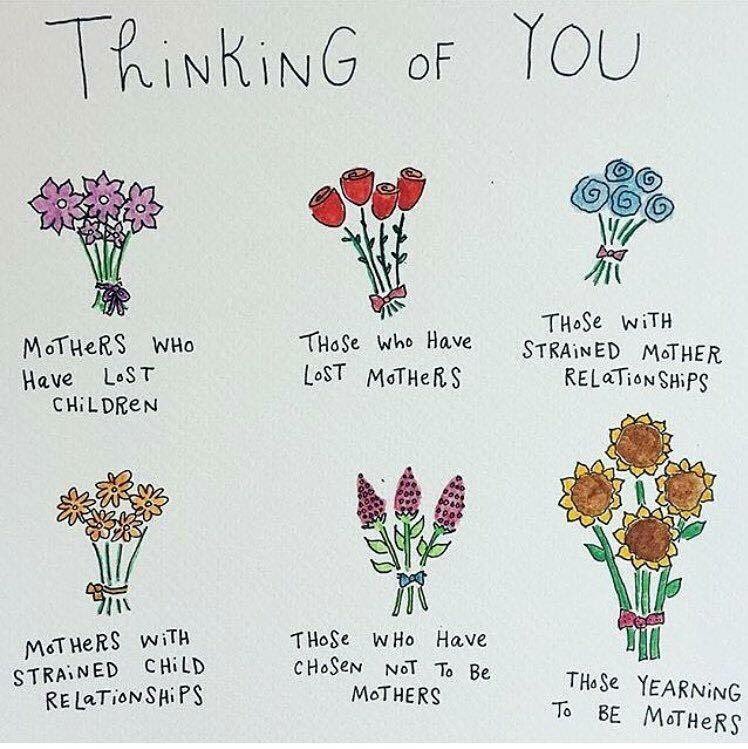
Now, as I say, the average person expects some mention of Mother’s day on Sunday, as well they might.  This is how we mark time now, these are the seasons, but unfortunately, as with all secular celebrations, mother’s day comes with some baggage attached to it.  And these days, mother’s day has more baggage than it ever has.  Consider this image, if you will.


This image is something that I have seen circulated an awful lot, or images like it.  Images that speak to the difficulties in mother’s day, because, like it or not, mother’s day isn’t easy for an awful lot of people.  It’s not easy because of the immense pressure that exists within the framework of mothers’ day.  For Mother’s day has risen to a fever pitch, as all celebrations do which revolve around the perfection of any human class of people.  When mother’s day hits, I’m sure it’s nice and easy for all those people who have perfect mothers, and who have perfect relationships with those mothers, but for those who do not, things are significantly more complicated.  The commentary that I hear are from people who don’t have a perfect life with their mothers or with their children; they may not have access to them, they may have died, they may not get along, they may not be able to have children, any of these can and have come up, and normally, these things are perfectly easy to deal with from a Christian perspective – we live in a fallen world in which thing frequently don’t work out. But the trouble is, when you are running the secular next to the sacred, and the secular takes over, all of a sudden, the fallen world conversation fades into the background behind the immense pressure of the perfection of mother’s day.  And on mother’s day, you are impelled by and immense cultural narrative to say that you have a perfect relationship with your mother, or with your children, and that your mother is the best ever.
Well, I’m here to take the pressure off of you, to let you know that you don’t have to pretend.  And by me, I mean St. Paul.


I am so glad that we had the reading that we did from Acts on Sunday, where Paul talks about the fullness of the Gospel, and the issue of the fullness of the Gospel is that it deals with what humanity actually is.  And what that means is that we, as humans, are sinners.  We had a baptism on Sunday, which allowed me to remind everyone who was at church that they had all agreed with the reality of the statement that we are all conceived and born sinful.  It’s easy to say that about the people you work with, it’s easy to say that about fellow parishoners, it’s easy to say that about your boss or the people in traffic, but the fullness of the Gospel means that it applies to your mother as well.  Your mother certainly agreed with that sentiment when she brought you to be baptized, because she knew that you were conceived sinful.  She knew that you were going to be born with the propensity for deception, the desire to steal, the ability to lie as soon as you were able to do so.  Your mother understood that about you, which is why she brought you to be baptized.  And in that same sense, you understand that about your co-workers, the people who make your sandwiches, the people who fix your cars, whatever.  The people who seem to let you down an awful lot.  The people who can’t be trusted with an unlocked door or an unsecured bike. The people who must be watched lest they thieve and steal.  This illustration is getting a bit long in the tooth now, but do you remember the Vancouver riots, where the Canucks lost the Stanley cup?  There was mass rioting and looting, and regular people, once it became clear that nobody was going to stop them or arrest them, smashed everything they could.  The most alarming thing about it was not that there were a bunch of people smashing the place up, but rather that these people were smashing their own city. These weren’t rioters trucked in to destroy, these were just regular people, once restraints were removed. Okay, so if your mother understood your sinfulness, and you understand the sinfulness of other people, then you should really be able to understand that your mother is sinful as well.  She was conceived and born sinful just like the rest of us. 

Does that bother you?  It might, especially on mother’s day, but I would ask you an important question, which is that what is the alternative?  Is the alternative to pretend that you have a perfect relationship with your families?  Is it to pretend that everything went well the whole time?  Go ahead and try that out, but right now, we as a society are bringing that harvest home.  Even after this selection of flowers above, there were still people who said that these categories didn’t go far enough.  There should be acknowledgement of those who had abusive mothers, those whose children were taken from the by the courts, those who have been disowned, birth mothers and surrogate parents, and on and on and on.  And it’s true, that image above doesn’t include all of those, but you can’t possibly come up with a graphic big enough to include all the ways in which things are not ideal in your own particular circumstances.
For everyone is broken in their own way.  And if all that mother’s day does is to hold up an ideal to be celebrated, then all we will be able to do in response is to look at the ways in which we are not meeting up with that perfection. It will only hurt if you are looking for perfection where it is not.  And all the cultural weight of mother’s day is built up around celebrating mothers and how great they are.  This will automatically make you feel worse.

Paul understood something, a lesson from his whole life. Think about his life before his conversion.  He had been a Pharisee of Pharisee, a Hebrew of Hebrews, circumcised on the eighth day, as to the law, blameless, but he took all that and counted it as rubbish for the sake ofgaining Christ as his Lord. And this is why he is so keen to bring up the fullness of the Gospel, because the fullness of the Gospel is the one thing that lets you celebrate mothers, or indeed anyone, with anything even vaguely resembling realism. If you don’t have the fullness of the Gospel, then you have to do one of three things: check out of mother’s day altogether, pretend that your mother is perfect which isn’t true because none of them are, or become tortured with the reality of your experience next to the required perfection.

But if what perfection worked for you instead of against you? What if you actually believed in the Gospel of Jesus Christ?  What if you believed in the power of forgiveness of sins in the real world? What if the Gospel of Jesus Christ wasn’t just vague idealism, but was instead the only thing that lets us love one another.  We love, after all, because he first loved us.  And once you have realized how much you need to be forgiven, how much you have done, and your propensity for evil that you have, then it becomes much easier to smooth over relationships with your mother because the pressure for her perfection is not there. You can’t blame her for not being perfect any more than she can blame you for not being perfect, because you are both sinful, both broken people.  And you’re both forgiven people, too.

Christ’s words aren’t just there to take up space, they are the power of God in the world, and the more we ignore them, the worse we end up, because we expect perfection to exist where it does not.  It’s not found in our homes or families, it’s not found in our desire for everything to be just so, and it’s not found in the flowery pages of the Hallmarks and Carltons.  The perfection that we are looking for exists outside us, which means that we can’t blame anyone for not meeting up with it.  We aren’t perfect, we are forgiven. And that means that we can look at each other, mothers included, in the same way as God looks at us: Rejoicing where we do what is right, and forgiving where we have done wrong.  And whichever of these issues that you may be having, whether they be strained relationships with your mothers,  problematic home life, distant people, or even a death in the family, these are all things that the Gospel of Jesus Christ are there to overcome. 

And the best thing about the Gospel is that it doesn’t matter if it’s mother’s day, or any other day, the Gospel is there to address these real world issues that plague and bother us.  It’s not theory, it’s absolutely practical.

Tuesday, May 7, 2019

From a certain point of view

Statistically speaking, you've probably seen star wars.  If you haven't, I'm about to spoil it for you right now.  So buckle up.

Darth Vader is Luke Skywalker's father.  There, now you're all caught up.  But there is more than that, of course.  Many of us came late to the story, we came already know that fact, and so the big reveal wasn't much of a surprise.  In fact, it wasn't a surprise at all.  But it's still fun to think about the way the story gets there, and although you know how it turns out, our friend Luke doesn't.  As I say, it's fun to join him on the journey, isn't it?

Darth Vader himself reveals the fact to Luke during their duel at Bespin.  He asks Luke what Obi-Wan told him about his father.  Luke reveals that Obi-Wan told him that Vader killed his father. That's when Vader says 'I am your Father.'  The big reveal, the big moment.  Due to movie magic, Luke did get the chance to follow up with the now-deceased Obi-Wan later, and Obi-Wan gives the cop-out answer that the dark side of the force betrayed and murdered the person of Anakin Skywalker, and that after his conversion to the dark side of the force, Anakin ceased to exist.  This culminates with the line from Obi-Wan 'what I told you was true....from a certain point of view.'

In other words, you would have to have Obi-Wan's unique perspective to understand the position that he takes. Fair enough.  But perspective counts for an awful lot.  Any and all Police officers that I have spoken to have recounted similar tales, stories of pulling people over, and having them immediately ask for a break, talk about how they're not the real criminals, that sort of thing.  And they'll do so without fail, essentially believing that from the perspective of the speeder, they deserve a break.  But if you have children playing, if you have other motorists around whose lives may be put in danger from racecar Johnny, then you're going to be happy that Mr. Leadfoot was pulled over.  It's all about perspective.


Now the notion of things being 'from a certain point of view' becomes extremely important when you consider the reality of what the scriptures say, and how they speak to people.  I want you to think very carefully about St. Paul, who was, at the time that I'm referring to, Saul of Tarsus. And Saul of Tarsus was, as the reading from Sunday tells us, breathing out murderous threats against the followers of the way.  Why was he doing that? Well, we have to work backwards a little bit.  We know that Saul approved of the murder of Stephen, and he would have done so because of what Stephen was preaching.  What was it that Stephen was preaching?  Stephen's testimony bothered the Jews who were there to the point of wanting him dead, precisely because Stephen brought forward a Christological reading of the Old Testament. Stephen recounts all the things that the Hebrews of the time would have thought were extremely important, the stories that informed their culture, and largely determined their place in the world, and Stephen tells them in no uncertain terms what all those stories are all about.  All those stories are not about us, they are about Christ.  The promise that Stephen keeps on talking about, that promise is the promise that is realized in the death and resurrection of Christ.  And what the people didn't want to hear was that they were in no small part responsible for that death.  They killed all sorts of prophets before, and now they had killed the Lord of life, with seemingly no remorse whatsoever.  Stephen culminates by saying that he can see Jesus standing at the right hand of God, and at that, the crowd stones him to death.  Why is Saul of Tarsus happy about that?  Because he is comfortable with and in himself.

The testimony that Stephen gives is that of righteousness perpetually existing outside the human race, and working on it.  Over and over again in his speech, Stephen tells the people that God acts, and people respond.  He tells them that God decides, and his people react, whether for good or for ill.  God speaks to Abraham, Abraham follows his lead to the promised land. God speaks through the prophets, the people of Israel kill the prophets who announce the coming of the righteous one.  This happens because of the heavy implication from these passages, and from the entire scriptures that there is, in fact, a righteous one - and it isn't you.

Paul tells you why it bothered him, and why it bothered him enough to kill.  He tells you this in the book of Philippians, where he talks about those who have confidence in the flesh, which he had in spades.  "Circumcised on the eighth day, of the people of Israel, of the tribe of Benjamin, a Hebrew of Hebrews, as to the law, a Pharisee, as to zeal, a persecutor of the church.  As to righteousness under the law, blameless...For [Christ's] sake, I have suffered the loss of all things and count them as rubbish, in order that I may gain Christ and be found in him, not having a righteousness of my own that comes from the law, but one that comes through faith in Christ.'  In order to be blessed by faith in Christ Jesus, Saul had to leave his entire life behind because it was based on his own righteousness as concerns the law.  But the law condemns, it doesn't save.


What the law does, and does very well, though, is to convince you that it saves.  That is, the law will deceive you into believing that you are keeping it, and that you are able to keep it fully.  And this is where things get dicey.  Most people then, as well as most people now, believe that they are keeping the law, which is why the words of the scriptures, the words of Christ, are so offensive to them.  That is, they want to continue to believe that they are good.  And what Christ does, what Stephen was trying to get people to see, was that they weren't anywhere near as good as they had led themselves to believe that they were. This is relatively uncomfortable to hear, it's unpleasant, but it has the unfortunate side effect of being true.  And that's the real trouble with it.  The belief that Saul had, that he was righteous and blameless under the law, it was comforting, it lets you believe that you're a good person, but unfortunately, it is full of holes, and that's what Saul discovered on the road to Damascus.

Now here's where things get truly and genuinely fascinating.  Think of this, if you will - Saul, knocked off his horse on the road to Damascus, hearing a voice telling Saul that Jesus of Nazareth, the one whom Saul has been persecuting, is intimately interested in him.  And when Paul gets up, and gets to town, scales fall from his eyes.  This is great stuff, because we're not talking only about physical blindness, you know.  We're talking about spiritual blindness too.  Perhaps even more so.  The scales that fall from Paul's eyes are spiritual scales, where he all of a sudden understands, he realizes why Christ lived and died in the first place, and why he shed his blood.  Paul understood that, as Stephen had told him, that Jesus came to redeem sinners, and the scales that fell from Paul's eyes were those that obstructed him from seeing that he was one of those sinners.  Once you understand that you are a sinner, then you will understand why Christ's message is so important.  The law doesn't offer you salvation, it only offers condemnation.  Paul understood at that moment that the words he had resisted when Stephen had spoken them, were the only words that could offer salvation.


But the words themselves hadn't changed.  Only Paul's perspective had.  When Stephen spoke, those words were harsh on Paul's ears, telling him that Paul's people had spurned and killed the prophets.  But when the scales fell from Paul's eyes, he understood the forgiveness that Christ offered was through his blood.  Identical words, different reaction, perspective changed.  And this is what leads to the curious conundrum of our reading that we had from Revelation from Sunday.  This reading talks about the one who is worthy to open the scroll and break the seals, and this one, the righteous one, is either the Lion of Judah, or the Lamb of God.  Which is it?  Well, it's both.  It's both because they are the same person, truly and genuinely.  For Jesus is both the Lion and the Lamb, it just depends on your position next to him. He doesn't change, but we perceive him differently based on where we are in comparison to where he wants us to be.  He can bring Peter to tears when Peter is denying him, but will also embrace Peter and bring him back to the fellowship of the Apostles when Peter repents.  He can demolish the evil, and restore the repentant.  This is what the work of Christ is all about, and our reaction to him tells us a lot more about us than it does about him.  His words don't change, so when people hate him, as Saul did, it is because they fell as though they have to believe that they themselves, through their effort, are righteous.  But when people love him, preach about him and declare him, as Paul did, it is because they know that their sins are covered.

It truly depends on the point of view, because the words themselves don't change.