The musings of the Pastor from Good Shepherd Lutheran Church, Regina SK

Welcome. If you're a member at Good Shepherd, welcome to more thoughts and discussion of the week that was, and some bonus thoughts throughout the week. If you're not a member, welcome, and enjoy your stay. We are happy that you're here.

If you like what you see here, consider joining us for worship at Good Shepherd Lutheran Church. Sunday mornings, at 8:30 and 11:00. You can also follow us on Facebook.

Monday, May 26, 2014

We seem to be made to suffer. It's our lot in life.

Yes, there will be trouble.  There will be persecution of Christians.  But the thing about Christians, especially North American Christians, is our claims of persecution seem to be a little disingenuous.  For a start, the Christian church is by far the dominant faith, and informs a great deal of the culture of the nation.  It's difficult to claim too terribly much discrimination when the faith that you hold ends up being on the money, in the anthem, in the courts, in the houses of parliament, and all that tut.

North American Christians have basically rolled the double sixes, the boxcars, when it comes to discrimination, and we aren't likely to face any large scale massed discrimination for the faith that we profess, no matter how bleak things seem to be.

But here's the thing, Christians are almost always looking for persecution.  We have a nasty habit of looking wherever we can for whatever persecution we may encounter.  It can be under whatever rock we choose to lift up, it can be in anyone's refusal to toe our particular line, and it can be as simple as the government not actively supporting us enough for what we want it to do.

But the Christian faith has suffering built into it.  It is made of suffering.  As a Christian, I can promise you without even checking your current status, that you ought to be suffering more than you would as a non-Christian.  Wait a minute, ought to be suffering?  That's strange, isn't it?  Shouldn't this Christian life be easier and nicer?


Well, not really.  This is the thing that happens when you bow to and raise an altar to an unknown god.  This was what Paul was running up against in the Aeropagus, the idea that you could worship in freedom and truth a god that you know very little about.  And this is not an alien concept in the
Christian church either, as most Christians essentially worship an unknown god.  Not that God can't be known, but that they don't know him.  The entire ministries of people like Peter Popoff are based on the idea that people like God, but don't know anything really about him, so they have to have someone else tell them about him.

And the various hucksters and shysters peddle the word of God for profit, and make sure to tell you that if you pray hard and send them money, that all your troubles will be over, because they'll sell you miracle spring water.  Which will be great.  Because the miracle spring water totally works, and it totally makes you wealthy..... as long as you're the one selling it.

You and I have a responsibility, as Christians, to get over the whole notion of treating Jesus like an unknown god, of treating him like a far away god of whom we can never know anything.  Most North American Christians treat God like this, as an unknown in their lives, they have an idea that he's there, but they have no idea what he's all about.

And yet, the God of the Bible is near, not far off. Near in three ways:  First of all, through Jesus Christ, who took on flesh and dwelt among us.  Secondly, in the Holy Spirit, who is the part of God who lives in us, and makes us holy.  That was what Jesus promised to us when he gave us his word that he would not leave us as orphans, but would take care of us.  The third thing is through his holy word, the Bible.  And the Bible will tell you stuff about what it means to suffer as a Christian.

For there are two ways to suffer as a Christians.  One is to suffer for saying you're a Christian, and the other is to suffer by being a Christian.  I'll explain.  In North America, it's quite unlikely that someone will execute you for saying you're a Christian.  Yes, it can potentially happen, but it is remarkably rare.  Far more likely is you taking on board the words of Jesus, living them out, and suffering for it.  When you read through what Jesus says, saying it directly to you, then you will be mashed flat under an avalanche of incredibly difficult moral teachings.  He has some things that he wants you to do, and if you were to look at them, you would likely conclude that you don't want to do them.  Because they're hard, and because you would be essentially better off if you didn't start trying.

But that's not just the teachings of Jesus.  It's not as though the New Testament and the Old Testament tell different stories, because they don't.  They tell the same story.  And something you need to know, that you absolutely need to know, is that a call to holiness, to being set apart by God, is not a call to timidity or to weakness, to idleness or to passivity, but a call to holiness, uprightness, righteousness and strength.  And if you read through the Old Testament, you'll find that those called to God's path are
those called to a much harder experience.  That trip that the Israelites made through the wilderness, when they left Egypt, things got much harder rather than much easier.  Things were all of a sudden far more complicated, things were way more difficult, especially compared to the surrounding nations.  Think about the Persians, the Babylonians, the Hittites, all those nations surrounding Israel, and about how they actually got less interference from God.  He was less harsh to them, less present as a consuming fire to them.  But Israel, he was very interested in what they were doing.

Ultimately, we who are Christians, the more we know about God, the more we will know about his will for us.  Reading through his word, we will uncover so much about what he has in mind for humanity, how we are to behave, how we are to interact, how we are to relate to each other, and that will be far more restrictive than otherwise.  And if you treat Jesus not as an unknown God, but as a known one, then you will find that he has some incredibly difficult things for you to do and to observe.

But there is more than that.  Even those who treat Jesus as a barely known quantity will know that he has some restrictions for you.  Anyone who is anyone knows that Jesus is interested in how you live your life, in what you do, in being moral.  But the big secret, the one that requires you to listen to Jesus incredibly closely, is the one where he tells you that it's not all dependent on what you do.  It's dependent on what he does.  This is part of the change between Jesus as the unknown god, to him as the known God, is knowing what he's all about.  And you only do that by knowing him, by knowing what he says, and who he is, and what he has done.  If you stop having the altars to him as altars to unknown gods, and instead having his altar as the altar to a known god, then you will find something.  You will find that this is not an altar where God demands more and more and more sacrifices, but this is an altar where God himself provides the sacrifice.  It's just like it was waaaaaay back when in the book of Genesis, in which Abraham was told by God to sacrifice his son, and promised to his son 'God himself will provide the sacrifice.'  After God provided the sacrifice, then the name of that place was changed to 'the Lord provides.'

You see, a cursory look at the Bible, a cursory look at God, will tell you that he demands sacrifice.  But knowing God, knowing Jesus, will tell you that he provides the sacrifice that is demanded.  If you stop treating God like an unknown god, then you will know something remarkably important about him - that he asks you to take his burden upon yourself, and learn from him.  For his yoke is easy, and his burden is light.  You won't know this unless you know Jesus in the way he is known, through his word, through what he has left for us to read mark learn and inwardly digest.  And that's the curious thing about the God of the Bible.  If you move him from being unknown to known, you will discover both how much more you have to do, and how much more he does for you, culminating with the all availing sacrifice of his body and his blood on the cross, that because he lives, you will live also.

PJ.

Thursday, May 22, 2014

The Feast of Stephen

This was the Sunday where we commemorate the martyrdom of St. Stephen.  And St. Stephen was the first Christian martyr, the one who went to his death for his faith.  Before the rest of the disciples, before the rest of the apostles, before the noble army of martyrs, there was St. Stephen.  And Stephen went to his death by speaking out to the synagogue, and he knew what the results would be.

Now, you may have heard by now of the execution of Clayton Lockett.  Mr. Lockett, after being tried and sentenced for this crimes, underwent what is being referred to as a 'botched execution.'  This was a major issue, because most everyone is searching for a painless, humane way to execute criminals, that causes no suffering and no pain.  And ostensibly, Mr. Lockett's execution was nothing like that.

There has been an effort in place to find a much more humane way to execute criminals, more humane than hanging, firing squad, and gas chamber.  There have been enough stories about executions that have gone less than perfectly, that have caused pain, that have caused agony, that have caused decapitations, and all that, to try and find a much more humane method of execution.  There have been some who have determined that hypoxia is the most humane way to execute criminals, determining that it causes no pain, and in fact, causes slight euphoria.  As has been said in the documentary above, it's 'a hell of a way to go.'  Painless, and lethal 100% of the time.

Now, the good people of Stephen's time weren't too concerned about that.  Capital punishment back then was astonishingly unpleasant, and was designed to be.  You wanted those whom you were killing to suffer, for it to be an agonizing death.  Take crucifixion, for example.  You didn't want to be crucified.  In fact, crucifixion is, by nature, excruciating, with the word meaning 'from the cross.'  If you were executed by the Roman government, being nailed to a cross was a bad way to go.  You were lifted up in front of the crowds in order that everyone might know that the Roman government was not to be trifled with.

Stoning, not really much different.  Of all its merits of not being able to ascribe the killing blow to any one person, it is essentially death by torture.  It's painful, drawn out, and remarkably unpleasant.  And lest you think that this method of execution is not only barbaric but outdated, I would like to remind you that Brunei popped stoning back into their law books in 2013, and in Indonesia in 2009.  This is still happening in the world, and remains as unpleasant as it ever was.

And this is what Stephen voluntarily walked into.  He knew what was going to happen, that he was going to be brought up on blasphemy charges, and the synagogue were going to assemble, and pick up rocks.  And, as I said on Sunday, when the entire congregation gets together and gathers rocks, it's not because they're going to do some zeroscaping.  And Stephen approaches this with a lack of fear that you or I would expect.  We would expect him to do what Peter did, which was to lie and flee to save himself.

Peter's performance when it came to representing Christ was hardly stellar.  The spirit was willing, but the flesh was weak.  He said to Jesus that even if they had to kill him as well, that he would never desert his Lord.  And that ended up being not true. Peter was quick to abandon Jesus out of fear of execution.  And so were the other disciples, quick to flee their Lord on account of the possibility of death and punishment.  They fled, they took their balls and went home, and they got out of dodge.  And they all went and fled and then went back to their lives, assuming that nobody would figure out that they were involved.  They stayed where they were , doors locked, for fear of those who would kill the body.

It's important to know that the disciples were cowardly.  They were cowardly like we are cowardly.  They had a faith in Jesus that had been tested, and they were found wanting.  When Jesus was led away, they fled.  They weren't towering figures of faith and majesty in the way we've constructed them since.  They were largely spineless, being paper tigers, talking a good game, seeming to be threatening, but ultimately folding as soon as they were opposed.  This is an issue that actually does us good, because the disciples are human beings like we are.  They get scared, and when they get scared, they run.  Their faith is something that they can hide and put away, in order that nobody would find out something that may lead to their deaths.

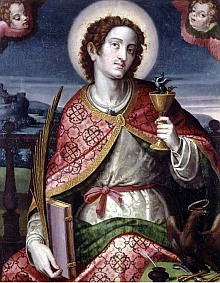
But wait.  In the book of Acts, those craven cowards become incredibly brave, even and especially when staring down certain death.  All of a sudden, the paper tigers become real tigers, unafraid by all the various tools and tricks that the Romans, and even the Sanhedrin, might offer.  You can often tell the sculpture of the various Saints by way of what they're holding

This is Saint Peter.  He is holding an upside down cross, which is what he is said to have been martyred on.


Here's Matthias, holding an axe.  Why is he holding an axe?  Was he a woodsman?  Or was he, perhaps, stoned, and then beheaded, in Jerusalem?


This is St. John, holding a cup in his hands that has a serpent coming out of it, because, even though it didn't kill him, he was poisoned.  You can also tell it's John because of the Eagle sitting by his side.  St. John almost always has an eagle with him.


I hope you're beginning to get my point, which is that while Jesus was being slain, the disciples were terrified.  After his resurrection, they believed in a more powerful, tangiable way, in their Lord and Savior Jesus Christ. They believe in the words that Jesus had spoken to them, that they ought not be afraid of those who can kill the body.

After the resurrection, they proclaimed their faith boldly and proudly, with little fear and trepidation, and all the tricks of the Roman government began to work against them. After all, what possible punishment can you level against someone who is not afraid to die?  The answer:  Nothing

Without the resurrection, there would be no chance for Peter, James, John, Matthais, Stephen, any of them, to boldly cling to their position even in the face of death and loudly proclaim the messiah.  And they proved it before his death, they were weak, they were afraid.  They definitely were in fear of those who could kill the body.  After his resurrection, though, something changed in them.  They were no longer afraid of death, and it showed.  That's our legacy now.

Do we live up to it?  Not usually, because we're cowards, just like they were.  We claim to represent Jesus faithfully up to and including the point of death, but we flake, we do.  But there is something else behind all that, which says that is is that kind of sin that Jesus died for.  He didn't just die for the other sins, like adultery, murder and slander.  He died for our cowardice, too.  As he did for Peter, who had denied him three times, and yet was reinstated, Jesus tacitly tells him that it was for this that he died. Because we are weak, not because we are strong.

The resurrection remains a big deal because if we die with him in a death like his, we will surely be reunited with him in a resurrection like his.  The disciples saw this, and were gladdened and motivated, and sincerely believed that death itself was no longer a barrier to them.  And they faced their deaths with gladness, unafraid, because of the truth of the resurrection of Christ.

PJ.


Monday, May 12, 2014

Happy mothers' day, from me to ewe.

This last Sunday, it was Good Shepherd Sunday, as well as being mother's day. And mother's day is a thorny one, isn't it?

On the surface, it doesn't seem like it should be complicated, does it?  Just render thanks unto all the mothers, and tell them how great of a job they're doing.  But the thing about mothers is that, well, it ends up being a little bit exclusive.  You see, this was the first year that I was made aware of the policy
of having mothers stand up to be recognized.  And on the surface, again, this sounds like a great idea, to recognize and laud and honor mothers, as we ought to do.

But it runs into a snag.  And that snag is something that I hadn't considered, but I need to.  Thanks be to our DPS Amanda Knodel for pointing this out.  Her most excellent of all children's messages was one about knowing the voice of the shepherd, and likening that to knowing the voice of our mothers who call us home for dinner and out of trouble, and so on.

It's no coincidence that the voice of the conscience in my head is my mother's voice, though with an Irish accent, and when I think on moral issues, I do so with her voice in my head.  And on mother's day, I recognize my mother for all the hard work that she did in raising me, and in making me into the person that I am today.  For she is my shepherd, and I know her voice out of all the others, and I follow where she leads.  And here's the rub, and one that ends up being incredibly important.  As Amanda Knodel told us, the significance of our mothers on mothers' day, is that it's our mother.  Not someone else's mother, not another mother in a crowd out there, but rather a specific mother in a specific place and time, and one who should be acknowledged and thanked for the work that she has done by the people who have benefited from it.


Because the thing about being a mother is that it doesn't exist in a vacuum.  You can't be the concept of a mother, you can't just claim motherhood, there has to be a child, whether that child is still with us or not.  And the work that you do is on behalf of that child whom you are called to serve as part of your vocation.  That work you do is for that child, and the rest of the world will never quite know or appreciate the work that you did on behalf of that child or children.

This is part of what we get into with the notion of the great shepherd of the sheep.  We get into Jesus as the Good Shepherd, who calls his sheep who know his voice, and will not follow another.  And this is why Biblical literacy, prayer, conversation with God and with each other, ends up being so important, because everything revolves not just around how great God is, which he is, but about how great he is for you.

This 'for you' statement ends up being significant in the Lutheran faith, coming from the small catechism of Martin Luther which ends up being etched on our hearts.   If you didn't feel like reading it, allow me to sum it up for you -

How can bodily eating and drinking do such great things?

It is not the eating and drinking, indeed, that does them, but the words which stand here, namely 'given
and shed for you, for the remission of sins.' Which words are, beside the bodily eating and drinking, as the chief thing in the sacrament, and he that believes these words has what they say and express, namely the forgiveness of sins.


This whole thing is for you.  And this is why the discussion of Jesus as the Good Shepherd is such a big deal, because he's not just a good shepherd, he's your Good Shepherd.  He's not just God, he's your God.  His body and blood weren't just broken and shed, they were broken and shed for you.  It's not just that in his father's house there are many rooms, but that he goes to prepare a place for you.

Your mother is a big deal because she's your mother.  Nobody else will get that about her.  Nobody else was there when she chased monsters away or bandaged you up, or taught you how to cook or hit a ball or ride a bike or how to do math, or anything like that.  And your children are your own.  Nobody else will get or understand what it was like to hold them, to raise them, to hear them speak, or coo, or yawn, to watch them sleep, and know that you helped to make that life and to help it to grow.  You took that lump of flesh and formed it into a person, like God did with Adam, telling him and his wife to be fruitful and multiply.  

So what's important here?  That the mothers in the congregation stand up and be recognized by me?  Nah.  Unless it's my mother.  The important thing is that we celebrate that very special relationship between our mothers and ourselves, or our children and ourselves, even, and this is especially important in a church, if that union has been broken by death.  Because it's a church, and we know that the work that Jesus did for us is so that these incredibly powerful relationships will not be forever broken.  He came, says the reading for Sunday, that we may have life, and have it abundantly.  We rejoice that this work was done for us, letting us know that neither life nor death nor things past nor things to come can separate us from the love of God that is in Christ Jesus.

Happy mother's day, everyone.  Give your mummies a hug if you can, call them if you can't, and if
they have left this world, then give thanks to God for the time you had with them, and look forward earnestly for that time when you will see them again.

PJ.

Monday, May 5, 2014

May the Fourth be with you

Every once in a while, the stars all line up, and the infamous Star Wars day falls on a Sunday.  And I get to talk about it.  Yes, it was Star Wars day yesterday, May the Fourth (as in May the Fourth be with you), and it gave me a nice, convenient jumping off point to talk about Mark Hammill, Carrie Fischer, Harrison Ford, and age in the cage.

A good time to make sequels would have been when George Lucas was planning on making prequels.  Getting the original cast together again is fun, but it has been almost my entire lifetime since they were
together onscreen in their original roles.  31 years.  And 31 years is a long time, especially for someone like Mark Hammill, who I last saw in Wing Commander. And that was a long time ago too.  Sure, he's had voice acting in the meantime, but we haven't seen him onscreen really.  Oh, and in the remake of Village of the Damned, but now I'm dating myself.

Point being, he was a young man in Return of the Jedi.  They were all young 31 years ago. And these days, that original cast will look significantly older (except Billy Dee Williams, who still looks amazing).  And this the best image that we have right now of all flesh being grass.  The march of time has a way of working on us, and when we see someone after a 31 year absence, they certainly look much much different.  This is a pretty rare case, too, because it's not that often, outside of an entertainment expo, that we see someone after a long, 20-30 year absence, and see how much they've changed in the meantime.


But that cast has changed. And like it or not, so have we.  In that 31 years, there's a good chance that a bunch of you weren't born.  I was three when Jedi came out, and I'm 33 years old now.  It's been basically my whole lifetime, and I've changed a lot since Jedi came out. So have we all.

Because all flesh is grass.  We're all getting older, though we don't like to admit it. And because it takes place so gradually, we don't really notice it.  But when we see it all at once, like with the cast of Star Wars, we realize that there's no picture of Dorian Grey.  There's no fountain of youth (sorry Ponce de Leon).  All flesh is grass, which, according to St. Peter, grows up one day, and then is gone the next.

So, that's unpleasant.  We don't like to think about it too often, but it's true.  And the other sad thing is that it's not just us, either.  I picked up a small book in Montreal called 'the skeptical approach to religion' that had a really interesting opening chapter, which talked essentially about the eventual heat death of the universe.  It talked about the fact that it's not just you and your family that are aging out of existence, but also the sun in the centre of our solar system, and all other suns, too.  You may have a rich and lasting legacy, but on a long enough timeline, everyone's life expectancy drops to zero.  And knowing that ought to give us pause for thought, given that on a long enough timeline, the life expectancy of the sun in our solar system drops to zero as well.  Everyone we have ever known and loved, everyone we have ever held dear, all the things we have done, are worth nothing on a long enough timeline.

So what does that tell us? Well, we have a seed of eternity planted in our hearts that seems to want to lead us towards things that last forever.  We have an idea that we, and all people, ought to last for all time.  We have an idea that the stuff we do matters, that our lives have import and worth and meaning, which they don't if we're just on a dying planet in a dying solar system.

But this conception of eternity is actually phenomenally important to us as Christians.  It's important because of who Jesus is and what he does.  1 Peter tells us that all flesh is like grass, and its glory like the flower of grass that grows up one day and is gone the next.  But the word of the Lord is forever.  And this is important for us as Christians. It is important because it tells us where our help comes from, and what our hope is in.

When Jesus met up with his disciples on the road to Emmaus, he told them everything about himself that was in the scriptures, beginning with Moses and the prophets.  And that's something we forget,
because after all, if we were to start telling the story of Jesus, we'd start with the story of a stable in Judea.  But Jesus doesn't.  He starts with Moses and the prophets, going all the way back to essentially the beginning of time.  And that is where the story of Jesus starts.

In the beginning.  In the beginning, John tells us, was the Word.  And the Word was with God, and the Word was God.  It was with God from the beginning, and through Him everything that has been made has been made.  This is important.  It's poetic, it's nice, it sounds beautiful and all that, but it is incredibly important for us to know.

We need to know this because we live in a fallen creation, and we're part of that fallen creation.  We have decay, entropy, and collapse built into us and wired into us. As consequence of sin, all creation fell, and it became susceptible to entropy, and to collapse.  All things became like grass, not just all flesh.  Heaven and earth were set to pass away, and all creation was set to melt away like wax.  And both faith and science will tell us the same thing.  That all creation is winding down and wearing out.  They'll give you different reasons, but will lead you to the same conclusion, that our sun is burning out and going away.

And this is why Jesus as the word of God is so important.  This is why his presence as the eternal word of God is so vital, because of course God spoke creation into existence.  God spoke, and it happened.  God spoke the sun, the moon, the stars, the animals, all that into creation.  His word was around before everything, and it will continue to be around long long after it all goes away.  Heaven and earth will pass away, says Jesus, but my word will never pass away.  He predates creation, and will postdate it too.

And this is what we as Christians cling to, not just to his goodness and rightousness, which we do, but also to his eternity.  We cling to the fact that he is the only thing in all of creation that is not part of this decay.  He doesn't wear out, he doesn't break down, he doesn't fall apart.  Heaven and Earth will pass away, but his words will never pass away.  And through his work on the cross, we are yoked to him.  We take his burden upon us, and he takes ours upon him.  And all that decay, all that rot, he takes it with him to the cross, leaving us with his eternity.

That's how big forgivness of sins is, it's not just a matter of saying 'oh, well, never mind' about the things we do that we ought not do, it's a matter of reaching into creation, plucking us out, and giving us eternity.  Making us last forever.

All flesh is grass, but the word of the Lord remains forever.  Which is the source of all our hope.  On May the 4th, and always.

PJ.

Monday, April 28, 2014

Con-phone-mation.

We all have cell phones.  We do, right?  And they're all fancy and have a thousand features.  Well, believe it or not, I come from a time before cell phones.  Heck, I remember a time of rotary phones.  Yes, non-button phones.  But that's beside the point.  What I mainly want to talk about is how we exist and operate in a fast moving fast changing culture.  Especially as confirmed Christians.

Your phone is a marvel of modern engineering.  It sits in your pocket, and buzzes when you get calls.  It does facebook, twitter, youtube, and all that tat.  But phones first came out, the only features they ever had were buttons, a screen, and an antenna.  And all they did was make calls.  These days, phones don't have buttons or antennae, and the screen is the size of a book.  And nobody uses them to make calls.  

Things have changed.  Things have changed a lot in the last few years.  And please bear in mind that these changes didn't take place over thousands of years.  This development, though it may seem to come from a time before time, doesn't.  In terms of time, this is incredibly recent.  This takes place not over fifty years.  The first cell phone to be commercially available was the Motorola DynaTAC, and that was in 1984.  And in case you were wondering, old cell phones used to look pretty much exactly like this:  


Knowing this about phones, we know that development of these things is remarkably quick.  We know that phone technology went from that thing to the galaxy s5 in 30 years, so understandably, we are keen to swap our programs as quickly as possible, given the circumstances.  And this is what makes the means through which we get cell phones so burdensome.  We get our phones through contracts.  We sign up for contracts, and we lock in to the most recent, most fun phones that are out there.  And here begins the trouble.  The trouble begins because even if we get the most recent, flashiest phone that there is at the time, it will be wildly outstripped as soon as we get it home.  To put it another way, I bet that galaxy s3 in your pocket used to seem pretty special, didn't it.  But if you signed your contract when that phone first came out, then you'd still be locked to that s3 even though we are now on the s5.  And all of a sudden, your s3 doesn't look so special anymore.  


This is the perpetual burden of phones, that you're locked into something from which the lustre comes off pretty quickly.  As soon as you get it, it's old and busted, and you're stuck with it.  And you are haunted day and night by visions of what you could have if only you hadn't locked in quite so hastily.


Now, we in the Lutheran church, we baptize babies, which is great, and then we have children confirmed when they get to be about thirteen.  This is good and nice, to be sure, but we ask the kids who are getting confirmed to say some pretty serious things.  These are children who have can't legally sign contracts, who can't get into things too heavy for them.  They can't get married, they can't take legal oaths, they can't do any of this stuff, and yet here in the church, we confirm them in their faith, and their public profession of the same.  


Now, you're all probably sick to death of me talking about it, but I'm going to bring up classic western movies again.  Why?  Because they're timeless.  In the film 'The Magnificent Seven,' there's a wonderful exchange that gets to the heart of confirmation and the ins and outs of it.  When the seven have been resoundly beaten, and they're told to leave by the villanous Calvera, they discuss whether or not they're going to ride back into town to confront him again.  When some of them mention cutting and running, this exchage comes up.


Chris: You forget one thing. We took a contract.
Vin: It's sure not the kind any court would enforce.
Chris: That's just the kind you've got to keep.

We confirm teenagers / children in our churches and there is no earthly way that they can be legally held to anything quite so strenuous as a cell phone contract.  They won't be held to that because they can't legally make these kinds of decisions. They can't legally swear anything that will be held up in a court of law.  But that's just what makes this so special, and helps us to understand a great part of our faith.  

In a cell phone contract, you get a phone, then instantly want another one.  And you have to suffer through the burden of your choice for three years until the contract finally expires, and you can move on.  And getting out of the contract is going to be intensely difficult, and incredibly expensive.  If you don't believe me, check out your local online classified ads in the 'free' section.  You'll find a tonne of entires telling you that you can have the latest cell phones for free... as long as you take over the contract.  But in confirmation, there's nothing holding you to that promise.  There's nothing holding you to that promise to remain steadfast in this confession even unto death.  You don't sign a contract, you don't offer collateral, you don't put up security, and your parents don't co-sign.  Instead, it's just you.

Or is it?  This is hopefully what you learn as confirmation students, is how this all works.  What you learn as confirmation students is tied heavily into the third article of the apostle's creed, and Luther's explanation of it.

I believe that I cannot by my own reason or strength believe in Jesus Christ, my Lord, or come to Him; but the Holy Ghost has called me by the Gospel, enlightened me with His gifts, sanctified and kept me in the true faith; even as He calls, gathers, enlightens, and sanctifies the whole Christian Church on earth, and keeps it with Jesus Christ in the one true faith; in which Christian Church He forgives daily and richly all sins to me and all believers, and at the last day will raise up me and all the dead, and will give to me and to all believers in Christ everlasting life. This is most certainly true.

 Do you see what's happening in here?  What the children or adults in the confirmation rite confess is this faith that they have come to learn it from the small catechism.  They profess publicly that they cannot by their own reason or strength believe in Jesus Christ or come to him.  They profess that they cannot come to Christ, confess him with their lips, or believe in him in their hearts.  They profess that they believe in Jesus because of Jesus, not because of them.  And this is the big secret that you learn in confirmation class.  This is the big truth that underpins everything else in church, in the scriptures, in everything.  

What do I mean?  I mean that when Thomas has in mind his own list of what will make his Christian faith a functioning thing, he does so assuming that by his own reason and strength he will believe in Jesus and come to him.  This is the reading that we had for confirmation Sunday, which I love, because it shows Thomas making a string of conditions, saying 'as long as Jesus fulfils these issues, as long as he ticks these boxes, as long as he does what I want him to do, and satisfies my approaches, then I will believe.'  And then Jesus shows up, and it all crumbles to dust.

Jesus Appears to Thomas

24 Now Thomas (also known as Didymus[a]), one of the Twelve, was not with the disciples when Jesus came. 25 So the other disciples told him, “We have seen the Lord!”
But he said to them, “Unless I see the nail marks in his hands and put my finger where the nails were, and put my hand into his side, I will not believe.”
26 A week later his disciples were in the house again, and Thomas was with them. Though the doors were locked, Jesus came and stood among them and said, “Peace be with you!” 27 Then he said to Thomas, “Put your finger here; see my hands. Reach out your hand and put it into my side. Stop doubting and believe.”
28 Thomas said to him, “My Lord and my God!”
29 Then Jesus told him, “Because you have seen me, you have believed; blessed are those who have not seen and yet have believed.”

Do you see what is happening here?  Thomas as in mind that his faith depends on him, on his own strength and reason, his own needs, his own investigation, his own approaches to everything.  He assumes that he cannot believe unless his own stipulations are met.  Yet all that flakes when Jesus actually appears, and speaks to him.  And he says to Thomas 'Stop doubting, and believe.'  This is huge for us, because we need to stop thinking about our faith in confirmation as being something we do, and more about it as finally understanding what is done for us.  What we speak, believe and confess in the rite of confirmation is that we cannot by our own reason or strength believe in Jesus Christ or come to him, but our Lord has called us through the Gospel, and enlightened us through the Spirit.  And everything in the worship service hangs on this - confirmation, baptism, the Lord's Supper, the forgiveness of sins, all that, is based not around what you do for God, but around what God does for you and all believers.

The reason this is so important?  Well, if confirmation was about what you do, then you'd be in trouble, since you are likely to fail.  How do I know you're likely to fail?  Because we all do.  We all make confessions of faith in confirmation, and we all flake. We do, Peter did, Paul did, James and John did, we all do.  We all do except Christ.  The entire worship service hangs on this, all the sacraments hang on this, that Jesus loves us so much that he came to earth to rescue us from our sins, and bring us to life everlasting.  He knows we're weak, he knows we're frail, which is why he accomplishes what he accomplishes.  This is why he does what he does.  This is why he is who he is.  He is the one person who doesn't flake, and who isn't frail.  And it's all based on a very very old promise, in which after humanity sinned, and fell into sin, God made a promise to Adam and Eve, where he said:

" I will put enmity between you and the woman, and between your offspring and hers; he will crush your head, and you will strike his heel." 

This is the promise that God made to the first people, promising them that Satan, sin, and death would be eventually crushed by Jesus.  That's a promise that God makes, and he makes it only on himself.  And unlike a cell phone contract, it's not a contract that would hold up in any sort of court of law. But then, that's the sort of contract that you have to keep.  Jesus does.  He keeps his promises.  He keeps his vows that he makes, he keeps them perfectly, in the same way that we don't.  He embraces and loves us, and does so precisely because we can't even take a single step towards him.

What you're confirming in your confirmation is not that you're making the decision that you couldn't at your baptism as an infant.  You're confessing that you have the exact same ability to take a step towards God as a teenager getting confirmed as a baby does when it gets baptized.  None.  You can take the same motions towards Jesus as you could when you were baptized.  You are incapable of moving in his direction, and so he had to come to you.  You cannot by your own reason or strength believe in Jesus as your Lord or come to him.

So what do you confirm at your confirmation? That your confirmation, your baptism, the Lord's supper, every service, every prayer, is all about Jesus, and his ability to follow through on the promises that he makes.  The promise to take the cross, and to give you his grace.

PJ.

Monday, April 14, 2014

A murder of crowds.

Sometimes my lack of understanding shows itself.

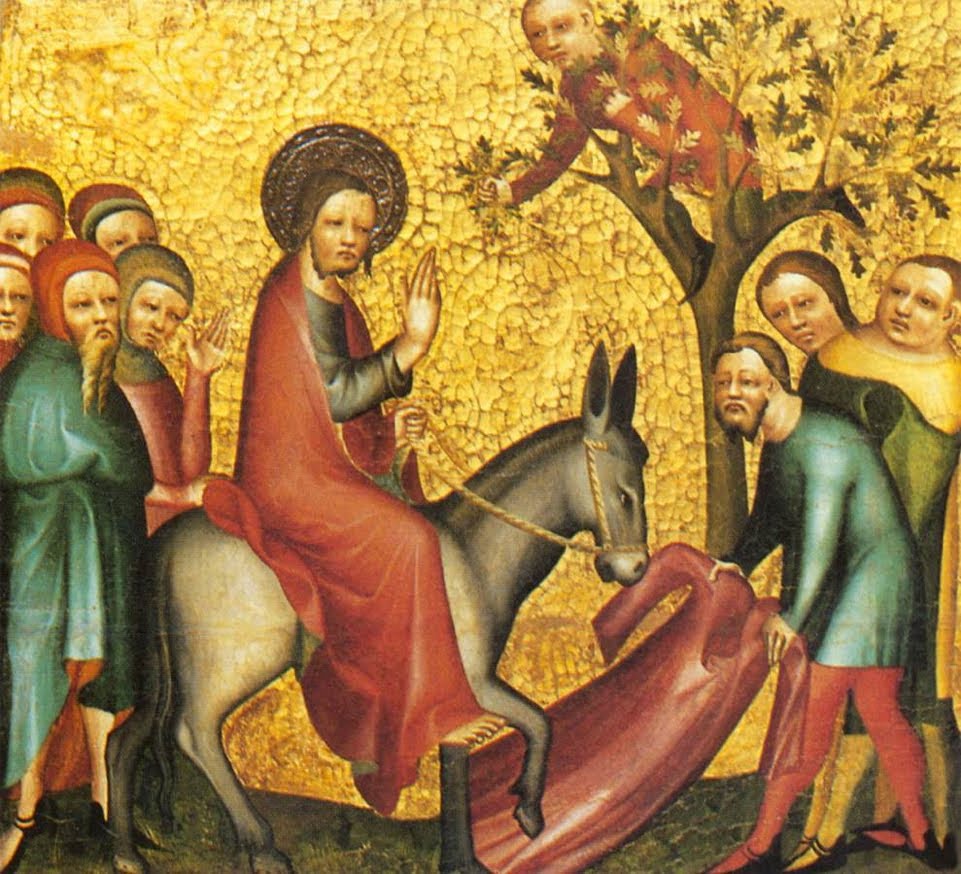
This week, some very learned clergypeople were having a facebook discussion, and they talked about the idea, the notion, that there were two crowds in holy week.  This was sermon Kryptonite.  This was a disaster for me.  It was a disaster, because I'd based not only my sermon for the week, but also my entire understanding of Palm Sunday on the idea that people turned on Jesus within a week.


The way I'd understood it was that the Palm Sunday story is about us.  It's about Christians, Christians who welcome Jesus into our hearts as he approaches in humility on the back of a donkey.  We who welcome Jesus in every week as a humble servant who comes towards us.  We welcome him in, and delight in his presence.  But Jesus has a nasty habit of not staying where we want him to stay.  He has a nasty habit of breaking out of the bounds we put him in.  If we want him around in our lives, he will intrude into every area, he will poke and prod around to make sure that our hearts are a fitting dwelling place for him.  And we don't want him to do that.  We want Jesus to stay in a small box where he can sit and not bother anyone.  We want a crucifix around our necks, or a cross on our walls, or a Bible on our shelves, but we don't want said Lord to actually interfere with anything too much.  It bothers us when Jesus begins to speak about specific issues that we'd rather he'd butt out of. It's sort of when Jesus goes from talking about how people should be nice to talking about how YOU should be nice.  Or the difference between talking about how charity is good, to talking about how YOU should be more charitable.  And this ends up being reasonably equivalent to Jesus being welcomed into the holy city by Jackie Chan.. You see, the people want him to be involved in some things, but not in everything.  They want him to be the leader, but a leader who does what he says.  But Jesus, being God incarnate, doesn't do that.  He interferes in everything, grabs a hold of every aspect of life, and points out the righteousness that probably isn't there.  That's why it's always a little suspect when you run into someone who says that they're a Christian, and that they love Jesus and all that, but don't really let him interfere too much in their lives.
the cheering crowds, and then following that up with kicking over the tables in the temple like he's

Most of us who welcome Jesus on a Sunday will end up resenting him by Friday.  He says so many difficult things, so many things that push us in a great many ways that we don't want to go.  And so the only solutions are to either ignore him, or seek his crucifixion.

And so that's the way that I have perpetually seen the Palm Sunday story, that we are in the crowd, who love Jesus and then who resent him.  I say this because I myself go through alternating times of loving and resenting my Lord, too.  It's real life for me.

But then the thought came up that there were two crowds.  One crowd who supported Jesus, and another crowd who despised him.  There were two crowds, and one of those crowds consistently supported Jesus.  As pastor Alex Klages told me on social media:


Palm Sunday is likely mostly Galilean pilgrims who, at about 6am on Friday morning, would likely all be a little sleepy still from the Passover feasting the previous night. The crowd on Good Friday was likely mostly hired guns of the chief priests/Sanhedrin crowd.

So there's the notion that the crowd on Palm Sunday was supportive, the crowd on Good Friday was not supportive, and that there wasn't necessarily overlap.  You can have crowds who are favourable to Jesus of Nazareth, and crowds who call for his death, and those might not be the same crowds.  And this was a huge revelation for me.  It was a huge revelation, because I honestly didn't understand the point of the story after that.  I didn't understand the point of the story if it was a crowd that was consistently supportive of Jesus, loving him all along.  And then my mind raced to the natural conclusion, which was to ask which crowd am I in?  Have I consistently supported Christ in everything he's ever said and done?

No.  No I have not.  I have not been universally supportive of Jesus of Nazareth.  I have not given him my best.  I have not called for his release, I have chosen Barabbaas.  I have turned my back on Jesus and fled.  And this fills me with trepidation, as I think about the distinct possibility, then, that I'm in the other camp, that I'm calling for his death.  I wonder if I can muster up sufficient will, sufficient love for Christ, to be in that crowd in which I can consistently shout loud hosannas.

But after all this obsessing, I realized something.  I realized something important.  I realized that I was missing the point.  I was missing the point in the same way so many people have before me.  I was spending so much time thinking about me in this story, that I hadn't actually considered Christ.

You see, this whole notion of there being one crowd, or two crowds, or five crowds, or ten crowds, it's really getting in the way of the most important thing, which is that there was one man, and one cross.  One Lord.  If you dwell on the crowds, as I had been doing, you'll miss the man in the middle of it, and he's the most important part.  What he does on Palm Sunday is to ride into town, to take up his cross and to die for the world.  To die for one crowd, two crowds, or as many crowds as there are.  He went to town to die for Pilate, Judas, Peter, Mary, Caiaphas, Stephen, Lazarus, Mary, Martha, and everyone else that there was or would ever be.  The sins of the world were laid upon his shoulders, and he carried them to the cross.

In that sense, though there may have been two crowds, there was only one crowd really.  And that crowd is all of humanity.  We are all in that one crowd.  And the death of Christ is for all of us.  And we all say the same thing about it.  Hosanna, meaning 'God save us' is the frequent refrain on Palm Sunday, and for good reason.  The people are calling out, begging for salvation.  And the refrain on Good Friday is 'crucify him!'  People seeking the death of Jesus.  Two crowds, but both saying the same thing, whether they realize it or not.  People call for salvation.  How is that salvation accomplished?  Through the crucifixion of Christ.

We can spend a lot of time wondering about the crowds, worrying about which of those crowds we are part of, worrying about which of the groups we are in, are we fickle or steadfast, waffling or noble.  Or, we can realize that however many crowds there were, there was one Lord who dies for those who love him, and those who hate him.  He dies for everyone, lays his life down for all the crowds who may or may not be there.  If you only greet those who greet you, what reward do you have?  Love your enemies and pray for those who persecute you.  The death that Jesus died, he died for all.  Sinners, righteous, those who think they're righteous, the crowd of supporters, the crowd of deniers, whether those were the same people or not.  He died for everyone.  And he died for you.


My difficulty with Palm Sunday was trying to work out where I fit in, what this story says about me.  Maybe it doesn't say anything about me.  Maybe it just talks about the suffering servant, his final trip to Jerusalem, and his death there for me.  And maybe that's what's important.

Tuesday, April 8, 2014

It stinks!

I mentioned this on Sunday, but have you ever had something go so bad in the fridge that you'd rather throw out the container than have to smell what's inside while you toss it in the garbage?  Sure you have.  If you haven't, then I welcome you to planet earth, where people that we call humans every once in a while forget about the meatloaf that they put into a tupperware container in the back of the fridge, and then promptly forgot about.


But if you are from this great planet, then you should know that this issue happens to literally 100% of fridge owners.  At some point, something will go bad, and you will face the most insane game of chicken of all time.  Everyone in the family can smell that something has gone absolutely rank - who is going to break first, and act to get rid of the stink?


All this talk of bad food should inevitably lead us to talk of Lazarus, Lazarus who had been dead in the tomb for four days.  And people back then, they weren't buried like people now.  These days, people go to a morgue, then they get embalmed, then they get pleasantly made up and dressed in a sharp suit, and it's all good.  But back then, well, remember the story of Jesus?  How they laid him in a tomb and didn't bury or cremate him?  This was an admittedly brief phase in burial practices, one in which people were laid to rest and were expected to decay over the course of a year.  So, obviously, Lazarus wasn't treated with anything to slow down the decay process, it was actually expected to speed up and accelerate.  What this means is that by the time he had been dead for four days, that decay process had begun.

Here's a fun experiment you can try at home.  Go to the market, buy a fish, a whole fish with the head still on, and leave it out on the counter at your home for four days.  Oh wait, on second thoughts, don't try that at all.  Don't try it because it would be a horribile experience for everyone.  As the fish rots, it will stink up the place something terrible.  I heard rumours when I was growing up of people who used to take a frozen carp to their safety deposit box in the bank, lock the carp in there, and then walk away.  And yes, as the fish first thawed, then decayed, it would stink up the whole bank.

For those of you keeping score at home, press play on this charming video to watch a baby pig decompose.  Trigger warning - maggots.

Knowing all this, bringing Lazarus back from the dead, it ain't as simple as just telling a corpse to get up and walk again.  That's zombie movie stuff, where reanimated corpses get up and stroll around.  And it's no good.  It's not real life at all, it's a pale shade of life.  But this is the resurrection of the dead found in Nikos Kazantzakis' book 'the last temptation of Christ.'  There, although Lazarus has been raised, he is still decaying.  Or to put it only slightly more recently, it's like that film 'death becomes her' starring Goldie Hawn and Meryl Streep.  You probably don't remember that movie because I believe that according to box office receipts, only three people saw it, and one of them was named Bruce Willis.  But in these movies, people die, then come back to life, but continue to decay.  This is an immense problem when it comes to resurrection, in that our thoughts are that the best we can hope for is to reanimate a corpse, like Frankenstein, the ladies from death beccomes her, or Lazarus from the Last Temptation of Christ.


But what this does is it plays into how we feel about the limits on the power of God in general.  We feel, as Martha did when it came time for Jesus to visit the tomb, that if Jesus had been there at the right time, then Lazarus would not have died, however he did, so, well, I guess we're done here then.  Also, when Jesus asks for the stone to be rolled away, Martha gives the very sensible response that he's not going to smell too good, as he has been rotting meat for four days.

But Jesus deals with this stuff.  Not with reanimating dead flesh like we're in some sort of late night zombie film, but in terms of unpicking the stitches of death.  Of going back, and reworking the body.  If you watched the time lapse decaying pig from earlier, you'd know that after four days, you can't just shock the pig with some electricity and have it walk around again.  The cells have begun to break down and fall apart.  They're broken.  The body looks like a body, sure, but it is decaying rapidly from the inside out.  The soft tissues, the organs they're turning to mush.  Without the electricity and oxygen from the body's processes, the organs that make up the viscera, they just turn to goo.  And this is what Jesus was dealing with as far as the work he came to do.

It wasn't just reanimating Lazarus, it was unworking death.  It was unwinding the coils that held him in the tomb.  It was undoing decay, reversing the goo-making rot that was bloating the corpse.  In other words, Jesus was unpicking the stitches that death had made in Lazarus' body, in order that he might sew a new garment.

Now, we believe that Jesus will do this on the last day for us, too.  We believe that he will raise us up on the last day, that what is sown perishable will be raised imperishable, we believe this.  But we also believe that there is work to be done in the here and now.  The book of Colossians tells us that while we were dead in our trespasses, Christ died for us.  And what we typically take this to mean is that while we were asleep in our trespasses, asleep in our sins, Jesus died for us.  But it's deeper than that - things that die are changed.  They are chemically different.  They go through changes that make them unable to just decide to get up and walk.  They go through changes that twist them and break them and turn them into something completely different.

We are dead in our trespasses.  It was while we were dead in our trespasses that Christ died for us.  And forgiving sin is more than just condoning it, or pretending it doesn't matter.  Forgiving sin as big a deal as raising the dead, really.  This is why the religious authorities of the time were so bent out of shape when Jesus claimed to forgive sins, because it isn't as simple as saying 'it's no big deal' or 'don't worry about it.'  It's a matter of changing us, unpicking the stitches, of reversing the decay, getting rid of the rot.  It's that big a deal.  It's winding back the clock, drilling out the decay, cutting out the cancer, reversing the death that infects and awaits us all.  It's that big of a deal.

You who are dead in your trespasses, you are as busted as Lazarus.  You bring as little to the table as he does.  You bring nothing to that particular table.  And your sin stinks.  You're dead and rotting in your trespasses, and stinking to high heaven. If you're like me, when it comes time to discuss your sin, and Jesus says to you 'roll the stone away,' you reply 'Lord, no.  There will be an odor.'

Yes.  Yes there will be an odor.  There will be an odor because of the stink of your sin and death.  But if you leave the stone over the tomb, if you don't let Jesus in becasue you're embarrassed, because you think it's too late to deal with it, if you leave the stone in front of the tomb because you don't want Jesus to see or smell or deal with how rotten you actually are, then that's that.  But if you allow that stone to be rolled away, then Jesus will call with a loud voice 'come out.'  He will forgive sins, he will grant you peace and life, and he will roll back the clock and undo all the decay that you thought was permanent.  The death of Lazarus, thanks to the work of Christ, was reversed.  And Christ himself was too good for death to hold!  And because of his goodness, because of his merits, because of who he is, death has lost its sting.  For the sting of death is sin.  If Christ has triumphed over sin and death, if he can rewind decay, if he can undo decay and death with Lazarus, if he can unwind death and sin at that time, he can do it for us. The passion of Jesus is all about this, all about taking the sting, the stink, the weight of death away, undoing sin, reworking death, unwinding rot, and giving us new life.