The musings of the Pastor from Good Shepherd Lutheran Church, Regina SK

Welcome. If you're a member at Good Shepherd, welcome to more thoughts and discussion of the week that was, and some bonus thoughts throughout the week. If you're not a member, welcome, and enjoy your stay. We are happy that you're here.

If you like what you see here, consider joining us for worship at Good Shepherd Lutheran Church. Sunday mornings, at 8:30 and 11:00. You can also follow us on Facebook.

Tuesday, July 18, 2017

Sow what?

On Sunday, we had the parable of the sower.

It's a great parable, a classic even, and one that gets better the more you think about it.

For in this parable, you will find the best explanation for why the word of God, even when preached in its fullness, doesn't always find a good harbor, and a healthy space for growth.  For us in the church, it seems so obvious, that the word of God is lively, active, it is what divides bones from marrow, it is sharper than any two-edged sword, it's the bees' knees, all that.  But hang on, you say.  If the word of God is so great, then why isn't everyone a Christian?  If it's so obvious that it's the way, the truth and the life, then why is there any opposition at all?  Should not the entire world be faithful, loving, bible-believing Christians?


Well, certain things that are obvious to you may be complete mysteries to others.  One man's junk is another man's treasure, one man's completely obvious is another man's obscure, that kind of thing.  And ultimately, common sense is relatively uncommon.  So things that should be clear end up being kind of not.  And God's word, and the application thereof, is just one of those things.  If you're in the church, then it seems obvious to you that this is all good stuff, that we are sinners, that Jesus forgives those sins and grants life everlasting, that kind of thing.  But if you're not in the church, then these things will seem laughable, or foreign, or silly, or perhaps you're one of those people who will say 'I wish I could believe, but I just can't.'

If you're in the church, if you're a baptized, redeemed child of God, then you're fertile soil for that word of God to grow.  If you're in the church, you're fertile soil, and a place where the word of God can, will and does grow.  But if you're not, then something is keeping you from being there.  What will those things be? Jesus helpfully explains.  Perhaps you're a path, where the ground has been compacted down.  You're a path where the birds can swoop down and pluck the seed up before they've had a chance  to take root.  Perhaps you're rocky ground, where the seed falls on the ground, and you're overjoyed, but you do too much too fast, you try to flower when you should be laying down roots, and all of a sudden, the lack of roots scorches you out, and your faith withers away.  Or perhaps you are amongst thorns and thistles, weeds who take all your sunlight and water from you.  Sure, you want to grow, you may be keen to do so, but the weeds crowd you out, the cares of this world, the pursuit of wealth, all sorts of things get in the way, and you don't quite get around to it.  Your enthusiasm all gets misdirected, all goes in the wrong place, all gets sucked up by everything else, all those other cares, and leaves your faith choked out.


There's a good chance that if you're reading this, and you don't have faith in Christ, that you fall into one of those categories, which is both possible, as well as likely.  And for you, that's some bad news.  But if you're a Christian person, if you have faith in Christ, saving faith, if you believe in Jesus as your savior, the one who came to take away the sin of the world, then you don't have those problems.  You just have a completely different set of problems.  That is, you have to go out and sow the seed in these conditions.  You have to go, sow the seed, spread the word of God on what would appear to be non-fertile soil.

That's less of a thrill for the individual Christian.  Because, of course, what we want to do is to simply scatter the seed where we know it is going to work.  We are less farmers in this capacity, and more gardeners.  That is, we want to plant where the harvest will grow up with almost perfect certainty.  We want to plant a garden in fertile soil, and if you're a hobby gardener, you're not going to waste a whole lot of time forcing the ground around you into working for you.  You're going to do what we all do, which is to have a raised bed, or a garden in the back or front of your house, and garden in that.  There may be rocks, there may be thistles, there may be all kinds of things on the rest of your property, but as long as your garden is fine, then the soil can be clay, or mud or sand or pea gravel, and it won't matter, because you can grow what you want to grow.  But the sower went out to sow seeds, and in doing so, scattered them both where they were likely to grow and where they were not.  Because the sower knows something that you and I seem to have forgotten, which is that the job of the sower is not to plant things where we assume things will grow, but rather to turn the soil where the seed is scattered into fertile soil.


Think of the command that Adam and Eve were given in the holy scriptures by God, that they should be fruitful and multiply, to have dominion over the earth and subdue it.  We have been tasked with something special, something that we tend to forget, which is to subdue the earth, to work on the soil that is out there by preparing it for the seed.  We tend not to, though.  We tend to plant only where we think things are certain to grow.  We tend to not bother planting among thorns, we tend to assume that birds will always plague the path, and we tend to think that the rocky soil will always be shallow and no good for planting.

In other words, we tend to think of a resistance to God's word, a turning one's back on God's word, as the last stop on the railroad.  But it isn't.

Your job is to scatter the seed, to sow it, and to also prepare the soil to receive it ,as you would with any other field.  Think of the situation that you may find in any field across this great nation of ours.  What would have happened to us if the people who were setting up farms would have looked at the fields, and would have said 'oh.  It looks like birds have taken away the seeds I tried to plant.  Ah well, guess we're heading back to the Netherlands then.'  Not likely.  You know what happened, and why the pioneers were such a big deal.  They were a big deal because they took the land that was at their feet, and wrestled it into shape, into doing what they wanted it to do.  They took the land, and pushed and pulled it, grappled with it, sweat and bled into it, until it produced what they wanted it to produce.  When encountering rocks, they didn't just plow around them, they picked the rocks out so the soil could be fertile.  When they found that the birds were there to swoop down and steal the seeds, they had to chase them away.  When there were thorns and briers, they had to uproot them, and make the soil clear to plant seeds that might grow to fullness.  They took the soil and made it do what they wanted it to do.

This is our task, too.  This is our task, to make the soil out there into something that might produce the harvest that we've been sent out to plant.  It's no good for you as a Christian to shrug your shoulders and assume that just because ground is rocky, or has birds in the air, or is thorny that it cannot bear fruit.  We assume that as soon as something stands in our way, that it cannot go back, and it can never go back.  We assume that any incursion by thorns into our flower patch is a forever problem that will never go back to being fruitful.  But you know what?  We're wrong.  And we've been wrong for a long time.  And it's time to shake off that paralysis, to stop being quite so moribund, and to face the fact that the seed that we are planting is powerful and effective, that it causes springs to appear in the desert, causes the desert to bloom, it can make fertile ground, and to make it produce abundantly.  This is good news, but this means that we are going into the world with something that can produce, something that can make a difference in the lives of people, and seed, being what it is, if planted and growing, makes more seeds.  Scatter it on the path, all it needs is a crack.  Scatter it among the rocks?  Pick the rocks, and move them aside.  Scatter it among the thorns, uproot the thorns, and have people see that the word that you are bringing them is something that they may be interested in following up on. What would people do if they saw birds eating the seed that they'd scattered? Do you think they'd just give up, stop planting? Or do you think they'd go through the effort of chasing those birds away?  What would you do?

Scatter the word.  Spread the seed. And don't do the thing that you might think you should do, which is to only scatter the seed where you think it would take root.  Don't only approach people to be Sunday School teachers who have already done it.  Don't only share the word with people who already know it and live it.  Don't find elders or pastors out of those who have already been down that road, or who are guarantees.  Spread the word, the seed, plant it and water it, let God provide the increase as he does.  For he is the one with the powerful and effective word, the seed which can and will and does reclaim the path, breaks the concrete from underneath.  The weeds can only choke out the weak plants, but if the plants are healthy, vigorous, growing well, then they can crowd out the weeds, that's the point. For evangelism isn't the end goal here, salvation is.  Salvation of God's people, for people to realize that the word of God is powerful and effective, that it is there that forgiveness of sins is to be found, and righteousness is to be given.  And that is wonderful, good news, life changing news, news of eternal consequence, and it carries something else with it as well.

For it carries with it something equally incredible.  For there's a way plants work that we sort of forget, too.  A way plants work that has made them incredibly important for us as humans who seek to use them for our benefit.  That is, unlike almost everything else, they're self-replicating.  Each plant carries with it the seed for many many other plants.  They replicate like crazy, and if you want proof of that, then go outside in cotton fluff season, or hang out in the autumn under your crabapple tree.  Take a few moments to walk past your raspberry patch, where you only planted one plant, but now you have a million.  The ability of plants to bring forth more seeds cannot nor should not be understated.  For the issue here, is that when salvation is proclaimed ,when the seed has been sown and the plant begins to grow, it bears seed on its own.  This is part of the struggle, and part of the glory.  That we see in the field the ability of the grain to bring forth more plants, it produces grain which is both seed and food.  


Maybe, just maybe, Jesus knew exactly what he was talking about, and still knows what he's doing.  Bear this responsibility carefully, and realize that the word that you are called to spread, called to share, called to distribute, is powerful, saving, effective and life-changing, that it can shatter through the limitations we place on it, all the more so if we do the work of prepping the soil first.  We plant, we water, and God provides the increase.  

Friday, June 30, 2017

servitude

You know the stories about pet alligators, right? You all heard the same things that I did, where families would get a tiny baby crocodile, and it would do what crocs do, which is to get bigger as they fed it, and then, after a while, it would get too big for the family to handle.  So, they'd flush it, but after doing so, the croc would grow to massive size in the sewer.  This, of course, is bad for essentially everyone. 

Now, that idea of a baby croc, small enough to handle, small enough to tame, is a great illustration for what it is to have a pet sin that any of us may have. For we do have a pet sin, each of us does.  And you, likely, know what your pet sin is, don't you? You know what it is as much as I know what mine is. Perhaps it's drinking.  Maybe it's gossip.  Maybe it's pornography, or cheating, flirting with people who aren't your spouse.  Maybe it's your pride, your desire to be the best in the room no matter what.  Whatever your pet sin is, though, we all have something in common with them, and that is that the sins that we have start small, and then we encourage them to get bigger.

It's like getting a puppy for your kids.  Let's say you get a golden retriever for your child, your three year old girl.  Now, when the puppy is a puppy, like a really little puppy, your daughter can take her for a walk.  No trouble there so far.  But, as the puppy and the girl both eat, sleep, and get older, one will grow faster than the other.  What that means is that you could count on your daughter when she was three and the dog was a puppy to direct and guide that dog where it should go.  She can control that dog.  But a two year old dog and a five year old girl?  Different story altogether.  In that arrangement, with that leash, the girl will end up going where the dog wants to go, not the other way around.  And if that girl and that dog are both tied together, then woe to her when the dog wants to run away. 

Now, friends, your pet sins are just like that.  Your pet sins being the things that you are for sure for sure that you can control.  One more drink, one more link clicked, one more juicy gossipy story shared.  One more mp3 stolen, one more drink with your married co-worker.  One night spent with a girl you don't even like that much, but it beats being alone, right? One more fight with your spouse. One more comment with your girlfriends bashing your spouse.  You know, our pet sins.  The ones we think we can control.  And like with anything else, these little sins, these pet sins, we feed them time to time.  And when we feed them, they grow.  And pretty soon, as we feed them, they get bigger than us.  All of a sudden, that thing, that sin you thought was your pet, it pulls you around.  How on earth are you going to compete with that especially when you keep on feeding it.  It's a nightmare scenario, in which you feel as though you are being pulled around by your sins, almost compelled to keep on committing them, even though you hate yourself as you do them.  Paul talked a lot about this, but most prominently where he said of himself that the good he wants to do is what he avoids, and the evil he wants to avoid is what he does!  That's him, and that's the rest of us too.  That sin that you fed for years and years and years, the thing that you were sure you could control, that you enjoyed because you were in charge and fed it bit by bit, it's a monster now, and now it's in charge.

They say that the first sign that you're addicted is when you can tell that you no longer enjoy feeding the addiction.  The first sign that you're hooked is that you aren't having fun when you're doing those things anymore.  If you're pulled to more and more extreme pornography, you're probably not enjoying it anymore.  The thrill is gone.  You're just feeding the monster.  If you're an alcoholic, you don't actually enjoy drinking anymore, it's just to get you to the point of feeling normal.  You know that this is the case.  And if you're addicted to sin, if you're enslaved to it, if sin that you thought you could feed is in charge, then you're stuck feeding it over and over again.  And that's a problem for you.  And this is what Jesus meant when he said that everyone who sins is a slave to sin. He's right, you know; when you sin, it gets to be in charge, and you don't get to decide what you serve anymore.  You serve your sins, and you chose your masters, shackling them to you, and ensuring that you would not and could not let go. 


None of us wants to feel as though we are in servitude to anyone.  None of us wants to feel as though we are in servitude to anyone or anything, we want to feel as though we have agency, and can do what we want.  But you will find a master for yourself to serve, you really will. If you will not follow the edicts of Jesus Christ, you will find a master somewhere out of something.  You will make it for yourself, you will choose who you serve, and you will serve that master.  But nobody can serve two of them.  And this is where Christ comes in.


Jesus knows our plight.  He knows that we are in a situation in which we have lashed ourselves to certain sins, that we are fascinated and interested in serving masters that we think we can control, and so we do.  And he knows that if he were to free us from one of those, we would instantly replace it with another one.  This is who we are and what we do, every single time.  So Christ, in his wisdom, decided to do something that would circumnavigate all this trouble - he lashed himself to you.  If you read through the Old Testament reading from Sunday, when Jeremiah discusses his relationship with God, he refers to God as stronger than himself, as a dread warrior, which is phenomenal, fantastic, and worth remembering for any of us who are struggling with sin.  For as we struggle with sin, it feels as though we have a monster that we are feeding pulling us down.  We feel as though there is a millstone around our necks dragging us down.  But that's not the entire story here.  In the Christian faith, as opposed to all others, it's not the story of what you need to do for God, it's the story of what God has done for you.  For any of you feeling dragged down, burdened, cumbered with a load of care, remember your baptism, and in your baptism, something amazing happened.  You had the presence of Christ in your lives who lashed himself to you.  In the same way as you chained yourself to your pet sins, Christ chained himself to you, he lashed himself to you in your baptism, and he is prepared to do the work necessary for your salvation. 

It's all about who is stronger, you know.  It's all about who is stronger, who is a dread warrior, who can drag whom.  If you're lashed to things, one of your volition, one of God's, then you'd better hope that God is stronger than you, and you'd better hope that he can drag you to heaven.  Which he does.  This is exactly the work of Christ, to drag humans towards salvation if necessary, to pull them along, though they may fight, though they may kick and scream, though they desperately want to lash themselves to other thing in the way, but Christ will continue to pull us towards salvation, towards heaven.  If left to your own devices, you will make destructive choices, harmful choice, because you feel as though you can be in control.  And as you tie yourself to your sins, as you put a leash on them, you tend to feel as though you can and will always be in control.  And as your sins get bigger, the thing you tied yourself to is now in control.  It is bigger than you, stronger than you, and is pulling you, pulling you down.  But Christ is stronger.  He is stronger than you, he has battled and has prevailed.  Your baptism is the pure and certain proof of that, where Jesus tied himself to you, and is pulling you towards the salvation he has earned for you.  You're never going to find yourself getting your story straight 100%, you're never going to find yourself serving righteousness of your own free will.  What you will find is that Christ will pull you, he will drag you towards what is good for you, towards salvation, towards heaven.  That's the bond that counts: not the ones you make for yourself, but the ones he makes for you.

Monday, June 12, 2017

Trinity

Everything in the creation account is true.

This simple, relatively orthodox statement is controversial these days, as it is usually to be found when Christian teaching deviates from cultural safeties.  It always strikes me as strange that the church is frequently chastised for marching too closely in lock-step with the cultural and social norms of the past, and yet is castigated for being counter-cultural today.  You would think that if the church was expected to hold permanent truths no matter what happened elsewhere, then the church would always be at odds with the culture.  But the culture constantly requests, nay demands, that the church march in lockstep with it, and then hates it when it does.  There's a lesson to be learned somewhere in here.

Point being, that back in the day, the Christian church held to the view that the world was created in six days by the Lord our God, and that he looked at it and saw that it was good.  Fine fine fine, and the culture outside was there as well.  Everybody saw that it was fine, nobody really had too much of a problem with things, and the world proceeded as it was intended to.  But things changed, they developed, and the world that was content to have a six day creation no longer found that to be sufficient. They had looked into things, dated the world by stars and glaciers, had checked fossils and tree rings, and had determined beyond a shadow of a doubt that the world certainly didn't take six days to make.  That can be argued.  What can't be argued is what happened next.


For we, the clumps of atoms and stardust that we are, made of dirt and with the breath of life in our nostrils, we need to know something about ourselves from the story of creation.  When God makes everything, and places us as the crown of creation, the most important aspect of it, the shining star and glittering symbol at the top, he breathed into our nostrils the breath of life, told us to have dominion over the earth and to subdue it.  He told us not to sin, and then we sinned.  And that's what you need to know about the origin story. 

I'll put it another way.  They're bringing back the Universal monster movies for reasons that I can't quite identify, and the old Universal monster movies worked for a good reason, and have continued to be worthwhile for the same reasons.  Setup and payoff.  Of course, when looked at from the outside, without suspending disbelief, then the story collapses right away.  Naturally, vampires don't exist.  We all get that, of course.  But if you accept as the subject matter of the film that there are vampires, that drink blood and die upon exposure to sunlight, well, then you would expect the vampire in the film to fall in line with that.  If the setup is given that vampires die on exposure to sunlight, and they drink blood, and then for the rest of the film the vampire just wanders around during the day, drinking sodas, then you would find the film to be ultimately unsatisfying.  He's not a vampire if he doesn't fit with the setup, and if he does, then he is. 

Now, as human beings, indeed, as all of creation, we have a setup in the Old Testament.  We have a setup there, where it tells us that God made everything, he created the universe out of nothing, made it, formed it, fashioned it, spoke everything into being, and finally made us as the apex of creation.  We were created in a world that God looked at and saw was good.  And we were placed in creation, told to tend it and take care of it.  And then we fell, we fell and all creation with us.  And after that, the world became a dangerous frightening place, and we were going to have to work to make it work for us.

That seems to fit, doesn't it?  We keep on forgetting, as we do, that the creation account is true, and uncomfortably true.  And when we toss it out, assuming that we are now too smart for it, we have advanced too far, and now no longer need it, well then, we are going to find ourselves missing the most important point.  And that point, clearly, is who we are, and why we are here.  And that is a moment that is hard to figure out, really, and for some reason we miss that more than we miss anything else.  Oh sure, we can get to how we arrived at this point through the scientific method, but the world has continued to clamor for meaning even though science has progressed.  We keep asking ourselves who we are, and what it is we're all about.

Understanding that we are people, made to be good, tasked with having oversight over all of creation, and that we fell from grace, that's not only important to know, but that setup explains almost everything else that we see around us.  We think we're pretty well okay, but keep on getting into trouble.  We think that the world is improving, but people are still petty, bitter and dangerous.  We feel like things should be better than they are, and we are surprised that they aren't.  Though we shouldn't be.  The creation account has already set that up for us.  People were created good, fell from grace, and became sinful people, passing sin down from parents to children this entire time.  There is no substitute for this, for understanding this element of the human condition that makes everything else make sense.  Everything you see around you is the payoff for this setup.

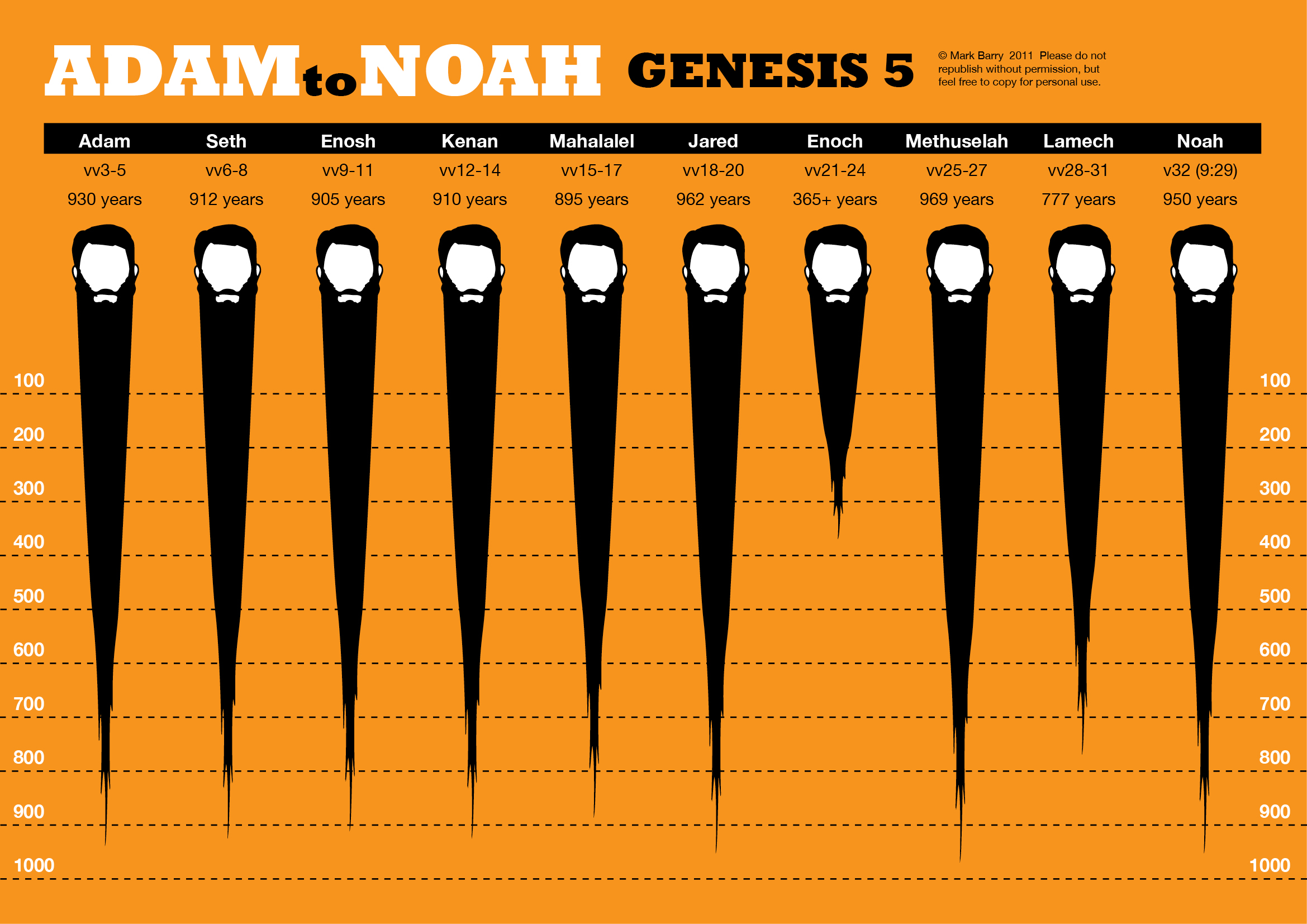
Now, the thing is, the creation account tells us what we need to know about the human condition and the human situation.  But what it doesn't do, of course, is to go into great detail about what it is that God did to create everything.  It tells us that he told the earth to bring forth plants, but the scriptures don't tell us exactly how that happened, nor what it looked like.  And for good reason.  Are you looking into the scriptures to find a blow by blow of names and dates and facts and figures?  No, of course you're not.  And do you know how I know?  Because you know certain Biblical stories pretty well, don't you.  You know the Biblical account of creation, of Cain and Abel. You know the story of the flood, and Noah with the Ark.  But do you know what happens between those two things?  Let me share Genesis 5 with you.


Did you read all that?  I bet you didn't.  I will wager that you skimmed that at best, even if you did click the link . I would wager that if you looked at that link, you rolled your eyes, and decided not to read it too terribly deeply.  Funny, isn't it? The part of Genesis that does what you say you want, tells you names and dates and numbers, and you skip it to 'get to the good parts.'  The good parts like what it means to be human.

Now,  the massive numbers of humans stacked up here are what we skip over, and as you know, it comes up a couple of times.  The begats, the numbers, the bits you skip.  But these parts are incredibly important, because they tell you who you are.  For it isn't just this part in Genesis that tells you who all the generations of people were all the way up to Noah.  Instead, you get this in the New Testament as well.  And in the New Testament, it traces the ancestry, the family tree of Jesus all the way back to Adam.  The parts that you skip tell you something really important about not jus who you are, but who Jesus is.  And Jesus' family tree goes all the way back to the beginning, back to Adam, back to the garden.  This is the family that Jesus came to save.

Remember how I said that the setup leads to they payoff? Well, this is it.  If the setup is that we were created, that the garden was made when God created everything, that we were formed as good and then fell, and that tells us what we need to know about who we are and what we're all about.  And then in the New Testament, when it tells us about the work of Christ, it tells us that he took on flesh and dwelt among us.  He took on flesh to bear our sin and be our savior.  He took on flesh, and was the flesh of a very particular family.  Your family.  If Christ goes all the way back to Adam, if the savior of the world goes back to one particular family, it's worth noting that he died to save that family, and that it's your family.

Have a hard time believing all this?  This is where the third part of the trinity kicks in.  We were made by God in his image, then fell from grace.  And we were redeemed through the work of Christ, who took on flesh in your family to redeem your flesh and your bloodline.  And if this is tough, that's why we have the third part of the trinity.  That's why we have the third part of the trinity, the Holy Spirit who gives us faith, sanctifies us and makes us holy.  All of us have trouble believing all of these things, as we do with any hard concepts.  But this is where you get to trust in God, and lean not on your own understanding.  This is where you get to say to Christ 'Lord, I believe, help thou my unbelief.'  And this is where through your baptism, through the scriptures, through communion, and through the preaching of God's word, faith is created, sustained and restored in the Holy Spirit.  The person of God who knows that we are weak in our faith, and will need to be sustained in our belief. And because he knows this, he's not going to give us truth, and then just count on us to figure it out and to get with it.  Rather, he is going to give us truth, and then work through word and sacrament to increase our faith that we may find comfort, solace and strength in that truth, that our faith may increase and our trust in God who creates, redeems and sanctifies may increase.

And that's what Trinity Sunday is all about.  Now go say the Athanasian Creed.

Thursday, May 18, 2017

Mother's day

We have a problem in God's holy church.

Okay, we have several problems in the church, but there's one I'm thinking about specifically today.  That problem is the problem, the difficulty of living in the world, but not being of it.

At no time is this more pronounced than at the moment of a worship service on Mother's day.  For mother's day, as you may know, is not only a secular observance (which it is), but is also always on a Sunday.  And in case you weren't paying attention, the readings that we have in our lectionary don't have much to do with Mothers.  In fact, this Sunday, the reading from Acts was all about the stoning of Stephen, the first Christian martyr.  Not really one of those coddly mother's day readings.

Now, that's the eternal struggle, isn't it?  The eternal struggle that says of us as Christian people that we are looking towards Christ, that he is the be all and end all, but then we find ourselves in a situation in which we look to the culture to tell us what is important.  What is important on Sunday?  Moms!  What's the pastor going to speak about on Sunday?  Well, either not moms, or moms if he changes the readings.  That's about it.

The Gospel reading isn't about moms though.  The Gospel reading was cryptic instead, and featured a line from Jesus that ought to make us at least a little bit uncomfortable.  For we as Christians are used to the idea of Jesus as the greatest man who has ever lived, the only person to ever be perfect, flawless, the only person who has ever fulfilled the law, who has ever consistently done what is right and good, who has ever done what is right 100% of the time.  That's Jesus for sure.  And the rest of us, well, we can't even compete with that, can we? None of the rest of us can hang with that kind of history.  The best we can do is to do what Paul does, which is to repent, because the good we want to do is what we avoid, and the evil that we want to avoid is what we end up doing!  And yet, Jesus says something in the Gospel reading from Sunday, where he says that those of us who believe in his name will do greater works than him.

Could this be true?  This seems like a bit of a problem for us, given that Jesus is top dog who saved all of creation through the redemptive power of his death on the cross.  He raised the dead, healed the sick, restored sight to the blind and hearing to the deaf, he did all these things, was right all the time, and still told us that we were going to do greater works than him.  Possible how?

Well, what does greater mean?  For those of you who were wondering how this would be possible, think on this:  The greek word  μέγας is great, of course, but means literally 'Any extension in space and in all directions.'  Now that's interesting.  For it means that we are able to do a larger work than Jesus, not a better one.  What could this larger work be, in terms of size and scope?  You've noticed by now that there was a Greek word earlier in this paragraph, and it is there because the New Testament was written in Greek.  Why was it written in Greek if that wasn't the language of the speakers who were transcribing it?  Because it was the language of the intended audience.  There is a moment in the Gospels where some Greeks come to see Jesus, and as soon as they do, instead of holding court with them, Jesus begins his journey towards his death.  He is set to die at that point, and does not go and minister to the Greeks.  His mission is, as he has said, to the lost sheep of the house of Israel, and as soon as the opportunity arises to minister to those outside the house of Israel, outside of the community, the gentiles, he goes to his death.  Because Jesus knew something important that we have all assumed.

While he is still here on earth, the faith he is here to create cannot be a global one for all people.

We've all heard it, of course, which is that the stereotypical picture of Jesus that hangs in a great many churches doesn't look like what the real Jesus would have looked like.  No kidding.  


So that's not what the actual man in Israel would have looked like?  I had no idea.  Well, of course he wouldn't have looked like that (likely).  He also wouldn't have been speaking English.  Why do we have the Bible in English if Jesus wasn't speaking English? Because that's the language of the intended audience.  Why do we have Jesus looking white in this picture that hangs in North American churches? Because that's what the majority of parishoners look like.  And the average suburban church in North American doesn't have a monopoly on this, you know.  Consider the following images, all of Jesus.


How many of these pictures are authentic to what Jesus would have actually looked like?  Well, none, I would expect.  But that's sort of the point.  We obviously want the Bible to be in the languages of Africa, and Asia, and North America, and viewing Jesus as the same race as you, as the same culture as you, as your personal Lord and Savior, that's exactly what that is.  He wouldn't have been speaking English, but we translated his word so it means something to us.  He wouldn't have been a white guy, but in our art, to be our savior, he appears thus, the word made flesh has been translated for this audience, without losing the message.  That's a greater work.  Jesus, being middle eastern, being Jewish, was only ever going to reach the Hebrew people of the middle east, he said as much himself.  But if he dies, if he rises, and if he ascends, then the Gospel becomes not about the middle east, not about Israel and Palestine, not about light vs dark, but becomes about the Word of God made flesh, dwelling amongst us. 

This is a bigger issue than you think it is, and it's the greater work that Jesus would have us do, as people who believe in him. We are called to be great commission people, and we honestly don't really realize how big of a job that is.  For we, as great commission people, are called upon to do the work of evangelizing the world, and it frequently happens one person at a time.  Sure, you have moments like you do in the book of Acts, where three thousand came to faith in one day, but you also have moments like that in Timothy, where we hear about Timothy's faith that was passed on to him through his mother and grandmother.  And that second one is usually where the heavy lifting of evangelism actually takes place.  For it's one thing if you're trying to evangelize a world, a disbelieving world, to bring them into the fold of your faith, but it's quite another to bring those who are of your family into your faith.  And if you're one particular type of evangelist, then you evangelize harder than anyone else, because you have so much to lose.

If you're doing door-knocking evangelism, then the people that you meet, who are all presumably nice people, well, if you don't know them then if they reject your message then it doesn't mean that much to you. You tried, you failed, and you move on.  If those random strangers reject paradise, well, it just doesn't make that much of a difference to you.  But if you are a mother, and you are rabidly, dangerously protective of your child, if you gave birth to that child, and if you are living for that child, to give it life and health and strength, if that child's tiny hands and shell like ears dominate your thoughts, if you would pour your life into that child an hour at a time, if you want them to have everything you could never have, to live better than you do, then you'd do something really important for them.

You'd want them to live forever.

It's usually our mothers, our grandmothers who bring us to baptism in God's house, and more than that, it's our mothers and grandmothers who tend to do the hard work of evangelism, not just getting us 'done,' but also bringing us to the services at God's house, leading us in prayer in the home, praying with us and for us, insisting that we say grace, helping us to read the scriptures, encouraging us in confirmation, and so on.  In other words, fulfilling the words of the great commission, to not only baptize, but to teach us to obey everything Christ has commanded us.  And that's the greater work.  The kind that Christ, by definition could not do, because he cannot and never will be called into that vocation as a mother.  It's a greater work in the sense of it being a bigger, a larger work, not a better one.  Obviously, we cannot do better work than Jesus Christ of Nazareth, who saved the world, but we can be part of a larger work.  Instead of bringing the gospel to 12 men in Israel, we can take it to the ends of the earth.  Instead of bringing it to Jerusalem and then to all of Judea, we can bring it to everyone.  And instead of going door to door with the message of Christ for a moment, we can go into our own doors, and build the body of Christ in that place, person by person.  And that, if it goes to the end of the earth, is a greater work.

Tuesday, May 2, 2017

Church growth and the liturgy

Church growth is a nebulous topic, primarily because there are so many opinions on how it should be done.  For you see, when you get a group of people together to talk about church growth, most of them will end up talking about what it is that they need, what it is that they are looking for, and what it is that brought them to the church and sustains them in it.  And that's no surprise there, because one of the great and abiding mysteries of human nature is that we don't have any real idea how to think like someone else.  That's why ads directed at teenagers always seem so lame and stilted, that's why marketing towards the kids these days always seems as though it was written by a corporate hack, because it was. And 40 plus year old guys can't think like teenagers.  It doesn't work.

So when you get together a whole bunch of well meaning evangelists together to talk about church growth, how to get people in the doors, it all ends up collapsing pretty quickly because you have two things going on at the exact same time.

Thing 1 - You are getting information and ideas from people who are already in the church, and
Thing 2 - You're getting zero input from the people you're trying to reach, because they're as of yet unreached.  And you're not likely to get information from them until they're already in the door and have signed on.


So what to do? It's a really good, really important question that can't be overstated.  You can't get input from people unless they tell you, and the only feedback you'll ever get is that you guessed wrong.

Now, we who are in the church, who want to share the message of meaning, of dignity, of purpose and of salvation that Jesus Christ brings, it's complicated to bring that to people whom we don't know, and who aren't giving us any clues.  And in that case, how on earth are we supposed to figure out what they need? How on earth are we supposed to work out what it is that the kids of today are into, given that they're not telling us, and they just roll their eyes when we talk?

Well, fortunately enough, we have been given a great gift in the scriptures, something that we don't often talk about, and really only in this period following Easter, and that is the book of the Acts of the Apostles.  The book of Acts tells you what the disciples were doing, and what they were doing to attract people to faith in Christ worked.  The book of Acts, chapter two tells us that

All the believers devoted themselves to the apostles' teaching, and to fellowship
and to sharing in meals (including the Lord's Supper) and to prayer.  

Okay, that seems a little simplistic, doesn't it? Meet together, share meals, share the Lord's Supper, dedicate yourselves to the apostles' teaching and figure it out from there.  Simple enough.  Prayer, worship together, fellowship.  That's too simple.  What about a ten step program for teens? What about a fifteen point evangelism program? What about any of these things?

I'll be the first to admit that I don't know much about "church growth," but what I do know is that the book of Acts tells us how the early church operated, and they seemed to grow okay.  And if they grew okay in those days, without easy communication, with the church being under fire and threatened with calamity at any second, if that's the case there, then who am I to disagree? 


It comes down to a tale of two things, classic vs modern.  Look at these two buildings for a second.


These are both buildings from the University of Regina, one classic, the other contemporary.  But the problem with contemporary, is that it is dated.  And it is dated instantly.  Because things that are contemporary are by nature of a time, then usually, as far as buildings go, by the time they're finished being built, they're out of style.  It's inescapable, which is why so many modern buildings end up looking far more out of date than far older buildings that may be surrounding them.  Not because those older buildings are more timely, quite the opposite.  They exist out of time, and external to pressures of change in fashion.  Again, take these two cars.


One is classic, the other is dated.  I'm not telling you which one is nicer, you're free to like either, obviously, but hopefully you see that one has transcended time, and the other has not.  By trying to capture the moment, once the moment is passed, the item becomes dated.  And that leads us back to evangelism, and back to Acts.  Back to how the disciples grew the church.  Through prayer, through dedicated to the teaching of the apostles, through the Lord's supper and worship.  Through fellowship.  Those are all key details that you need to consider, and you also need to consider one more. One more powerful one.  And like with most massively powerful things, this one may be lurking underused.

Consider the walk on the road to Emmaus.  Consider the stroll that those two disciples were making when they encountered their risen Lord.  He greeted them, they responded.  He asked them what was on their minds, and they told him all their disappointments, all the reasons that sadness was etched on their faces.  They told him everything they had expected, and their frustration that it hadn't worked out the way they had planned.  Jesus was supposed to save them from everything temporal, and instead he had gotten himself nailed to a cross and killed.  So much for their liberation from worldly problems.  And then as they walk, Jesus goes ahead and explains everything from the scriptures concerning himself.  And the scriptures are long, you know because you've given up trying to read them all the way through a few times, right? The scriptures are long, and they are laced through, filled to the brim with references, stories, allusions and signs of Christ our Lord.  The Bible is about him, and everything in it points to him.  And after Jesus has explained to them everything from the scriptures concerning himself, then they invite him in for a meal, and he takes bread, blesses it, and breaks it with them, and they at that moment recognize him, and he is real before them.  Then he vanishes from their sight, and they carry the joy of having encountered him with them, and communicate it to others when they see them.

You know what that is?  It's the liturgy.

Think about that walk to Emmaus, and how closely it mirrors the liturgy in churches.  They meet up with Christ, tell him what it is that has given them sorrow, why they feel as though Christ has not lived up to his promises to them.  They tell Jesus why they are sad, angry, hurt, disappointed.  And then Jesus tells them about himself in the scriptures. He explains to them everything in the Bible about himself, from the Old Testament to the New, he tells them that the scriptures are all about him.  And then, he takes the bread, breaks it with them, and is suddenly recognized by them as their Lord.  And that is exactly what the church service offers.  What do we have to offer people in our churches? We have Christ to offer them, the word made flesh.  We have the real presence of Christ here among us, and if the idea of the walk on the road to Emmaus leading to encountering the risen Lord is something that you think you'd enjoy, then prepare to face the fact that that's exactly what happens every single week.


Every week we encounter the risen Lord.  Every week when the words of institution are spoken, and the bread is broken, Jesus Christ is literally every bit as present there in that meal as he was on the road to Emmaus.  That's every week.  Every liturgy, every Holy Communion, every time we meet together and break bread, Christ is present.

So when we're thinking about church growth, it's always good to consider and to ponder through the fact that the Holy Scriptures already told us how to get it done, and in both cases, it involves breaking bread. Breaking bread in fellowship, and breaking bread at the Lord's table.  And in both those cases, those are places that Jesus promised to be, and to be found.  So when you're thinking about church growth, and thinking about what it is that people are looking for, it's a good chance they're looking for Christ.  The big secret that we have in our churches is that we know where to find him.  He is found in the breaking of the bread.

Tuesday, April 18, 2017

The end of Lent

Easter is something that a lot of people celebrate as a thing in itself, that is, they have a party, have a ham, have chocolate and eggs, and all that sort of things.  It's even getting to the point where people give pets and gifts at Easter time, running it as a rival to Christmas.  But the two celebrations aren't the same thing, and celebrating them in the same way really doesn't do what it's supposed to do.


I'll elaborate. At Christmas, what are we celebrating? The birth of a baby in Bethlehem.  In a manger.  But that's a thing that celebrates something new, something that hadn't been there before.  At Christmas, the wise men show up, to offer gifts of Gold, Frankincense and Myrrh, this is all stuff that happens, and so it makes sense that we celebrate Christmas with gifts, with parties, with celebrations of new thing, new and exciting things.  But Easter doesn't work like that at all.

If you have ever given something up for Lent (which maybe you haven't.  It's not scriptural, so don't worry if you have or haven't), you will have noticed that one of the best things about Easter is not the arrival of anything new, but rather the return of the things that you used to enjoy, but had given up.  And that's a different feeling altogether.  For those of you who have given something up, if you've given up something that you are relatively attached to, something you enjoy, something that has, for a large part, been working as a crutch, that you feel very much like you can't or won't do without.  When you've gone without something for a while (alcohol, meat, sweets, dessert, chocolate, tv, the internet, facebook, whatever), returning to it is a distinct reminder of how great your life, as it has been for a long long time.  Returning to that, to your life as it had always been is a wonderful, semi-ecstatic experience.

It always reminds me of some guys that they had to come in and talk to us in Junior High school (which Saskies don't have) all about why we should stay off of drugs. And something that he said stuck with me for a long time, a long time until now.  He spoke to us about his drug use, his heavy drug habit, and how he'd been taken away and locked up behind bars.  Now, as you know, you can't get drugs behind bars, but depending on what you've been using, you can't just stop using drugs without some serious side effects.  Withdrawal is a real thing that will hurt and affect you, and will damage you from the inside out.  It's a matter of potential dangerous injury, because your body has taken on a dependence to a substance that you have all of a sudden ripped away.  And that dependence will make itself felt as soon as you withdraw the substance.  He couldn't get the drugs that he was accustomed to using while in jail, and so he had to tough out withdrawal, and all the difficulties that came along with it.  But the withdrawal wasn't a permanent thing.  It didn't nor was it ever going to last forever.  And the day that the withdrawal lifted, the observation that this guy had was that for the first time in years, he was 'high on feeling normal.'  Feeling normal, feeling regular, was such a wonderful feeling that he couldn't get over it.

Most of us will never go through that level of withdrawal, we will never experience the nature of drugs leaving our systems, we will never have that buildup or that addiction, nor will have to overcome it.  That's a far cry from most of us in our experience, but you know what is fairly regular, and fairly commonplace? Recovering from a cold.


You know what having a cold is like, where you are suffering, runny nose, aching joints, sore throat, all that stuff. You can't sleep, you can't taste anything ,you don't feel like eating, it's all that all the time.  And while you're in the throes of the cold situation, you start to long for feeling normal.  Feeling like you do everyday is exactly what you want, what you crave, and when you finally get there, it's an amazing feeling.  That morning when you wake up, and you can breathe through both nostrils, when the fever is gone, and you feel overall really really good, that's what you want, it's what you crave, and it's all about feeling normal, back to the way things should be.

Now, I'm talking about this so much because of the nature of the resurrection, of the glorified body, of the defeat of death, all that.  And when I talk about this, I'm talking about the resurrection of Christ as so thoroughly mundane.  The most alarming, most exciting thing about the resurrection of Christ is how easygoing, how dull it all is.  When Jesus appears to his disciples, when he is seen by them, he's not showing up with thunder and lightning, nor with lights and sound.  He is showing up, and says to his disciples 'greetings.'  That's it.  In his other resurrection appearances, he shows up and walks with disciples on the road to Emmaus, he shows up to his disciples and asks them for breakfast, it's a fantastic thing, an amazing story that Jesus is so absolutely commonplace about his resurrection, and how mundane and ordinary it is.

And that's because it is.  The thing about the resurrection, the glorified body, life everlasting, all that, is that it's a return to the way things should always have been, not the addition of anything unusual or out of the ordinary.  It is a return to the way things always should have been, and to the way we all know they all should have been.

On first glance, you may not believe me, but if you're a Christian, you will know that we as human beings were designed for eternity.  When we were formed out of the dust of the ground, it was with the idea that we were forever people, that we would be eternal, with no interruptions.  It was the idea built into us that we were going to last for all time, that we were going to be forever people.  When Adam and Eve sinned, and were cast out of the garden, part of the punishment that was leveled on them was that they were dust, and to dust they would return.  Something had gone wrong, death had entered into the world, and we would, from that time on, be stung by it and tormented by it.  And you know what a sting is, right? It's something that hurts because it's bad, because it's not intended for you to have it happen to you.  Death stings in that way too.  Whether you're religious or not, you feel the sting of death when it happens to you, to someone you love.  That sting of death that tells you that something has gone wrong, desperately badly wrong, that things are not going in the way they were supposed to.  Nobody has children really honestly expecting them to die.  Nobody is ever really truly ready to lose someone from their lives.  Nobody is genuinely prepared for death, especially when it happens to someone else.  To that end, the work of Christ Jesus our Lord is the work that tells us that he has come not to do anything new, not to do anything absolutely shocking or different, but to return us to where things were always supposed to be.

That's what makes his greetings to his disciples post-resurrection so fun, is that they're so mundane, that they're so easygoing.  What does he say to his disciples? Greetings! Hello! What's new? Do you have any breakfast? Can I have a snack? Peace be unto you.  Do not be afraid.

All of his reactions, his greetings, his statements to his disciples are so thoroughly mundane as to be laughable, if they weren't so fascinating in their nature as being commonplace.  Because that's the end goal of the Christian faith, to have resurrection, glorification, reunion with God be completely commonplace.  It's the nature and goal of the Christian belief that glory, through Christ, would come to common people like you and me, that Jesus would bestow his grace on the most ordinary people, the most mundane people you see every day.  The majesty in the 12 disciples is that they weren't majestic.  They were just guys.  A great deal of criticism leveled against the work of Christ was that he was eating with sinners and tax collectors, that he wasn't spending his time with the most majestic, most outwardly religious, most well thought of people in the world, and that criticism was absolutely true.  It was accurate, and on point, and that's what makes the work that he does so wonderful and so compelling.  Christ's work, his resurrection work, his work of making all things new, is what applies to all of us, you and me, people who aren't perhaps the most majestic, most well though of, most spiritually well assured.  The great gift of the Gospel is that when God looks at us, he sees Christ, and therefore even the mundane is robed in glory everlasting.

So commonplace, but what was always intended is what is actually good. 

Monday, April 3, 2017

Lazarus

The Gospel reading we had for Sunday was one of the best known readings in the entire scriptures, which seems to happen a lot at this time of year.  That is, we had the raising of Lazarus from the dead.

Lazarus is sort of like Thomas, in that his name has become a short form for his defining characteristic.  That is, Lazarus is to resurrection as Thomas is to doubt.  And the raising of Lazarus is so well known, obviously, that we aren't taking into account the mundane truth of it all.

For at its core, death is phenomenally mundane.  You know that it is, though you don't think about it. We are people who think about death as a big event because we're not really used to seeing or experiencing death of humans, of people we know and love as a daily part of life.  Unlike in the time of Christ, people die at hospitals, at hospices, far far away from the hustle and bustle of home.  In the time of Christ, people both lived shorter lives, and died at home. If you were sick, you were sick at home. If you were sick to the point of death, you died at home.  It wasn't unusual to have a house that someone had died in, it was incredibly common.  Common as death.

Now, though we are distant from death of humans that we love and care about, we are actually closer to death of certain other things than we think about on a regular basis.  We don't think of meat as death, but it sure is.  But in our homes, even meat stays fresh, fresh for days.  It's not as though you could go to the Zebedee brothers in the first century, buy some tasty tilapia on Monday, and then fry it up on Thursday.  If you were to wait that long, without refrigeration, that tilapia wouldn't be quite so tasty anymore.  Meat doesn't really stay fresh that long when it's dead.  We are people of the fridge, people of the freezer, people of the dehydrater, people who have worked out ways to keep meat fresh for a long time.  But if you leave it for long enough, you'll still find out something about death, and how mundane it is.

Jesus said, Take ye away the stone. Martha, the sister of him that was dead, saith unto him, Lord, by this time he stinketh: for he hath been dead four days.

This little bit from the book of John, from the account of the raising of Lazarus, tells you something mundane about death.  That if you leave a human being out for a few days, then they become, well, dead meat.  They stink.  This simple mundane fact of death, that things spoil, that they go bad, that bacteria gets in and ruins and corrupts, that simple fact is something that we need to know and wrap our heads around, for your fridge is frequently as close to the tomb of Lazarus as possible.  Sometimes, when you open your refrigerator, you will find that it stinketh, for something has gone bad.  And not only has it gone bad, it will stay bad. I know, I know, many of us, upon opening the refrigerator will have a similar reaction to that in the Gospels, saying 'it stinketh,' but then will close the fridge to prentend that we didn't smell anything, and let someone else clean it up.  But when you finally confront the content of the refrigerator, when we find the mouldering pork chop, the rank sausage, the toxic tilapia, you know a simple truth.  If it has spoiled, you're not bringing it back.  There's nothing you can do about it. Once it has started going bad for four days, then the slimy meat that has begun to putrefy, you're not going to serve that to your guests anymore.  It stinketh.


Lazarus was no different. This is the mundane, everyday fact of death.  Lazarus had died, he had turned from a living, breathing human being into meat.  And dead meat at that.  He had become expired meat, past its best before date, and had begun to rot.  And as you know from your own fridge at home, once things have gone bad, once they have begun to rot, they're not coming back.  Lazarus wasn't just dead for a minute, for an hour, for an afternoon.  He had been dead for four days, and now stinketh.  And that's when the raising happened.

Jesus waited for the fourth day for a reason.  We know from the scriptures that he didn't rush over to the home of Lazarus as soon as he heard that his friend was sick.  Rather, he waited until Lazarus was dead, and had been dead for a few days, before moving in to take care of things.  He waited until things were done, over, until things had turned from concern to mourning before doing something about it.  But this is how God operates.

If you know about the concept of 'festivus' from Seinfeld (I have never seen the episode, but I understand it exists), then you'll know about the concept of 'festivus miracles.'  That is, mundane things, not even really coincidences, that people would say are miracles of the festivus season.  Well, in the case of Christ our Lord and Savior, he tends to wait until things are impossible before acting.  He tells us as much when he talks about Lazarus and his illness, saying

And I am glad for your sakes that I was not there, to the intent ye may believe; nevertheless let us go unto him.

Do you see that?  Jesus is telling his disciples, and anyone who would listen that he is glad that he missed the illness of Lazarus, that he did so on purpose, in order to make what was to happen meaningful, or even possible.  In other words, the God shown at that moment is and remains the God of the impossible.  Sure, Jesus could have shown up and healed a dread disease, but how much more impressive is it to raise the dead, the dead meat?


And this is the good news of the Gospels, which is that Christ is able to take what is dead and gone, and to give it life.  We know that we were dead in our trespasses, and that is where Christ decided to step in and give us new life.  Understanding this is key and critical, that Christ doesn't just encourage you, or give you a pat on the head, forgiveness of sins isn't that simple.  We think that it is, because we think of ourselves as being sort of okay, doing alright, but we aren't.  We are dead meat, and we stink.  If Christ is going to do something with us, it's got to be more than just walking a corpse around.  It has to be making new life, working the clock backwards to a time when things were genuinely good, when things worked.

This is the Gospel promise.  And if you're someone who believes that Jesus can raise the dead, those who have gone bad and are rotten, from the grave, then you should believe the same about those who are dead in their trespasses too.  What Jesus tells you at the grave of Lazarus, dead for four days, stinking and rotting, is that nothing is too late and too far gone for him.  He is the one who makes all things new.  He is the one who creates, who restores, who makes whole. That is his job, his calling, his work, is to work with and grapple with even the impossible, the lost causes, to restore, to renew, to give new life even to that which has gone bad.

You know, to you.