The musings of the Pastor from Good Shepherd Lutheran Church, Regina SK

Welcome. If you're a member at Good Shepherd, welcome to more thoughts and discussion of the week that was, and some bonus thoughts throughout the week. If you're not a member, welcome, and enjoy your stay. We are happy that you're here.

If you like what you see here, consider joining us for worship at Good Shepherd Lutheran Church. Sunday mornings, at 8:30 and 11:00. You can also follow us on Facebook.

Monday, January 28, 2013

ASTAR, sea star, star wars

Ugh.  Before I even start writing, I know what's going to happen.  You see, when I talk about Astar, a robot, one of two things is going to happen.  Either:

a) You grew up in the 80s and will get a shot of insta-nostalgia when I talk about him, or
b) You're a young tech savvy punk who has never heard of this in any way whatsoever.

Well, consequences be darned, here's a video of Astar from the 1980s doing what he does best, i.e. death defying stunts and limb removal.


This was classic Canadian content right there, and gets to the heart of what our great nation is all about: It's stylish, weird, and has a message.  And that message is very simple: a fun loving robot can put his arm back on, but human beings can't.  You lop off an arm, and I'm pretty sure that you'll be doing an impression of a slot machine in pretty short order.  The human body is a marvel of design and engineering, but it doesn't do what we honestly wish it would do most of the time: If you cut part off, it doesn't grow back.  
Now, this seems like a bit of a cruel joke, given that there are many species in nature that are unencumbered by such an issue.  Check out the starfish, or more accurately, the sea star.  Now, you know that they have a whole bunch of arms (between five and five thousand), and you'd perhaps expect them to be able to grow arms back if they get removed.  No problem there.  But the sea star can do something wholly remarkable:  From a removed arm, the sea star can grow a whole new sea star.  Bet you never saw THAT coming!  
It's funny that you never saw that coming, because it's something that you sort of expect to happen as a Christian in a church, isn't it?  You see, this last week was the reading from Corinthians all about how we as Christians are part of the body of Christ.  It's a long, elaborate metaphor, which remains one of the best metaphors for membership in a Christian church.  It is so precisely because the human body is one of the few things that we have a really intimate relationship with.  That is to say, we know it in and out, because it's ours, and we have to live with it and in it and it is us and we are its.  Or, as Norm MacDonald would say: "You don't have a soul, you are a soul.  You have a body."
The body of Christ image is painted for us by Paul in first Corinthians, where it says this much:
12 Just as a body, though one, has many parts, but all its many parts form one body,so it is with Christ. 13 For we were all baptized by[a] one Spirit so as to form one body—whether Jews or Gentiles, slave or free—and we were all given the one Spirit to drink. 14 Even so the body is not made up of one part but of many.
15 Now if the foot should say, “Because I am not a hand, I do not belong to the body,” it would not for that reason stop being part of the body. 16 And if the ear should say, “Because I am not an eye, I do not belong to the body,” it would not for that reason stop being part of the body. 17 If the whole body were an eye, where would the sense of hearing be? If the whole body were an ear, where would the sense of smell be? 18 But in fact God has placed the parts in the body, every one of them, just as he wanted them to be. 19 If they were all one part, where would the body be? 20 As it is, there are many parts, but one body.
21 The eye cannot say to the hand, “I don’t need you!” And the head cannot say to the feet, “I don’t need you!” 22 On the contrary, those parts of the body that seem to be weaker are indispensable, 23 and the parts that we think are less honorable we treat with special honor. And the parts that are unpresentable are treated with special modesty, 24 while our presentable parts need no special treatment. But God has put the body together, giving greater honor to the parts that lacked it, 25 so that there should be no division in the body, but that its parts should have equal concern for each other. 26 If one part suffers, every part suffers with it; if one part is honored, every part rejoices with it.
27 Now you are the body of Christ, and each one of you is a part of it. 28 And God has placed in the church first of all apostles, second prophets, third teachers, then miracles, then gifts of healing, of helping, of guidance, and of different kinds of tongues. 29 Are all apostles? Are all prophets? Are all teachers? Do all work miracles?30 Do all have gifts of healing? Do all speak in tongues[b]? Do all interpret? 31 Now eagerly desire the greater gifts.


Paul writes a big old block of text, but his underlying point is sound:  We are members of one body.  Now what on earth does it mean for us to be members of one body?  That means first of all that we're all part of one bigger system, which is part of the appeal of our faith.  You are plugged into something much bigger than yourself, something that goes back older than time itself.  The head of the body of Christ, we learn from Colossians, is Christ.  And all of us are his various body parts, and systems.  All good so far, right? We get that.  And we've all got a specific job to do, as in the endocrine system handles the insulin business, the digestive system handles the snack times, and the lymphatic system does whatever it does.  And after a while, we see how we fit into the church that we exist in.  No problem there.  But then there comes the natural human inclination, in that we desperately want to find people like ourselves, and latch onto them.  And your church  may not have people like you there.  It may not have suburban twentysomethings, or young families, or youth, or heck, even seniors.  And it's what we do, we look for folks who are just like us, and latch onto them like crazy.  But the body of Christ was not supposed to be like that.  Although eyes want to be with other eyes, if it was nothing but eyes, things wouldn't go too terribly well for anyone.  The eyes may be glamorous, they may be the windows to the soul, but unfortunately, if they're detached from everything else, then even they themselves stop seeing.  You get a whole bunch of feet together and they stop walking.  They just sit there.
These are feet with other feet.
Together, these feet are nothing.  They're just feet on their own.  They have no agency, they're done walking.  They have nothing on their own.  Vacant, deprived of life, they're all done.  But this is what we want, or so we think.  We think we want things that are just like us, and only things that are just like us.  And we are wrong.  The body only works as long as the body works.  It only functions as long as all the parts are working together.  But we Christians have a really funny idea about how we fit in, because we feel as though we are starfish.

We honestly get to thinking that we, if we break off from the head, will carry on. And not just carry on by ourselves as a floating limb, but that we will spontaneously grow the rest of the body, just like a starfish.  We feel as though we can drop off from the body of Christ, and then grow a whole new body of our own, based off of us.  But it just isn't all that likely.

Unless you're a starfish, and you're not, the odds of you successfully navigating this maze are about zero.  You lose a limb, and it's gone.  You drop an arm, and not only are you not like Astar, but the arm you drop isn't going to grow into a whole new body.  It stops there.  The body goes on, and the arm withers and dies, once removed from the body.  That's all.

That's the bad news.  Or maybe it isn't.  The thing is, that if the body could just re-grow a lost limb, then the limbs would be replaceable.  But they aren't.  You cut off an arm, and that arm was one of only two.  And you don't necessarily get another shot at it.  The reason that Jesus came to earth, lived and died, was precisely because as members of the body of Christ, you and I are irreplaceable.  He doesn't just get to grow limbs back, though we may think he might.  He's not a starfish either.  You and I, as branches sliced off, had to be grafted back on.  As limbs removed, we had to be sewn back, because nothing like us was ever going to come back.  It's not like bacteria, where they're identical and reproduce by just separating off into identical versions of themselves, no no no.  It's a matter of the individual bits being massively important.  You cut them off, and you have to reattach them back, because nothing close to that is ever going to grow back.

Christ's love for you has that kind of impetus.  The separation that we felt from him was so staggering that it caused him to take on human flesh, dwell among us, live and die to graft us back onto him.  Knowing that each and every single one of us is a unique part, a vital component, and a precious snowflake, he did what he had to do to get the body back together.  And this is why it pains him so terribly when we reject him - because it's the same as when an organ or system rejects the host.  Something that was meant to be there is no longer, there is an absence, a void, a gap that desperately demands to be filled.  And it is not being filled.

And so what do you do?  If you are missing a body part, odds are you can live without it, without a foot, or without a gall bladder, or tonsils, or a thyroid, or whatever.  But even as you're missing this thing, it becomes abundantly clear that your body is incomplete, and is crying out for this lost item to be replaced.

I cannot believe that I'm about to nerd myself out like this, but for goodness' sake, it's happening for real.  The idea is that we aren't like B'omarr monks, from Star Wars.  They were a sect of monks who thought that the best thing to do would be to remove their bodies completely, and just be brains in jars attached to droids, so they could better ponder the universe without the sensory distractions that go along with, you know, having a body.  And there's a great subsect of Christianity that feels this way too, that feels as though everything regarding matter is bad, that the human form is dreadful, and as soon as we're done suffering through this body, then we can finally be free of it.  But it really isn't the case.  Why oh why would God make bodies, or anything for that matter, if it was all universally bad and wrong?  It went wrong, that we know.  It went wrong and bad a long time ago, and we're still suffering through that.  But that doesn't mean that it always was.

At the end of all things, according to the Christian faith, you have a body.  You're not without one forever.  Your body, fully and complete, without spot or blemish, without the taxing weight of the second law of thermodynamics.  Without frailty or disease.  For any who think that the idea is to be spirit people floating around without a body somewhere in heaven, you've missed a pretty important part of creation: that before the fall, people had bodies, and they were good.  After his resurrection, Christ had a body, and it was good.  And both Christ and Elijah ascended into heaven in their bodies, and that was good.  In a sense, then, Norm MacDonald was a little bit off.  It's not as though you are either a body or a soul.  You're both.  Because you're human.  And being without any part would just be wrong.

PJ.


Sunday, January 20, 2013

Turning water into wine, as opposed to the other way around.

Hi folks.

This has been the week where we commemorate the wedding at Cana, the first of the miracles of Christ.  And the funny thing is, I'm going to reproduce it here, so you can all read it, and that's funny because you all already know it.  You could almost recite it off by heart, but you know what?  The devil's in the details.  And it's the details of this story that are so powerful.  You all know the big picture (water = wine), but do you know the deets?


The Wedding at Cana

On the third day there was a wedding at Cana in Galilee, and the mother of Jesus was there. Jesus also was invited to the wedding with his disciples. When the wine ran out, the mother of Jesus said to him, “They have no wine.” And Jesus said to her, “Woman, what does this have to do with me? My hour has not yet come.” His mother said to the servants, “Do whatever he tells you.”
Now there were six stone water jars there for the Jewish rites of purification, each holding twenty or thirty gallons.[a] Jesus said to the servants, “Fill the jars with water.” And they filled them up to the brim. And he said to them, “Now draw some out and take it to the master of the feast.” So they took it. When the master of the feast tasted the water now become wine, and did not know where it came from (though the servants who had drawn the water knew), the master of the feast called the bridegroom 10 and said to him, “Everyone serves the good wine first, and when people have drunk freely, then the poor wine. But you have kept the good wine until now.” 11 This, the first of his signs, Jesus did at Cana in Galilee, and manifested his glory. And his disciples believed in him.


Familiar stuff, wouldn't you say?  Yes, you know this story.  But without some context, without some background, this passage can quickly turn into a sort of magic trick kind of deal, where Jesus turns water into wine, and everyone has a pretty good party.  But why did he turn water into wine in the first place?  Well, because they'd run out of wine.  As in, the party guests had already consumed everything.  Fun for everyone, right?  It's one of those weddings.  I've been to those weddings, and probably so have you.
The couple you see here on the left, their wedding was the one where before we'd even said grace, the MC came to the microphone and informed us that the wedding was completely out of pil.  That's right.  Cocktail hour was set to become mocktail hour, because the table from Saskatchewan had already consumed all the pilsner in the house.  Now, wouldn't it be convenient if we had someone at that wedding who could turn water into to pilsner?  While everyone else was busy turning pilsner into water?
The MC of that fateful wedding. Bearer of bad news


It would have been convenient, but we probably shouldn't reduce the work of Christ to a fun holy trick that gets folks out of a bit of a jam.  It's more than just party time, and Jesus is more than party God.  Let's look at the detail that I want to draw your attention to, shall we?  

It's the water.  Or more accurately, it's where the water comes from.  Check out the stone jars, and you'll get an idea of what's up.  Six stone jars, used for the Jewish rites of purification, each holding twenty or thirty gallons.  That's a lot of water, for a lot of purification.  And there was a lot of purification in the Old Testament that was required.  You forget about this a whole lot, because, as Christians, you don't get into the whole ritual purity thing.  You are new Testament people, you are people who have Christ firm in your hearts, and there's not a whole lot of stuff in the New Testament about ritual purity.  As well there might not be.  Because we've moved past that. And why have we moved past that?  Why do you not care (beyond, you know, germs and stuff) how hands are washed?  Why are there not wudu stations set up in the Christian church? Why don't you care about ritual purity?  

It's because of passages like this one.  The water used for this water into wine business is taken from the selection that the hebrews would have been using to wash themselves, ritually, so that they may be clean.  But they weren't actually 'clean'.  All they were really doing was adding another layer of whitewash to the outside of the tomb, and inside was all spiders and decay.  But when Jesus looks at this situation, what he does is quite remarkable.  He makes more wine so that the party may continue, yes.  He does in fact do that.  But he takes the water away from the works that people were doing to make themselves clean.  He takes the works that people would do for themselves and for God, to make themselves right with God, and removes the ability that people have to make themselves clean.  And he replaces that water with wine, in effect replacing law with Gospel.  That's the good news of this passage.  What were the people at this wedding going to be using to ritually wash themselves with now? nothing!  There was nothing to do that with.  God is there in human form with them, and what does he do?  He blesses them, both by providing the drinks (yay) and by removing the requirements of the law (double yay). 

This seems like small potatoes, doesn't it?  I know it's a miracle, but providing wine at one wedding?  Big deal.  So the people at that wedding were happy and were ritually unclean.  So what?  Well, this is just a shadow of what is to come.  Because you all know what the Old Testament folks did to get clean of their sins, right?  Sacrifice.  Sacrifice of animals at the altar of God at the temple in Jerusalem.  They'd bring animals (the animals referred to in Leviticus), and slaughter them there, and that would make it all better.  But like with everything else, it turned into a work that people could do to merit God's attention.  And like with the washing, and the Sabbath day, all these things turned into how best to get God to notice us.  So so much.  But then, at the moment of the crucifixion of Christ, the temple curtain gets torn down.  Well and good.  The barrier in the Temple between God and humanity was torn down, so that people no longer had to have anything between them and God, sin included.  But the temple curtain was probably put back up, and sacrifices continued, until that fateful day in which the Temple itself was knocked down, and everything of value was removed, taken to Rome, and presumably melted down to make jewellery for Caesar's wife.

So what do you do, as a believer in God?  Most likely, you wring your hands, and accept the burden of your sin, realizing that sacrifices themselves have to stop, and there will be no more scapegoating.  Unless, unless of course you heard about the teachings of a rabbi who talked about how the sacrificial system was coming to an end.  Unless you heard about someone who promised to take away sin in a way that killing a bull never could.  Unless you heard about someone who had lived and died, and rose again from the dead to hammer the point home that sins were being forgiven, and people were clean before God. 

This was hot, hot news.  In fact, it still is.  And it is such hot news because it changes the entire profile of the faith, away from what you do for God, and towards what he does for you.  It's not about how you wash yourself to get free from ritual impurities, it's about how he washes you in baptism.  It's not about how you sacrifice animals on your altar, it's about the sacrifice he made for you on the cross.  This is hot, hot news, perhaps it always will be.  And it's linked in so deeply with the changing of the water into wine.  It was taking the law, turning it into gospel, taking the rules, and turning it into a blessing.  Taking sacrifice and work, and turning it into wine and joy.  With any and all miracles Jesus does, and this one is no exception, he makes all things new.  Including, but not limited to, you.

PJ.

Tuesday, January 15, 2013

Ring around the font.

No, the title doesn't refer to a fun game we play in church when we think that nobody's looking.  It has to do with the ever pervasive problem of what happens to the dirt after you have a bath.

Now, I know, nobody ever takes baths anymore.  There was a commercial on TV (doubtlessly on GSN), for a company, a service, that would, for a price, go into your home, and take out your bathtub, replacing it with a walk-in shower. The nice lady in the commercial said "Come on, who even takes baths anymore?"


Well, me for one.  I never really got into the whole shower thing, and now it's too late.  But as a bather, I have to deal with the criticism of people who think about baths, and say "you're just stewing in your own filth."  I suppose.  The dirt doesn't immediately go down the drain, it sort of sticks around with you in the water.  Granted, if you toss enough Mister Bubble in there, you can't see it, but it's there.  Now, even if we were to assume that all the dirt flows off you and doesn't come back, what happens to it after you get out of the bathtub.  Yes, that's right, it sticks to the sides of the bathtub.  Oh gross.

We call this the ring around the bathtub, and it's quite the phenomenon.  That is, your bathtub, the thing you trust to get you clean, is what you get dirty.  Now, that's a thing on its own, but what do you do with all the accumulated filth?

There's an old folk tale out there, by an old folk artist, named Theodor Geisel, who wrote about a feline in a topper, who returned one day.  And this cat in the hat who came back, he proceeded to eat cake in the bathtub.  And when the kids told him to get the heck out, he hopped out of the tub, and left a big ol' pink ring.  And the whole rest of the book is them trying to get the pink stain off of wherever it ends up, using increasingly creative means (that is, using a dress to get the ring off the tub, the using the wall to get the stain off the dress, then hilariously using "dad's new $10 shoes" to get the stain off the wall, and so on).  It's a spiraling web of turmoil and frustration, as the cat in the hat, who knows a lot about that, continues to try to get the stain off of things.  But the punchline in this story is that the dirt, the stain, doesn't go anywhere.  That is to say, it doesn't ever really go away.  Whatever the cat uses to get the stain off of the last item, it just clings to the next one.  It does that all the way until they get the stain outside, to the snow, and it makes the snow pink.  And mom would not like pink snow!

Now, we in the church, we tend to think about forgiven sin as being sort of water-soluble.  That is, your sin is forgiven, and it just goes away.  It disappears.  Functionally, it never happened, and never existed in the first place.  It's gone.  Well, that's a way of looking at it, but it doesn't really get to the heart of exactly what we're talking about.

Have you ever read Leviticus chapter sixteen?  No, of course not, pastor Jim, I don't read that boring and mildly disturbing Old Testament claptrap. Well, perhaps not.  But if you don't, then you've missed out on something rather important.  Check out, in Leviticus 16, the concept of the scapegoat.

"When [Aaron] has finished atoning for the holy place and the tent of meeting and the altar, he shall present the live goat.  Then Aaron shall lay both his hands on the head of the live goat, and confess over it all the iniquities of the people of Israel, and all their transgressions, all their sins, putting them on the head of the goat, and sending it away into the wilderness by means of someone designated for the task.  The goat shall bear on itself all their iniquities to a barren region, and the goat shall be free in the wilderness."

Okay, do you notice anything about this?  You should.  The idea here is that the sins committed by the congregation were not neutral.  They didn't just get dissipated and vanish into thin air.  The sins committed by the Hebrew people got transferred to this goat, and the goat was driven out into the wilderness with the sins of the people upon its head, presumably to die.  But they didn't sacrifice that goat. They let it go out into the wilderness with all their sins on it.  This is so phenomenally key that I can't possibly overstate it.  Just like the cat in the hat with the ring around his tub, the stain that went along with their transgressions didn't go anywhere at all.  They aren't neutral, they don't just vanish, they got transferred over to the scapegoat who took them away from the people.


Now, this last weekend, our reading was about the baptism of Jesus, which many of us in the Christian church may say would be unnecessary.  Why oh why is Jesus Christ getting baptized? He's perfect!  What we know about baptism, we take from Luther's small catechism, which states about baptism:

"It works forgiveness of sins, delivers from death and the devil, and gives eternal salvation to all who believe this, as the words and promises of God declare"
                                                                                                                       -Luther's small catechism.

Okay, great.  If those are the benefits of baptism, what did Jesus have to do with all that?  He's sin-free, perfect, flawless in the extreme.  And John the Baptism even confesses as much when he sees Jesus, and says, when Jesus asks him to baptize him in the Jordan river:

"I need to be baptized by you, and do you come to me?"
                                                                                                                       -Matthew 3:14

Jesus, with no sins, went to be baptized by John, even though John was pretty sure that there was no forgiveness of sins required.  And he was right.  There was no forgiveness of sins required.  So what the heck was Jesus doing going into that baptismal water?  He was taking that ring around the tub, the ring around the font, onto himself.  Just like that stupid pink stain that the cat in the hat had, the sins had to go somewhere.  And so when Jesus was dipped into the baptsimal waters, he took all those sins on himself, just like the scapegoat did.  And just like the scapegoat, he was then driven out into the wilderness.

"Then, Jesus was led up by the Spirit into the wilderness to be tempted by the devil.  He fasted for forty days and forty nights."
                                                                                                                       -Matthew 4:1-2

Do you see what's going on here?  Jesus is not only the lamb of God who takes away the sin of the world, he's the goat of God too.  The sins that get washed away in baptism, that's what Jesus takes with him, out to the wilderness.  In a way, it's a lot like bathwater.  If you go into clean bathwater, as in water that's cleaner than you are, then you get cleaner.  But if you get into a bathtub that fifteen, twenty, or a hundred people have bathed in, and you're using the same water, you're going to end up with an awful lot of other peoples' filth on you.  It's a beautiful thing, really, though it may not seem like it at first.  When the goat is led away into the wilderness, it presumably dies, is eaten by predators, who knows really.  When Jesus is led out into the wilderness, he comes back better and stronger. When animals are offered for sin offerings in the old testament, they are killed, their bodies are burned, and their flesh is eaten.  When Jesus is killed, with your sin on him and mine, he comes back better and stronger, with death no longer having any dominion over him.  He is free from death forever.  And if, as St. Paul says, we have been united with him in a death like his, we shall certainly be united with him in a resurrection like his.


Happy festival of the baptism of Christ, everyone.

PJ.

Monday, January 7, 2013

Stained glass

If you were around on Sunday, you would have heard my long, protracted metaphor about stained glass, inside jokes, and all that.  In case you missed it, here's a short form.

A great many churches have stained glass windows, and these are beautiful things.  If you see them from the inside, light shines in, illuminating the scene you see before you.  Scenes like the Lord our God, or his holy apostles, or the angels and saints, or anything like that.  It's beautiful and wonderful.  And when we're on the inside, we get to see what?  We get to see this scene lit up for our viewing pleasure.  But when we're on the outside, what do we see? We see very little.  Check it out:


This is a stained glass window as seen from the outside.  What does it look like? Nothing special, that's for sure.  You can tell what it's supposed to be, I guess - A dove at the top, and a couple of saintly gentlemen, but beyond that, what the heck?  Can't really tell what it's supposed to represent, and it isn't too terribly exciting to look at.  It isn't too exciting to look at, that is, until you get inside.
Oh my, that's better, isn't it?  Look at that!  The same window, but seen from inside.  You can tell very much what's going on, you can see the detail, the colour, as the sun's rays shine through and light everything up.  The only thing that changed is that you got yourself to the inside of the church to see the window as it was meant to be seen.
Now, this has long been a way of looking at the notion of church membership and attendance, to say to people "honestly, if you were just inside, if you were just in the church, then you'd get it!  Then you'd see things for what they actually are, then you'd know God, if you were in there, man."  Okay.  But you do realize what a hard sell that is for people, right?  Sure, you can tell someone that the first image above is dynamic and interesting and colourful on the inside, but they certainly haven't seen anything to help them to see that.  All they see is darkness, and they're not interested in heading inside to check out your nonsense.  You see, we've moved beyond a time in which pretty much everyone in this great nation of ours was assumed to be a Christian anyway, in which you could be assured of finding either practicing Christians or, at worst, lapsed Christians in all walks of life all around you.  Now, it's a little different.  We're dealing with people who aren't just bored with the church, or tired of its rites, or who have lost all sense of it being relevant in any way.  Now, we're dealing with folks who believe, sincerely believe, that religion in all its stripes, is responsible for any and all problems in the world.  These people are not likely to buy the argument that if they were only Christians, then they'd see how great Christianity is.  They're not going to swallow it, because they can't see us living up to even our own principles.  


So, we end up treating Christianity like a big old inside joke, as in, if you're going to understand it, you just have to be there.  If you're going to see the point of the whole thing, you have to be in the thing.  If you're going to see the beauty of the stained glass windows, then you'll have to be inside the church, otherwise, it just looks like dark glass.  Although we'd never exclude anyone from going to church in our churches, although we'd never tell anyone that they couldn't go in, we don't exactly do a good job of showing them why they should bother.  

But the stained glass once again is key.  You know why the windows look dark, right?  Because it's brighter on the outside of the church than it is on the inside.  Imagine if that was reversed. Imagine, for a moment if the church was brighter on the inside than the world was on the outside.  You see this when there's a function, or a service, or whatever, in the evenings.  You see, from the outside, the windows all lit up, displaying the grandeur and majesty of the images thereon.  

Now, what does this mean for us as Christians today?  It means, quite honestly, that we Christians have some work to do.  We have a job to do out there, and we have to remember who and what this whole church thing is for.  Yes, it's for us who are already in the church, obviously, but it's also for those who are outside, too.  And when they look at the church, what do they see?  Usually dark, impenetrable windows, which are great for those who are inside, who tell those outside that if they'd like to see this glory, they'd better head indoors to see it.  But our job is to do what Jesus tells us to do:

You are the light of the world.  A city set on a hill cannot be 
hidden.  Nor do people light a lamp and put it under a basket, but on a stand,
and it gives light to all in the house.  In the same way, let your light shine before
others, so that they may see your good works, and give glory to your Father who is in heaven.
Matthew  5:14-16

How is anyone outside the church supposed to work any of it out?  By becoming Lutherans first, then entering into the church?  Not likely.  It's probably going to end up being by looking at the church, and the church, perhaps for once, not hiding what it is, or what it's all about.  Believe it or not, the people in these places aren't perfect, and nor should they claim perfection.  Instead, they should be saying loud and proud, that they're all sinners.  They get stuff wrong.  The goodness that is in them, that is the work of God himself.  

It's humbling, but most of us Christians could stand to be humbled for a bit.  We could stand to open these places up so that those on the outside might see what it's all about.  We could stand to swallow our pride, stop treating the church like an inside story that you have to join to even begin to talk about, and begin to talk about it as a space that shines with the light of Christ, brighter than the world outside, shining for the benefit of those outside as well as those inside.  

That's what it's about.  Not an exclusive club, but a living, breathing place, with us as living stones.  The church, as the Bible tells us, is made out of living stones, and we're the stained glass windows through which people see what the church is all about.  What are your good works for, and who sees them.  And when they see you, what do they see?

All good questions.  Hopefully, they see a redeemed sinner, someone who has been forgiven, washed clean, and loved by God.  Someone who is excited about that, and who wants others to know that same grace.  Not because you're a wonderful perfect person, but that the light and love of Christ shine in you.

PJ.

Saturday, January 5, 2013

Cheating on your eye exam


whilst I was in Calgary over Christmas, my father showed me a video that amused me greatly, of Brian Regan cheating on his eye exam.  And it really got me thinking.


It got me thinking about the lengths that we go to make sure that we aren't going to end up getting help from pretty much anyone.  Even and especially people we pay to help us.  Think about the optometrist, or the dentist, or the doctor, or whoever, and most especially think of your maid, whom you pay to come into your house and clean it.  God forbid she should ever see the state you actually live in.  God forbid your optometrist should know that you have a problem with your eyes, and be able to correct it.  Nah, to avoid the coke bottle lenses, you do that squinting thing that makes it seem like you have better eyesight than you do.

Of course, the most greivous of any of these would be pretending there's nothing wrong at the dentist's office.  You see, everything else in your body, you can leave it alone, and hope it will go away on its own.  Teeth don't work like that.  If your teeth get damaged, they can't and don't repair themselves.  The only way that problem with your toothache will go away by leaving it alone is if the tooth itself goes away.  But we're proud people.  We'd rather that nobody, not the doctor, not the dentist, not the optometrist, not anyone knows there's a problem than they help us fix it.

Not even God.

As I say, we're a proud people, and sort of what we want more than anything else in the universe is to be right. That's been the guiding principle behind fights, wars, marital breakups,  all sorts of squabbles, because we'd all rather be dead than wrong.  As long as we're right, it doesn't matter how badly heaven itself is burning down.  We were right.

But as I've long said, the difference between the Christian ethic and the non-Christian one, hopefully, if properly considered, is not that the Christian will be an objectively better person than the non-Christian.  Usually it's the opposite.  There are an awful lot of folks who keep the law, who behave decently, who have nary a thought of Christ or him crucified.  So what does the Christian ethic offer you?  If taken seriously, the Christian worldview has you staring at the eye exam letters saying 'honestly, I can't see a single thing.'

This is why Simeon and Anna were so happy to see the Christ child in the Temple that day, because of what his arrival promised:  As John the Baptist said, he is 'the Lamb of God who takes away the sin of the world.'  And what does that Lamb of God do when he takes away the sin of the world?

He takes away the sin of the world.

And what does that mean?  Well, it means that when you come to church with a laundry list of stuff you shouldn't have done, and a bunch of stuff that you should have done but you didn't, well, it means that you have to be honest about what that is.  Jesus is called the 'great physician' for a reason, in that he  actually plans to make a few key improvements to you.  He plans for you to be perfect, just as you heavenly father is perfect.   But how is this going to be achieved if you just keep on hold onto the problems you've got and insist that you have nothing to work on?

Seriously folks, this is the big deal right here.  Most of us live our lives in such a way as to try to convince ourselves, God, and everyone else, that we don't really have any problems.  Ignore it, and it'll go away, right?  Right?

Well, if you take the confession of sins for what it says, it says this: "If we say we have no sin, we deceive ourselves, and the truth is not in us." Who do we deceive?  Not God, certainly.  And not anyone else, either.  We deceive ourselves.  We do ourselves a disservice.  We're the ones who sell ourselves short, in the same way as if we go to the optometrist having memorized where all the letters are in advance, then the only thing that'll happen is that you'll fool the optometrist into not giving you corrective lenses, but you'll be squinting all the way down the block.

The thing is, God has promised to divide us from our sins, and that's a scary thought for those of us who don't want to admit that we have any problems, especially most of us in the church.  We think of these things as so much a part of us, that we wonder what could possibly be left?  If we take away everything that was rotten and bad and licentious from us, what would remain?

What would remain is you.  Not squinting, not hiding problems, not concealing difficulties, not pretending your mouth feels great while your teeth are rotting out, not pretending you don't have a limp, for goodness' sake, admit you have some problems in your life that aren't going away the more you ignore them.

Yes, you, Christians.

This is where the rubber hits the road, and why the reading from the Bible for the week before Epiphany is so important to Christians.  Simeon and Anna were excited to see the Christ child why?  Because he comes to take away sins.  Not because he promises a new economic order, or to fix politics, or to give you a twelve point plan for living, but to forgive sins.  In the same way as optometrists and dentists and doctors who head into impoverished areas don't bother giving you a ten step guide on how to avoid needing glasses in the first place.  They get to work fixing those problems.  And what we've forgotten in the church is that we're not the doctors, or the dentists, or the optometrists.

We're the impoverished patients.  We're the ones who need help.  That's why we're in church in the first place.  If it bothers you to hear from my mouth, or from the scriptures, that you're too proud of yourself, that your lifestyle is a mess, that you're living in disharmony with your neighbors and your family and I don't care who started it, then you're barking up the wrong tree, and you're refusing the glasses that are being offered.  And have fun squinting.

But if you realize that this whole forgiveness of sins is something for you, then you'll react like Simeon and Anna did in the temple, with great joy, because Christ, the light of the world, has come.  The long awaited one.  The one who promised to free people, essentially, from themselves.  And that's a bit of good news for us at Christmas, as the new year gets going, that the promise, for us, for our children, is that corrective lenses can be given, rotten teeth can be fixed, and limps can be restored.

Happy New Year everyone.

PJ.

Monday, December 17, 2012

Monsters

I had no desire to talk about this.  I want to make this abundantly clear, from the get-go.  I had no desire to talk about violence and brutality in this world at this moment, because I have long internalized a thought from Simone Weil's book "Gravity and Grace" that my wonderful wife bought for me a few years ago.  I don't remember the exact quotation, but it went something like this:

When personal tragedies happen, why do you lose faith in God?  You know that tragedies happen all over the world, every day.  You hear about them on the news, you read about them in books, in newspapers, you are attuned to the fact that all over the world, children are dying.  Your faith in God remains unshaken.  So why is your faith in God crumbling when it is children who live close to you?

The weight of the shootings in Connecticut is heavy for us right now, because this is close to home.

But let's not forget that there are murders all over the world every day.  For example did you hear about this story?  It happened earlier this month.  29 Syrian schoolchildren and their teacher were killed when a mortar strike hit their classroom.  None of us batted an eye.  None of us said 'how terrible, those poor Syrian children.'  None of us noticed.  Not really.  They're children a long long way away.  We sort of say 'how sad' when we hear about it, but nobody posts statuses about how they're going to hug their own children a little closer after they heard about that Syrian elementary school.

Part of the reason that we're so devastated by this news is that it hits us close to where we live, and it calls into question the foundations of our lives.  It calls into question where we are safe, where we can feel safe, all that.  What do we base our safety on?  And more importantly, where are the monsters?

Where are the monsters?  The old maps used to have dragons on them where the civilized explored world ran out.  When you'd draw a map up, where the end of the world was, as far as your people had explored, then past that was where the dragons were.  Well, that's how we still feel about the world.  There aren't supposed to be dragons or monsters in Muncie Indiana, Poughkeepsie NY, or Winnipeg MB.  The monsters are supposed to be confined to the far edge of the map, where they won't bother anybody we like.

Well, it's a cute idea, and one that lets us ignore when monsters roar somewhere far far away, at the edge of our maps, in countries we can't pronounce, and that's where the monsters are.  Okay, simple enough.  But how do we feel when someone from this part of the world suddenly becomes a monster.  Someone like us, with a name we could pronounce, with a face that looks like he could live here, what do we do with that?

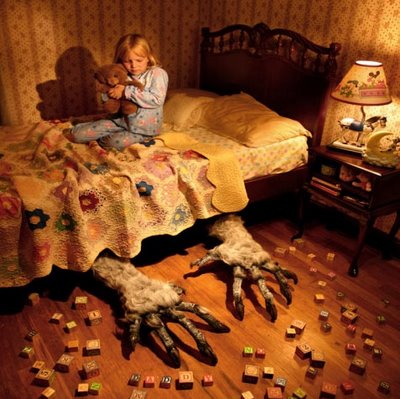
Well, as much as we may want to believe that the monsters are at the far far edge of the map, they're not.  I mean they are, but they're very much here, too.  We just forget about them.  I talked about this at length on Sunday, but I'd like to mention it again.  Remember when you were a child, and you were terrified of the monster under the bed?  Remember when it was bedtime, and you got your parents to look under your bed for you, and in your closet?  Remember when you got your parents to shuffle all over your room looking for non-existent monsters?  Do you ever remember them finding any?  Of course you don't!  Your parents never found any monsters because they spent an entire evening looking in the wrong places.

If you're familiar with the simpsons, I'd like to spin you a yarn.  Every year, they have a halloween episode, which is 'scary.'  That is, it's totally played for laughs, of course.  And you're not supposed to be scared by what you see or hear, because it's supposed to be funny.  But there is one episode of the Treehouse of Horror series that has a line that chilled me then, and it chills me now.  It sort of comes out of the blue in a comedy series, an animated series, which never really seeks to terrify.  But this line did.  And it still does.

It all happens during the episode "Hungry are the Damned," in which the Simpson family are abducted by aliens whilst enjoying a family barbecue.  And they are told by their alien captors that they will be cherished, worshiped, allowed to do as they please.  And they are given just a whole tonne of food.  Well, whilst they are on board the flying saucer, Lisa happens upon the alien cookbook.  And she is shocked to see that the title is 'How to Cook Humans.'  She runs, gets her family, and they confront the aliens.  Then follows an hilarious sequence in which alternating parties blow the space dust off of the cover of the book, changing it from "How to Cook Humans' to 'How to Cook for Humans' to 'How to Cook Forty Humans' to 'How to Cook for Forty Humans.'  The final upshot is that the Aliens were actually nice, seeking to do right by the Simpsons, but because of their untrusting nature, they are kicked off the saucer, and put back at their house.  As the flying saucer flies away over the rooftops, Marge turns to Lisa and says
"You see, Lisa?  This is what we mean when we say that you're too smart for your own good."
And Lisa, staring up at the disappearing saucer says:

"There were monsters on that ship, and truly we were they."

That line still chills me.  I still get the ol' goosebumps even writing it down.  Why?  Because it tells me what I don't want to hear.  I've spent a lifetime looking for monsters under beds, in closets, in attics, in the forests and dark bowers of man's domains.  It started with me looking for monsters under my bed and in my closet, and as I grew up, I started to look for monsters in Syria, in Columbine, in Sandy Hook, in Virginia Tech, so that I could console myself that the monsters were over there.  Somewhere, anywhere else.  But gradually, ever so gradually, the truth of what Lisa said dawned on me.  I've been looking for monsters in all the wrong places.  I've been looking for monsters under the bed my whole life, and never bothered to look in the one place that the monster was actually hiding.

In bed.  With me.

If I would have taken the time to look, I would have found all the monsters I could possibly hope to ever find.  Truly there was a monster in my house.  And he was in me.

I was the monster I should have been worried about.  And more importantly, I was the only monster that I could do anything about.  The fictional monsters, the faraway monsters, all they'd do was to absolve me of my Christian responsibility to confront the evil and pain and disaster in the world directly caused by me.  Because you know what?  I can think all day about what someone in Washington or Basra or Hartford should do to make sure that people don't murder each other.  I can think all day about what hospitals should be opened in places I'll never visit, and what metal detectors will be installed in schools I'll never go to.

Or, I can do the much more difficult job of looking for the monsters not at the edge of the map, not where I happen to know that they aren't, but where I happen to know that they are.  In me.  In my heart.

We're at the time of Advent, where it talks a lot about preparing our hearts for the coming of the Lord.  And John the Baptist talks a lot about repentance, about making straight the way of the Lord.  And what on earth does that look like?  Well, it has nothing to do with pointing out everyone else's problems ,and feeling comfortable doing it, nah, it has to do with the dragons and monsters that are in my own life.  The Christian ethos says that everyone's sin is their business, and that means that your sin is yours.  It's tough medicine, to be sure.

I can't control what happens in Washington.  I can't control what happens in Hartford, or in Basra, or in Tehran, or in Beslan, or any of these other places.  I'm lucky if I can control, for just a moment, the monster in the mirror at 3825 Hillsdale St.


I hope everyone can find some degree of peace over Christmas this year.  I hope everyone can find some space in which they are confident in who they are, in what they believe, and in a loving God who allows us to be free, with real consequences, but at the same time promises that like in good horror movies, the monsters don't win.  The monsters get defeated.  And the greatest of all monsters, death, is no exception.  That's what Christmas is all about, you know, that days and weeks like these don't win.  They aren't victorious.

I'm going to leave us all with the verse from 'for all the saints' that always gives me the chokies.  Happy Christmas everyone.  The light shines in the darkness, but the darkness has not overcome it.  It's dark right now, but Christ the light has come.


 And when the strife is fierce, the warfare long,
Steals on the ear the distant triumph song,
And hearts are brave, again, and arms are strong.
Alleluia, Alleluia!

Monday, December 3, 2012

The true meaning of Christmas

If you were around on Sunday, you would potentially have been quite jarred by the inclusion of the reading for the first Sunday in Advent:  The triumphal entry into Jerusalem.  Here it is for you if you missed it.

Jesus Comes to Jerusalem as King

28 After Jesus had said this, he went on ahead, going up to Jerusalem. 29 As he approached Bethphage and Bethany at the hill called the Mount of Olives, he sent two of his disciples, saying to them, 30 “Go to the village ahead of you, and as you enter it, you will find a colt tied there, which no one has ever ridden. Untie it and bring it here. 31 If anyone asks you, ‘Why are you untying it?’ say, ‘The Lord needs it.’”
32 Those who were sent ahead went and found it just as he had told them. 33 As they were untying the colt, its owners asked them, “Why are you untying the colt?”
34 They replied, “The Lord needs it.”
35 They brought it to Jesus, threw their cloaks on the colt and put Jesus on it. 36 As he went along, people spread their cloaks on the road.
37 When he came near the place where the road goes down the Mount of Olives, the whole crowd of disciples began joyfully to praise God in loud voices for all the miracles they had seen:
38 “Blessed is the king who comes in the name of the Lord!”[a]
“Peace in heaven and glory in the highest!”
39 Some of the Pharisees in the crowd said to Jesus, “Teacher, rebuke your disciples!”
40 “I tell you,” he replied, “if they keep quiet, the stones will cry out.”


The heck is this doing here? Why oh why do we have this reading here, at the beginning of advent? This is a Palm Sunday reading, isn't it?  Of course it is.  Here we are, at the beginning of Advent, the new church year, and we get a reading for Palm Sunday.  What the heck is this all about? Well, as jarring as this is, it should get your brain all moving around, because you know that something's amiss.

Christmas is the time in which you and I think about the baby in the manger in Bethlehem.  As we should.  No trouble there at all. That's what Christmas is all about.  And you and I, as the qulaity Christians that we are, we tend to get a bit upset about the war on Christmas that goes on every year.  And we want desperately to keep Christ in Christmas, and to be sure that everyone else does too.  Odds are that over the course of the month of December, you're going to end up thinking to yourself one of the following things.

-If you're not going to wish me a merrry Christmas, then I'm not going to shop at your boutique.

-The people who don't want to say Christmas should just go to work on the 25th of December if they resent Jesus being around so much.

- Happy holidays?  Season's greetings?  Bah humbug!

Ah yes.  As you will.  But let's say for example that we get everyone on earth to say 'Merry Christmas." Let's say that we could manage to get everyone on earth to focus on the newborn Christ.  So what?  It's not enough.  It never was.  If you want proof of that, check out this most excellent scene from Talledega Nights: the ballad of Ricky Bobby.

Ah, yeah, it's funny right?  Possibly the best grace to ever be captured on film.  It's fun to see Ricky Bobby praying to eight pound six ounce baby Jesus, with his little balled up fists, all cuddly, doesn't even know a word.  And as Ricky says, he likes the Christmas Jesus best.

-"When you say grace, you can say it to grown up Jesus, or teenage Jesus, or bearded Jesus, but I'm saying grace, and I like the Christmas Jesus best."

And why wouldn't you?  We all like the Christmas Jesus best.  You know why?  Because he's cuddly.  Because he's smaller than us.  Because he can't say a word.  Because he's full of potential, but is totally inoffensive.  If your entire idea is to get people to think that Christmas Jesus is great, well, they probably will.  They've got no problem with that.  People have very little problem with newborn eight pound six ounce baby Jesus, with baby God, all that.  They've only got a problem with him once he starts talking.  

Look at this whole scene for a bit.  Don't you find it funny and out of place that Ricky Bobby is praying for all sorts of insane things, that it's all about money, that he has to mention Powerade in every grace by contractual obligation?  Don't you find it strange that he encourages his children to yell at their grandfather, because they're winners, and winners get to do what they want?  And that he says and does all this almost in the same breath as he says grace, ostensibly to Jesus Christ?

But he's praying to Christmas Jesus.  Baby Jesus.  Little tiny baby God, who can't say a word.  Little tiny Baby God with balled up fists and a little fleece diaper, who can't tell you not to do what you're doing.  Have you ever wondered what the heck the cross is doing in this circumstance?  How did Jesus ever get executed if he was just a cuddly little tyke, who had balled up fists and a fleece diaper and all that? Well, as grandpa Chip points out, he was a man.  He had a beard.  And he had things to say.

We have this reading in here to remind us that it's not just baby God, who can't even say a word.  We have a God who became a man, the Word becoming flesh and dwelling amongst us.  You see, it's not just a matter of there being a child born into the world, it's a matter of who he is.  And who is he?  The word of God in human form.

Listen to what God says about Jesus on the mount of transfiguration:  'This is my son, in whom I am well pleased.  Listen to him.'  Do you get this?  I hope it's not escaping you, because it's important.  It's so important I can't overstate it.  The presence of Christ in the world is not one in which he's a baby in a crib forever.  He grew up.  He spoke.  And his words are of such profound importance that we're still talking about them today.  He is the word of God proper, the word of God that demands to be heard.  He is the word of God that has something important to say, and something important to do.  If you're planning on keeping Christ in Christmas, it can't be just as a little tiny Baby.  it has to be as a child who lives, grows, and speaks.  Who says incredibly inflammatory things that would shame Ricky Bobby down to his boots.  If you want to know what Christmas is all about, take some time over this busy festive season to seriously look at what Jesus does and says right after Palm Sunday's readings.  Right after what I quoted earlier.  Do you think this is the sort of man who would be thrilled with you calling out how hot your wife is at grace? Or who would love you to mention powerade?  Or who would be happy to hear that your kids yell at their grandfather?  

Highly unlikely.

The only God that would let you do that would be an eight pound six ounce baby God.  And that's how Christ was born, yes.  But did he stay that way? He did not.  Have you ever wondered why we have almost nothing whatsoever written about Jesus as a child?  Because he didn't stay a baby God for long.  He is the word of God.  And we need to listen to what he says.

PJ.