The musings of the Pastor from Good Shepherd Lutheran Church, Regina SK

Welcome. If you're a member at Good Shepherd, welcome to more thoughts and discussion of the week that was, and some bonus thoughts throughout the week. If you're not a member, welcome, and enjoy your stay. We are happy that you're here.

If you like what you see here, consider joining us for worship at Good Shepherd Lutheran Church. Sunday mornings, at 8:30 and 11:00. You can also follow us on Facebook.

Thursday, January 12, 2017

The Baptism of Christ

A long long time ago, I saw a movie called 'the order.'  You can tell it was a decent length of time ago, because it was starring Heath Ledger (too soon?)  Anyhow, the plot of 'The Order' was that there was a rogue group of priests who were known as sin-eaters.  And what they would do, is they would wait until someone was about to die, and then they themselves would eat that person's sin, and take it into themselves, leaving that person to die with a clear conscience, while that priest just accumulated vast amounts of sin on himself.  I bring this up, of course, because the film seemed to suggest that the whole point of the Christian faith was to go to Heaven, even if you had to find loopholes and plot holes to get there.  Even for the most mean and covetous sinner, there would be a loophole to get you there somehow.    Now the movie wasn't great, you understand, it was lacking in a few key areas, but that plot is at least semi-notable for dealing with the endgame more than anything else.
And that leads us quite happily to baptism.  It leads us to baptism, and to the modern idea that baptism can consist of just getting the kids done.  They can get baptized, and then they're all good for life.  It's a thing you do, and it functions as sufficient 'fire insurance' to get you out of all sorts of trouble.  Essentially, it functions as hedging your bets, being sure that you can get away with something if you need to.

But if the entire benefit of baptism is going to heaven, which is certainly part of it, the question comes up, does it offer any other benefits?  Martin Luther certainly thought so.  if you wouldn't mind dusting off your catechism from the seven inches of dust that it's lying under, and turn to the section in the small catechism on holy baptism, you will see this:
  'Baptism works forgiveness of sins, rescues from death and the devil, and gives eternal salvation to all who believe this, as the words and promises of God declare.'

Okay, fantastic, and Luther goes on, stating 'the Old Adam in us should by daily contrition and repentance be drowned and die with all sinsand evil desires, and that a new man should daily emerge and arise to live before God in richteousness and purity forever.'

So this movement of baptism isn't just a terminus movement.  It isn't something that gets you to heaven only, though that is part of it.  Rather, it is a matter of equipping you for life as well as for death.


The book 'Jesus Mean and Wild' talked about this in one of its chapters.  The chapter in question dealt with not just the baptism of Christ, but also what happened immediately after.  For Christ our Lord stood at his baptism, the heavens were opened, and the Spirit of God descended on him like a dove, and a voice from heaven said 'This is my son, in whom I am well pleased.'  It's a great moment, to be sure, a great moment where you see the entirety of the trinity together, and you see them all , arrayed and bedecked before you, like we're living in a stained glass window.  But what happens after Christ has been baptized?  What's the next step?

The Gospels tell us.  And this is one of those situations in which all the Gospels agree.  From Matthew: 'Then Jesus was led up by the Spirit into the wilderness to be tempted by the devil.'  From Mark: 'The Spirit immediately drove him out into the wilderness.'  From Luke: 'And Jesus, full of the Holy Spirit, returned fro the Jordan and was led by the Spirit in the wilderness for forty days, being tempted by the devil.' The only Gospel that doesn't talk about that immediate transition is John's Gospel, obviously, and that Gospel is the one where John is recounting the events of the baptism to us.

Of all those Gospels, I like Mark's the best, because Mark's Gospel carries with it a sense of immediacy, carries with it the idea that as soon as Christ was baptized in the Jordan, he went to work to do battle with the devil.  Right after his baptism, right after he went down into that sweet water, then he went out to be tempted, harangued, and beset by Satan.  So, for Jesus, we know that his need for baptism didn't cover his sin, because he didn't have any.  He was conceived without sin, born without sin, and lived without sin as well.  He was just fine, and didn't need that forgiveness of sins.  But did he get the other benefits of baptism?  Sure he did.  He was equiped to do battle with the devil through his baptism.  It was the start of his ministry, the beginning of what he would do in the world, and it was the start of his war with the devil, who would assail him either directly or indirectly for the duration of his ministry.

Your baptism functions in the same way, you know.  Your baptism functions in the same way, giving you a passport to heaven, clearly, but more than that.  Just as Christ was equipped to do war with Satan through his baptism, so you are too.  Your baptism equips you to, as Mark's Gospel says, immediately go out into the wilderness to be tempted, and to overcome.

Your baptism is the means through which your Old Adam is drowned, and the new man emerges.  Paul describes it in our Epistle reading from Sunday as being dead to sin, and alive to Christ.  It describes us as being dead from sin, no longer subject to its whims, no longer responding to it, no longer being moved in any real direction on it, being pulled by it into doing what it wants you to do.  The idea is to resist the devil, and he will flee from you.  To be dead to sin, and alive to Christ. And that happens in your baptism.  And it's not a one-time thing, though you do only need to be baptized once. Rather, like a vaccine, you get it one time, but it continues to work throughout your life, daily protecting you, daily strenghtening you, daily equipping you for the war that you have to engage in with the devil and the powers and dominions of this world.
People forget this.  And they forget their baptisms.  They forget what it was that that they received in their baptism, and thought no more about it.  They never considered that their baptism would be vital and useful to their wandering around in the wilderness, not just for 40 days, but for 80 years.  We're going to be out in this wilderness for a long time, with the devil assailing us at every opportunity.  We will be pursued by that prowling lion, who seeks whom he may devour.  We will be plagued by the monsters from our nightmares who seek our failure and destruction.  And what do we rest on?


We rest on our baptism.  We rest on our baptism and the moment where that Old Adam was drowned and put to death.  We rest on that moment where Christ reached into human history, and bound us to him through the same waters of baptism that he and we both descended into.  That's the hope and stay in the wiles of our lives.  That's what we are dependent on, and relying on.  We are counting on that to drown the Old Adam, to destroy him so that he might be dead to sin.  No longer tempted, no longer pulled and pursued, no longer interested in what may be before him, but altogether dead to sin.  And we also place our hopes in being fully alive in Christ, the author and perfecter of our faith, who provided us with that exchange in the waters of baptism, where our sin was washed off of us, and was taken upon him.  Like the sin eaters from 'The Order,' he took our sin on himself, taking it all away so that we could stand before God blameless and secure in our salvation through his merits.

It's funny, that the plot of 'The Order' was less interesting than the plot of the Holy Bible.  The plot that details not an order of rogue priests running around eating sin and taking it on themselves, but the descent of God our Lord in human form, living and dwelling in his creation.  The story of the word of God made flesh, the story of the magnificent force of creation becoming part of creation, and at the moment of baptism, you leave your sins in the water and he takes them away, drowning your fiercest enemy, and restoring you to grace.

It's a good story.  But don't take my word for it.

The book is better.


Monday, January 2, 2017

Benediction

I'm not sure if you're paying attention by the end of the service.


Yes, I know that the services can get awfully long, I am aware that they can drag a little in the middle, especially around sermon time, I'm fully aware that things don't always move along with pep and vitality, so I wouldn't be too terribly surprised if you had tuned out by the end.  And if you did, that would be a shame, because the end of the service contains the benediction, which is a favourite part of the service for a great number of people.

No, not just because it means that church is over.


It's because this is where, in the service, God blesses you.  And he blesses you in the same way that he has blessed countless people before you.  It's nice that this moment comes up around Christmas, because for families, Christmas is a time of great ritual.  There are certain things that just sort of have to be there, or have to be done.  You have to have brussels sprouts, there have to be cabbage rolls.  It's not Christmas without Christmas crackers, or without a glass of sherry.  There are certain aromas that we have heavily connected with Christmas, like pine needles, or like stuffing (dressing), that kind of thing.  And having mentioned all that, a connection with Christmas crackers needs to be made, which is the legacy of the cracker joke.
No, this isn't a joke about pepperidge farms, but rather these are the jokes that are wrapped up with the crowns, that you will find in your Christmas cracker after you have pulled it and popped the crown on your head.  And as you do so, you read out the cracker joke to the delight of almost nobody.  The reason for that is that cracker jokes don't change over the years.  They're sort of dad jokes run wild, where the content of the jokes is the same year after year, and by the time you get to be an adult, you know all the answers to all the questions.

What is the best Christmas present in the world?
A broken drum, you just can't beat it!

Hilarity ensues.  Or does it?  I have been listening to these jokes for as long as I can remember, and they never change.  It's really hard to be overly enthused about jokes that remain exactly the same for generations.  It's tough to get fired up for a laugh about material that just stays the same all the time no matter what.  It doesn't elicit the same laughs that it does over at the kids table.

Now, we have a way of thinking about all things like that.  We have a way of thinking about all aspects of our lives like that, in a quest for the novel, for the new, for the different.  We have in mind to continue, perpetually, looking for what is new, what is different, what has not yet been done.  We want to make sure that our lives are always looking forward, and anything that has been said or done or enjoyed already is no longer worth our time or consideration.  Usually. But at Christmas time, things have to be different, because if things don't mean something, then we're in real trouble. 
Have you ever considered what would happen if you engaged in a massive orgy of buying and selling goods and services, if you bought gifts for everyone you know on August the first, which here is Saskatchewan, is "Civic day."  What would happen if for Civic day, you made a huge meal, got the whole family together, sat everyone down, put up a civic tree, exchanged civic presents, and had a jolly old civic time.  Imagine if all the stores, all the companies, realized this, and made the entire civic day season all about buying and selling and gifts, and all that noise.  Imagine if that was the case.  This upcoming August the first, are you planning on buying gifts for everyone on your list, or are you just planning on sleeping in? 


In order for the mechanism of Christmas to work, we have to have it be about something else, not just buying and selling.  It has to be about the birth of Christ, or family, or togetherness, or something more than just 'commerce day.'  That's not enough.  It's never been enough.  That has never been sufficient.  There are commercials on TV all the time (TV, remember that?), or on the radio, ads playing before YouTube videos, billboards on every conceivable surface, none of the stores have any real interest in stopping this orgy of consumption, so any day could be an excuse to buy and sell.  But we, average Joe consumer, we need a better reason than that.  So it has to be tied to mother love, or to passion, or to the birth of a Baby, or to family, or to any one of a number of things, but never just because.
There are a lot of things that happen around Christmas, and honestly, some of the most repetetive bits are the best bits. It's the novelty that plagues you, that's what makes you miserable. The novelty, the buying and selling, the getting and the giving, the Christmas lists that change year after year, that develp to the point where you have no idea on earth what to get a neice or nephew because their wants and desires change every year. 

But it's the repetition, the grounding, the framework that makes things mean something.  The repetition, the ritual, is the bedrock that props the rest of it up, and if that framework isn't there, then then the whole thing doesn't function, it falls apart because it's built on nothing.  There absolutely has to be some routine, some framework to hang the season on, otherwise you just end up earning time and a half at the movie theatre.

For us in our family, there are three things that always must be read.  Firstly, the nativity account in the Gospel of Luke.  Secondly, we read 'A visit from Saint Nicholas' (AKA 'twas the night before Christmas, if you're a plebe), and the story of Jabez Dawes.  And to this date, none of us have gotten tired of any of them, and in fact would have a hard time getting in the mood of the season without them.  Though we've heard those stories dozens of times, we still want to hear them again. 
It's the same with the Benediction.  The Benediction at the end of the service, the Aaronic Benediction which Aaron, the initial, the original High Priest, was told to bless the people of Israel in God's name, with this Benediction.  And we continue to say this Benediction here at this church, and at all sorts of other churches as well.  We repeat that every week, week in and week out, and it keeps on being something that we need to hear.  That part doesn't change, that part never gets any different.  The moment in time that we hear the blessing of God, where after we have been through the service, we have heard about our sin, we have received absolution, and then we are being equipped for the week ahead, with the blessing of God.  We are blessed every week with God's word, as it was in the Old Testament, the words that have girded human beings for thousands of years, the words that have comforted and strengthened people for the world outside the walls of the congregation.  The words that we hear are a ritual, yes, but they're a vitally important part of the ritual of worship in the church.  No matter what the theme of the service was, no matter who the pastor is and how dreadful his preaching was, no matter if we entered with a heavy heart or a light spirit, no matter if our faith was strengthened or worn down, whatever happened in any of those moments, we have assurance, guarantee of the blessing of God richly poured out on all of us.  His blessing applies to each and every single person in that congregation, so no matter what else you may have gotten out of the service, get this. 

May the Lord Bless you and Keep you.
May the Lord make his face to shine upon you and be gracious unto you.
May the Lord lift his countenance upon you, and give you his peace.

Be strengthened and comforted through these words.  Be vitalized, be refreshed, and be blessed through the blessing of God, given as he had commanded.  And if you are flagging, weak in your faith, tired, worn down, be strengthened by the blessing that comes from God, the blessing that is the same yesterday, today and forever.  Grounded, fashioned and built up by our God, who is also the same yesterday, today and forever.
Sometimes, routine is nice.

Monday, November 28, 2016

Wake up

It's the most wonderful time of the year.  

Or so you'd think.  You'd think that this is the great party, the great party that we're all on all the time.  For in this time of year, the party begins, and we get into this way of thinking that Christmas is here already.  But there's a problem with that, which is that we are people who get sick of this forced mmerriment eventually.  Did you know this?  By the time we get to the actual Chriatmas day, then we usually just want it to be over laready.  Let's wrap it up, get to the movie threatre, and try to forget that Christmas ever happned. That's why we have the movie called 'surviving Christmas'.


This happens because Advent vanished.  It disappeared some time ago, gobbled up by Christmas.  We have a season of Christmas, a very very long one, but it's in the wrong place, and it takes up too much time.  It grew, spread out, and invaded Advent, eventually co-opting the entire season, and turning it into something completely different.  Turning it into more Christmas.  Now, on the surface, this sounds great, right?  This sounds fantastic.  More party, more merry-making, what's not to like?  Well, here's the trouble, kids.  What we have done is to move directly to joy and merriment with no preparation.

You all know that you can't start Christmas at some arbitrary time, right?  you all know that you can't just get Christmas going out of nowhere.  You need time, you need preparation, you need space in which to get everything done.  Think of it like cooking a turkey, something you hopefully understand fairly well.  Cooking a turkey takes time.  You can't flash fry it, that won't work.  It's a big old bird, and requires time to make it palatable, and less-fatal.  You can't just toss it in the oven and cook it for half the time at twice the temperature.  That just leads to a bird burned on the outside, and frozen on the inside. And if it works this way for a turkey, imagine how it works for your soul, for your spirit.

You need time to prepare. When Christmas comes, it should be a time of great joy, that Christ has come into the world.  It shouldn't be a time where you are just waiting for it to be done with.  But you won't be in that frame of mind if you've been in a holiday that has been lasting for two months before it can officially start.  By the time Christmas gets here, you've been in the throes of it since the beginning of November, and you've skipped advent.


So what is Advent for?  It's for preparation.  And it's for waking up.  It's for rousing yourself from sleep, and preparing to take on the day ahead.  Advent is your time to get ready for what is happening, and what is going to happen.  If you listen to the Advent readings, as most of us rarely do, the readings aren't joyful, they aren't riotous, they aren't phenomenal in their exultation.  Instead, they are intensely repentant in their character.  They are greatly repentant in what they say and what they tell us.  It isn't quite as sackcloth and ashes as Lent, but it's darned close.  Here, in the season of Lent, the atmosphere ought to be decidedly penitential, in keeping with the words and work of John the Baptist.  For John, as the voice calling out in the wilderness, is busy telling people to get their lives right, to figure it out before it is too late, for it will be too late faster than they'd expect.  John tells them that the axe is at the root of the tree, that the winnowing fork is in Christ's hand, and that judgment day is in fact coming.

When the people hear this, they panic, as they ought to do, and ask John 'then what are we to do?'  Right.  And this is the big question that will dominate our thoughts over the course of Advent.  You and I, as good, Bible-believing Christians, looking maybe for the first time at what John and Christ would say about the second coming, we may ask ourselves 'what do we do?'  And the answer that we get for this week is simple.  Wake up.

Wake up, as the epistle to the Romans says.  Wake up for the night has passed, and get yourself out of those works of darkness.  Paul doesn't mince words here, moving for an end to orgies, drunkenness, sexual immorality, all that stuff that not just makes up immoral works and deeds, but also makes up the sleep of our lives.  There was a great bit in that great book 'The Screwtape Letters,' that gets into this, where, to paraphrase, Screwtape describes the gradual bleedout of life from people, stating that their lives

You will find that anything or nothing is sufficient to attract his wandering attention.  You no longer need a good book, which he really likes, to keep him from his prayers or his work or his sleep; a column of advertisements in yesterday's paper will do.  You can make him waste his time not only in conversation he enjoys with people whom he likes, but in conversations with those he cares nothing about on subjects that bore him.  You can make him do nothing at all for long periods.  You can keep him up late at night, not roistering, but staring at a dead fire in a cold room.  All the healthy and out-going activities which we want him to avoid can be inhibited and nothing given in return, so that at least he may say, as one of my own patients said on his arrival down here 'I now see that I spent most of my life in doing neither what I ought nor what I liked. The Christians describe the Enemy as one 'without whom nothing is strong,' and Nothing is very strong.  Strong enough to steal away a man's best years not in sweet sins but in a dreary flickering of the mind over it knows not what and it knows not why, in the gratification of curiosities so feeble that the man is only half aware of them, in drumming of fingers and kicking of heels, in whistling tunes that he does not like, or in the long, dim labyrinth of reveries that have not even lust or ambition to give them a relish, but which, once chane association has started them, the creature is too weak and fuddled to shake off.

This is what Paul wants us to steer clear of, this fuddling, this clouding, this somnambulation through life where we end up stagnating in the same sins, as though we were dreaming.  And like with any addiction, the sins we are addicted to, we don't even enjoy them after a while.  Once we become comfortable in them, we continue to commit them with no encouragement, no temptation, it just becomes sort of what we do.  

Paul has in mind for us to wake up.  Christ has in mind for us to wake up.  Shake off the gloomy sleep that encroaches, push through the fog, and realize that the time for the return of Christ is closer than you may imagine. But fortunately, you have been given time.  We all have.  The time of preparation is now.  Advent is the time not just for the preparation for the birth of Christ, but for his return.  This is the time where we as Christian people focus on how we have prepared for his return,
for judgment day, and for what we have done in the meantime.  Has it been enough?  Can it ever be enough?  The time of Advent is a time where we consider the immediacy and inevitability of the return of Christ in glory, and ponder through what it would be like were he to return at the end of the month.  How would you live if you knew for sure that Christ would return, and the world would end in a month's time? Would you do anything differently? Likely you would, so perhaps start making those changes now.


Christ told us in the Gospel reading that we won't know the day nor the hour of his return, and if we take him seriously, that means that we shouldn't be trying to figure it out.  That means that we should be living in such readiness that it won't matter.  The entire Christian universe has been living in preparation for the end times since the time of Christ, and this time should be no different.  Don't get comfy, don't assume that you're living at the end of history, don't feel as though you've got all the time in the world.  Seriously consider that Christ is coming back, will be here at some point, and then ask yourself, if that were true, what would you do differently?

Because it is true.

And whatever you'd change, do it now. 

Monday, October 3, 2016

Hide it under a bushel, NO!

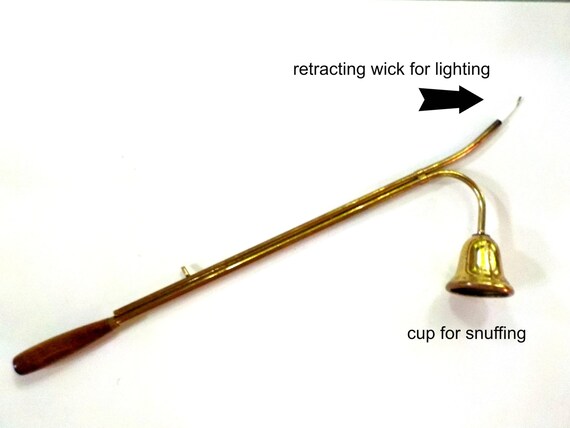
There's a church approved way to light candles.  Did you know that?  There's the magical acolyte wand that acolytes carry with them, to light candles and get the service started on the right foot.  But the candle-lighting apparatus, it has two functions, a real swiss army knife of candles.  It has the taper, for lighting the candle, and it also has the snuffer for extinguishing the candle.  And here's where things get interesting.


For you see, this was my first real experience with the science of fire, was being an acolyte in my church growing up, and using the lighting wand.  When the service was ending, we were told to go to the front of the church, bow reverently before the altar of God, and then hold the snuffer over the candle until it goes out.  Well, we were twelve then, and we all thought that it couldn't be that easy, to just hold it there, we figured that there had to be some sort of mechanical component to it, so we crammed the snuffer over the candle as hard as we could, to force the candle to go out.

We didn't need to do that.  The candle would have gone out all by itself, if we would have just left the snuffer over it quite passively.  It would have burned itself out.  Starved of oxygen, which is a vital fuel for fire, the snuffer ensures that the flame will burn through all the oxygen in snuffer, and then go out.  Science!


Why are we talking combustion?  Well, the disciples, this weekend, when they heard something they didn't want to hear, responded to Jesus with a resounding 'Lord, increase our faith!' As well they ought. Jesus had just told them one of the more difficult things that they were ever going to hear, which was that forgiveness, for a Christian, isn't optional.  This injuction from Jesus stings.  It hurts to hear it.  It cuts us in ways we'd rather not be cut, because it tells you that the commandment from Christ to forgive is every bit as binding as any other.  We're happy to talk about why couples shouldn't be cohabiting before marriage, and about how gambling is of the devil, but it's comparitively rare to talk about how forgiveness after sin isn't an option.  You don't get to choose.  The language of Jesus, your Lord, is perfectly clear.  'If your brother sins against you seven times in the day, and turns to you seven times saying "I repent," you must forgive him.'

You must forgive him.  Emphasis mine, but honestly, emphasis also Christ's.  We don't truck with that kind of controversy, you know.  We don't tend to give people a hard time in the church for long standing, unresolved grudges, but we ought to, given that Jesus spoke specifically about that.  He spoke in no uncertain terms about how forgiveness has to happen, and we don't exactly take that seriously.  Actually, we want to pretend that it sort of never came up.

Much to our detriment.  For you see, the prayer that we have all memorized, the prayer that Jesus gave to the disciples when they asked to be taught how to pray, that prayer has in it the line 'forgive us our trespasses, as we forgive those who trespass against us.' Of course, we are tempted to say 'well, that's part of the prayer, but Jesus meant it metaphorically, right?  Well, there's a problem with that, and it comes with the verse right after the Lord's prayer.

'IF you forgive others their trespasses, your heavenly Father will also forgive you, but if you do not forgive others, neither will your Father forgive your trespasses.'  -Matthew 6:14-15.

Oh.  Talk about your inconvenient truths.  And when you hear this, large as life, I know it's tempting to close the book and prented that it didn't happen, and wasn't ever said, but the opposite reaction is demanded.  The reaction of the disciples:  Lord, increase our faith!

For you see, we want to be shielded from this kind of discussion from Jesus, we want to avoid it, to bury our heads, and insulate ourselves from it.  We want to be protected from it, so we put a bushel over ourselves to try to avoid those words we don't want to hear.  But the bushel, the thing that we put over ourselves, over our hearts to insulate them from God's word, it just ends up being a snuffer, and puts out the flame of our faith.  Because our faith was never intended to run on this.

We think of our faith as a candle, and if it is blown on, it will go out.  That's how candles work, you know.  Children know that from a very early age, they know that if you blow on fire, it goes out.  That's basic observation.  But that's why the reality of the situation is so much stranger than you may have expected.

If you blow on a candle, it goes out.  No problem there.  But if you have dying embers left, if you had a roaring fire at one point, and it has died down to embers, how do you get it to spring back to life?  You blow on it.  The same thing that put a candle, a weak flame out, brings a strong fire to life.  It's crazy, it's counter intuitive, but it's the way the world works.

We think our faith is weaker than it is.  We think that the faith given to us in holy baptism is weaker than it is, that the holy spirit that dwells within us is weaker than he is, that faith is a frail candle that can easily be blown out.  But it is the opposite.  In the epistle reading, Paul tells Timothy to fan into flame the gift of God.  How do embers get fanned into flame?  Rekindled?  By being breathed on.

In the scriptures, Jesus breathes on his disciples and tells them to receive the holy spirit.  In Greek, the name of the Holy Spirit is either the Holy Spirit, or Holy Breath.  It is the breath of God that fans our faith into flame, and that breath of God is given in the holy scriptures.  I know your reaction is to look at what we're given in the word of God and to avoid it, that his injunction is too hard, his rules are too much, and we want to pop on the ol bushel basket and pretend it didn't happen.  But the reality is that our faith, the gift of the Holy Spirit given to us in baptism is a burning flame, which can die out, it simmer down, but it doesn't go out.  The thing we want to avoid is the thing we need, the words of Christ we want to side-step are the words we require.  They build faith, not avoiding the air that our faith needs.

Essentially, what it all boils down to is that by trying to protect our faith, we tend to put it out.  By trying to protect the flame, we snuff it.  Avoiding the breath of God, the word of God, it just makes things go out faster.  For the breath of God is the fuel that our faith runs on.  Grow in it, be immersed in it, and realize that the words you want to avoid, they're the words you need to hear.  They're what are going to increase your faith.

Monday, September 26, 2016

The one thing worse than fire and brimstone

I tell you the truth, me fulminating and bloviating from the pulpit all about fire and brimstone awaiting sinners is not really going to motivate anyone.  I know it used to be what people would do, to have preachers preach fire and brimstone, but I'm not really sure that the ol' F&B really has the power to shock, or to horrify, as once it did.  More's the pity.

I don't do a whole lot of fire and brimstone myself, but in the reading for this week, I found something that bothered me more than fire and brimstone possibly could.  I myself and used to the idea of hell as a fiery pit of unpleasantness in the centre of the earth, so hearing it mentioned is not overly troubling to me anymore.  But here's something that is troubling, something that does bother me, more than I thought it would.

When the rich man descends into hell in the account that Jesus shares with us, his name and his life are forgotten.  Think about us and how we live as people these days.  Think about how many selfies are taken and posted online every day.  Think about how much time we spend trying to get people to
'like' what we do, to get them to notice us and our cute filters, to get them to comment on our achievements and to see and enjoy what we are up to.  That's what an awful lot of our internet traffic is, to say nothing of googling ourselves.  This is our lives, and this is what we enjoy.  And what we want is our fifteen minutes of fame, to be well thought of, to be admired and noticed, to have people see what we do and like it.  And in our age of fame and glory, of instant internet notoriety, can you imagine what would happen if all of a sudden all this notoriety went away, and all records of you as a person, as a person of interest, disappeared.  The rich man's name isn't unknown by Jesus necessarily because he's making it up and didn't bother to come up with a name for this guy, nor is this a half-assembled parable with the rarity of only have the information being there.  No, this is a situation where one of those names is left blank for a good reason.  It's left blank to illustrate a point.  This person, this rich man who delighted in being known and liked in life, in the hereafter is obliterated, has vanished like vapor from the notion of anyone who is at Abraham's side. The man who loved to be seen, who loved to be noticed, has disappeared.  His old name that people used to use was 'Dives,' but that's not his name, that just means 'rich man' in latin.  His  name is not found in the book of life, so when it comes time to recount the tale, Jesus says of him 'I did not know you.'

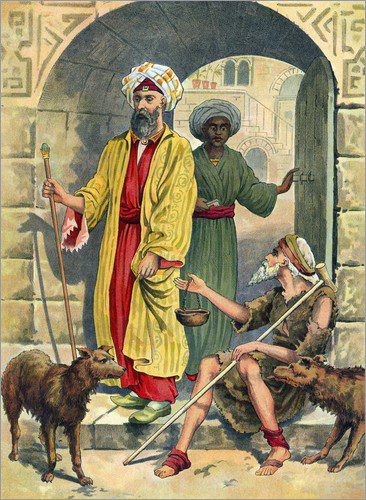
Now, this speaks to a pretty important part of how we treat the poor.  Think about where Lazarus was at the rich man's house.  He was at the gate.  He was lying at the gate, and would lie there day in and day out, hoping for some crumbs, some scraps, something, anything to give him a chance to eat.  And I would imagine that the various people who came in to feast sumptously at the rich man's house didn't really give Lazarus much of the time of day.  Not much at all.  They likely viewed this poor man as an obstruction, a natural hazard like a pothole, or a fallen log, the sort of thing you have to step past, or indeed step over.  They likely viewed this as an obstruction, and not as a person.  How do I know?

Because I've done this too.

Maybe I'm the only one here, and maybe I'm not.  But the accepted method of dealing with the panhandler coming towards you is to avert your eyes, look at the floor, and prented you neither see nor hear them.  These people, and there are lots of them, have little to no influence on society, they folks,' they have no humanity either.  We just walk by like we would walk by a monkey that was begging for scraps, or a hole in the ground, or some other obstruction.  Something to be avoided, not something to be actually looked at, cared for, or appreciated in any way whatsoever.They have nowhere to go and nothing to do, no jobs, and when they come face to face with us 'normal people,' they disappear, vanish, and become non-people, not even an inconvenience, but essentially invisible.

The beggars, the poor, the mendicants, those who don't have any kind of financial upward mobility, these are people who are completely without identity to us.  We all have names, of course, but those who are poor, who need help, may as well be called 'the poor man' for us.  And this is how I have treated the poor in my life, and there's a possibility that you have too.

The story of the rich man and Lazarus is not the story of the rich going to hell and the poor going to heaven, such a story would fly in the face of the prospect of grace, and wouldn't fit with the rest of the narrative of scripture.  But let scripture interpret scripture, and you'll get an idea of what this story actually is about.  Think about the 25th chapter of Matthew, where Jesus divides the sheep from the goats, mainly based on what they had either done or not done. We are used to this notion of division being along lines of the people who have done good going to paradise, and the people who have done horrible things going to hell.  But if you read through Matthew 25, you'll see that that's not really the case.  The people who are divided on the left hand of Jesus Christ are divided based on what they did not do.  Jesus says it clearly, that they had countless opportunities to do what was good and right, that they had countless opportunities to serve him by serving others, and they declined to do so.  They knew what was right to do, and yet they declined.  They knew that this was the right thing to do, and they felt as though it didn't matter too much while they were alive.  But Jesus makes it clear that it does matter.  This is what is important.  You have chance and ability to do the right thing, you have opportunity to do what is good and right, and yet you do what the rest of us do, which is to walk on by.

This doesn't run counter to the doctrine of grace, you know.  Instead, it tells you of your need for that grace that most of us have cheapened for so long.  Look at this story of the rich man and Lazarus, look at him and know that this rich man thought of himself as basically alright: not a murderer, not a killer, not an adulterer, probably not a thief either, someone who was successful and felt as though he was entitled to the fruits of his success.  No problem there, right?  But we learn from the holy scriptures that walking on by the suffering, the weak, the poor, the destitute, dehumanizing them day after day and week after week, that's a sin that doesn't exactly go unmentioned by the scriptures.  When you confess your sins, when you confess your sins to the Lord your God, do you confess the massive number of times that you had the right thing to do right in front of you and did not do it?  Likely not.  But you ought to.  Jesus thought that this was important enough to mention, that this is part of your imprefection, part of your sin, and deserves, needs to be addressed.  We are living in times and places where this is more common than ever before, and we need to think on it.  We are Christians, living in cheap grace, who believe that we're fine because we have nothing to repent of.  Well, read this passage, think of how many people you have passed right by and dehumanized, well then, this is why you have always needed and will continue to need Christ.  He has made promises to us that he can and will and does forgive sins.  If the story of the rich man being blotted out from the minds of those in paradise and burning in agony makes you uncomfortable, then good.  And you have a choice, which is to either step over those passages, to pretend that they were never said and aren't in the scriptures, or to realize that you maybe do have something to repent of.

And then Christ, as he has eternally promised by the blood of the new covenant, will forgive you.  Because that's the promise that he made.

Monday, September 12, 2016

Sheepin it real.

The more I think about it, the more I like the analogy I used on Sunday about the wasp.

For you see, if you have a wasp in your house or your car, you don't want to touch it, lest you aggravate the situation further and make yourself more likely to be stung, so what you do is to open doors or windows, and to hope that the wasp flies out.  After all, he managed to fly in there, probably through a smaller entrance even, so it should be perfectly simple for the wasp to, you know, fly right back out again. If it was a fly, you might have other options.   But the problem is, as it always has been, that the wasp can't find his way to the open window.  Because you'd rather not get stung, then, all you can do is gesture, wave, try to fan the wasp in the right direction, all the while saying, sometimes out loud, that the wasp should just leave already, and go through the massive door to freedom that you have opened for him.

But he doesn't.  So you have a couple of choices: Kill him or leave the vehicle and come back when he's dead.  That's it. 

It would be so simple, of course, if the wasp were just to take the exit, to take the out that you've offered him, but he won't, he will stubbornly keep on butting his head against the windshield, because he can see the freedom just on the other side.  But he can't or won't, move over to the window where freedom awaits. And if you've ever been seated in a vehicle with a wasp, who is growing more and more irate as time goes on, then you'll know what it is like to watch something fly right past freedom again and again and again.

If we've lived this dozens of times in our lives, then surely we can apply this to ourselves, as people who do much the same.  Jesus, in Sunday's gospel reading, talks about shepherds who, if they lose a sheep, will go out and try to find it.  Shepherds who will leave the 99 who are in the pen to find the one who has wandered away.  But sheep aren't dogs.  And they aren't cats.  They don't know where
they ought to go, and they aren't going to wander back to where they were from.  I'm not sure that little Bo Peep's awesome idea to get sheep back into the pen by leaving them alone is a good tactic.  Leave them alone and they'll likely stay lost, or even get further lost.  This should not be a surprise, given what sheep do, which is to follow other sheep, even to their own destruction.  Sheep will follow another sheep who looks like he knows what's up, even if it means their death.  And yes, this has happened, in recent memory.

So yes, sheep can not be relied upon to go and make good decisions, in fact quite the opposite.  And given that they'll be making bad decisions, they're likely to follow whoever looks like he knows what he's doing.  And this is where Matthew chapter seven comes into it.  For in Matthew chapter seven, you have a situation in which we see wolves in sheep's clothing, which I always thought meant that there was a wolf dressed up as a sheep in order to get close to a sheep to eat it.  But upon closer inspection, what's the point of that?  Sheep can't survive against predators, they're far too domesticated.  They've had all the fight bred out of them over generations, to be docile enough for women and children to take care of them.  If a wolf wanted a sheep snack, it doesn't have to trick the sheep.  It can just roll on up, outrun them, and take a bite out of the one it wants.  That's it. 

But hold the phone, because if a wolf grabs one sheep, then it eats for that day.  But imagine if you could get a situation, as a wolf, where you could get the sheep to follow you around.  Now you're talking!  Can you picture wolves turning into full on sheep rustlers?  Can you imagine them instead of running sheep down, getting tired and hungrier, just having a group of sheep back at their den?  That's what we do, so why wouldn't wolves want to do the same?

The wolf in sheep's clothing is out there to decieve, to take advantage of the sheep and to lead them astray, and because they look like they know what they're doing, then the sheep will follow them around, and will be taken advantage of.  Even to their own deaths and destruction.  Ultimately, they're not bright enough to stay still, nor to find their way home.  If sheep are lost, then they will trend towards further destruction, on average.


This is why Christ became incarnate, you know. To find and to seek out the lost.  He didn't come to earth to save those who were safely in the pen, he came to save sinners, of which you are the chief. He came to bring you back home, as lost and as desperate as you were, because you had a zero percent chance of finding your way home yourself.  It was never going to happen, and leaving you alone was just making it worse.  He came to earth to find and to seek and to save sinners.  Arguably the most popular psalm in the scriptures is Psalm 23, where it talks about the Lord as our shepherd, who makes us to lie beside clear waters, who restores our souls, who leads us to good pastureland, and who will always be looking out for us no matter what.  This is who the Lord is and what he does.  And most of us found our way to Him because we were led there by another sheep.  Be it our mothers or our grandmothers, be it a pastor or friend, a spouse or co-worker, most of us found our way to the Good Shepherd because we were led there by another sheep who wanted to show us where the good pastureland was to be found.  Wide is the gate that leads to destruction, and many find it, but narrow is the gate that leads to life. That doesn't mean that you're not going to get through, but it does mean that you will have to be shown where the gate is.

And that's where we come in.  We are people who desperately need to have a heart for the lost.  If all our evangelism consists of is Bo Peep evangelism, to leave them alone and they'll come home, then we shouldn't act surprised when they don't.  This should not be a massive shock to the system that if we leave the gates open and wait, that more sheep will wander out than wander in.  If you're going to leave the gates open, it had better be because you are bringing sheep into the sheepfold, and rejoicing at their return.

But do we have a heart for the lost?  I honestly don't know.  Sometimes I get to thinking about the church, and feeling as though it is a social club for lots of people, that it is a thing to do, but not necessarily the distinction between heaven and hell that Jesus Christ seems to think it is.  Jesus' heart for the lost led to him leaving Heaven itself, and going to wherever the lost sheep were.  Even the people of Jesus' time seem to have missed that point, asking why he was eating and keeping company with sinners and tax collectors, and that was the whole point.  He was going where the lost sheep were, leaving the 99 and going to find the one. 

We who are in the good pastureland, we who are enjoying the blessings of knowing Christ, who have gone in through the narrow gate, we have that responsibility now, of knowing that sheep will follow other sheep, to be the sheep that other sheep follow.  They'll follow someone, that's what sheep do.  And they'll either follow you or follow someone else.  As Bob Dylan said, it can be the devil, or it can be the Lord, but you're gonna serve somebody.  True it is.

We are not the saviors of the world, we aren't the Good shepherds ourselves, but we are and can be the ones who point out the way to salvation to the lost who are out there, the lost who find themselves following wolves in sheep's clothing.  We can have the same heart for the lost the Christ has, and we can know the eternal truth.  If you try to save a friend from hell, you may not succeed, but at least you tried.

Tuesday, September 6, 2016

Clean living

Choose life. 

That's the statement at the heart of the Old Testament reading from Sunday, with the idea that death and life are set before you, so you ought to choose life.  Fantastic.


Now, here's a thing, where the choice that is set before you, if it's in those terms, should be an easy choice.  It should be straightforward enough, that option, and it's easy for most of us to look at that scene, and say to ourselves 'choose life, well, why wouldn't I?'  And when it's in a spiritual sense, we all have in mind that we can choose life quite easily. People have in mind that they can choose life, can decide to follow Jesus, can choose not to sin, can choose a commandment to keep, that sort of thing.  People think this about their spiritual lives, but hold the phone there, Jimmy, because think about choices that you make that aren't spiritual.

Think of food.  Why does food taste good?  Or, more specifically, which food tastes the best?  I know we all have different tastes in food, in what we like and what we don't but honestly, the way you can
tell something is bad for you is that it tastes good.  Ain't that the way.  In fact, it can count as a good calorie metric that if you're enjoying the flavour of something you're digesting, then it's probably bad for you, and you should switch out to kale.

It's not just food though.  It's all sorts of stuff.  You know what you should be doing, drinking eight glasses of water a day, eating whole grains, limiting fats and alcohol, limiting excess sugars, limiting things that taste good or feel good, eating a tiny portion of sawdust every day, with matcha and yerba mate, you know, all that stuff that you are well aware that you should be doing, and yet, you don't end up doing the vast majority of it. 

You do what we all do.  You have another beer to keep the other three company.  You stop by a restaurant on your way home from another restaurant.  You go out to 'check the weather' several times a day.  You order portions bigger than you need, because the food tastes so good that it doesn't matter if you're hungry or not.  You make a long series of bad decisions, that over a long enough time add up.  They add up big time.  It's not as though one cigarette is going to rot your lungs clean out, but a number of relatively harmless things over a long enough period of time add up.  And they can destroy you from the inside out. 

Few of us make consistently good lifestyle choices. This is why for the first time essentially ever, life expectancy in the developed world is set to go down.  It has always increased before, has always gone up, has always improved.  Now, it is set to dip.  It's never done that before.  And this is a period in history where there aren't the usual outside factors, there aren't the normal things giving us pressure.  There's no war, no famine, no pestilence, no plague.  We have access to better healthcare than ever, better information than ever, food is super abundant and there's no crisis of where our next meal is going to come from. We have tons of literature about what we should and should not be consuming, so why is it that we are in worse shape than before?  Because of our daily choices.  Because we smoke and drink and eat for three people.  Because we are sedentary, and don't move very far.  Because our habits lead to our bodies breaking down. Because we have life and death set before us, and 90% of the time, in bits and pieces, we choose death.  Not too many of us would voluntarily choose a firing squad or gas chamber, but we are happy to kill ourselves by degrees, in fits and starts, getting ourselves into death by tiny tiny choices over a long period of time.


If you know you do that physically (yes you do, stop lying), then what makes you think that you don't do that spiritually.  If you have the food pyramid and ignore that a whole bunch of times, then what makes the ten commandments or the golden rule any different.  Jesus, the great physician, puts it into terms that are quite easy to understand, telling us that if we don't value him above everyone and everything else, if we don't hate our family and renounce all that we have, we can't be his disciples.  Cannot be.  If we value our families over him on occasion, if we still have house, home, wife, children, shoes clothing and possessions, we cannot be his disciples. With that kind of injunction, which of us can stand?  Whom amongst us is making choices good enough to be a disciple of Jesus Christ? 

None of us.  There is none righteous, not even one.  That's sort of the point.  That's why Jesus came to earth, that's why he lived and died, was because we were choosing death, consistently.  On a daily basis, we were choosing death, we were getting up to bad choices, dreadful options, and leading ourselves down the path to death, destruction and damnation.  We knew what we had to do to avoid it, of course, but time after time, we neglected to do it.  We neglected to follow through with it, and decided not to.  The commandments are there as large as life, and we all know them, have memorized them since we were children.  This is the way we are supposed to behave and operate, and we don't.  We choose death, and have been from the time of Adam and Eve.


Which is why Jesus. I know that people have a bit of a hard time with the atonement, they have a bit of a complication with Jesus' atoning sacrifice, but it's not that hard to figure out if you think about how you live on a daily basis.  Think about your little choices that you make that aren't that good for you.  Your small indulgences, the extra cream or extra sugar, the fourth beer or the extra fistful of chips, all that stuff that ain't great for you and you know ain't going to do wonders for your liver or other organs.  You know what you should be doing instead, but you decide not to.  You and I feel as though the chips are worth the tradeoff, and that a lifetime of eating sawdust and kale, skinless steamed salmon and lentils, it's just not worth it.  Life isn't worth living without the little indulgences. 


Well, we put ourselves through the wringer with this kind of conduct, you know.  We put our bodies through the wringer, and our organs are no exception.  Little by little, we wear ourselves down for the purposes of enjoying what's not good for us, and our organs break down because of it.  But imagine if you will, there was someone who was making good choices.  Only the skinless salmon and chicken breast.  No smoking, had never taken a drink. Someone who ate kale and quinoa and never put dressing on his salad.  Imagine if this person was going without all these little indulgences and guilty pleasures not because he thought that was a great thing to do, but because he knew that your organs were breaking down because of your decisions.  Imagine if this person was keeping himself pristine by clean living not because he was anticipating living a wonderful healthy life, but because he wanted to be ready to donate his organs to you when you needed them.  He wanted to donate his organs to you because you wore them out making decisions that benefited you in the short term.  This person went without little tiny indulgences their entire lives just so that yours could be better when you needed it. 

That's the work that Christ does.  His clean living gets imparted to us. His good decisions are what we inherit.  We get the benefits of his choices because our were bad.  It's not a matter of us making the richt choices, it's a matter of us knowing that the right choices were made for us.  I know I keep on bringing it back to this but I think it's important.  At the moment of his crucifixion, the soldiers took Jesus' clothes away, and gambled for them.  One of them won his tunic.  At that moment, Jesus was on the cross, and another man walked away with his robe.  Jesus died, and one of the people who killed him walked away looking like Jesus, covered in his robe.  That's what happens to us at the confession and absolution, at baptism and the Lord's supper, we are covered with the robe of Christ's righteousness given to us not because we were doing such a great job, but precisely because we weren't.