The musings of the Pastor from Good Shepherd Lutheran Church, Regina SK

Welcome. If you're a member at Good Shepherd, welcome to more thoughts and discussion of the week that was, and some bonus thoughts throughout the week. If you're not a member, welcome, and enjoy your stay. We are happy that you're here.

If you like what you see here, consider joining us for worship at Good Shepherd Lutheran Church. Sunday mornings, at 8:30 and 11:00. You can also follow us on Facebook.

Monday, November 26, 2012

It's the end of the world as we know it

Hey folks, and welcome to the countdown to the apocalypse.  Yes, it's true.  According to the Mayans, their calendar might possibly run out this year, in December.  This has ushered in a whole new realm of apocalyptical thinking, that we're on the road to disasters all over the place.  Yes, the Mayans, who couldn't forsee the coming of the conquistadors, are the authority now on when the world is going to end.

Of course, that's not fair.  You can see the signs all around you, can't you?  Earthquakes, rising sea levels.  Nation is rising against nation, bombs being dropped all over the world every day, it's a mess out there.  And is it just me, or does it seem to be getting worse?  Not one day goes by that we're not hearing about some new calamity or catastrophe. These may very well be the signs of the end times that Jesus was talking about in his discussion with his disciples.  He has all sorts of signs for them that the end of all things is about to happen.  Here, I'll let the man tell you in his own words:

24 “But in those days, following that distress,
“‘the sun will be darkened,
    and the moon will not give its light;
25 the stars will fall from the sky,
    and the heavenly bodies will be shaken.’[a]
26 “At that time people will see the Son of Man coming in clouds with great power and glory.27 And he will send his angels and gather his elect from the four winds, from the ends of the earth to the ends of the heavens.
28 “Now learn this lesson from the fig tree: As soon as its twigs get tender and its leaves come out, you know that summer is near. 29 Even so, when you see these things happening, you know that it[b] is near, right at the door. 30 Truly I tell you, this generation will certainly not pass away until all these things have happened. 31 Heaven and earth will pass away, but my words will never pass away.
          
                                          Mark 13:24-31

Jesus tells you that you should take the lesson from the fig tree.  That is, when you see the buds appearing on branches, even when there's snow on the ground, you know that spring can't be too far behind.  Likewise, as Canadians, you know a more pronounced sign:  You know those hot summer days when the cool beer in the backyard tastes as good as anything, and the burgers are sizzling on the grill?  You know the days when you just have to break out the wading pool because it's a million degrees, and the summer feels like it'll last forever?  You don't even know where your extension cord is, because you'd be prepared to swear you won't need it from now until doomsday.  You know those days?  Well, as you're sitting in the backyard, all of a sudden, a single, solitary leaf falls from your backyard apple tree.  Well, that could be anything, right?  And then the next day, you wake up, and the neighbor's tree is looking a little yellow in the leaves.  Once again, it could just be a sick tree.  Nothing to get too concerned about, right?  But then, two days later, you look out at your yard, and it's hard to see the grass beneath the dried out leaf carpet.

Those trees are smarter than you.  They know that winter's on its way.  They know it, and they drop their leaves accordingly.  You and I, we try to deny it for a while, but we know, deep down, that winter's coming.  

That isn't to say that winter's here yet though . That's the thing about Regina autumns.  The leaves can be all on the ground, the trees can be completely barren, but it can still hit plus thirty.  And then summer almost always gets a death row pardon before we hit autumn proper.  But when the leaves start falling, you know one thing:  That summer isn't going to last forever.  There will be an end to it.  It's not here yet, but it will be one day.  One day you'll wake up, and the world will be blanketed in snow like it's Edward Scissorhands.


Now, back to the Bible.  If you've read through the book of Revelation, you probably have an idea that you're living in the end times.  You might very well be.  But I'd advise you to not get too interested in trying to find too many parallels between that book and the world around us.  Yes, it may very well be that this is the end of everything, and that a planet will crash into Earth killing us all.  But it may not.  You remember all the fuss that there was about that guy who predicted the rapture earlier this year.  Oh, yes, that's right, he predicted the rapture twice, and he was wrong both times.  And after doing so, he lost all his credibility, not only with the press and the public, but likely amongst his own followers, too. Yes, we all had a good laugh, as we will after December comes and goes this year, and the apocalypse doesn't happen.  And we'll get lulled back into a not entirely deserved sense of security, thinking that this apocalypse thing is just a load of old bunk.

But the picture that Jesus paints is not of a world immune from apocalypse.  Just one in which you should be aware that time is running down overall.  He flat out tells you that it's useless to try to predict when the end of everything will be. 

32 “But about that day or hour no one knows, not even the angels in heaven, nor the Son, but only the Father. 33 Be on guard! Be alert[e]! You do not know when that time will come. 34 It’s like a man going away: He leaves his house and puts his servants in charge, each with their assigned task, and tells the one at the door to keep watch.
35 “Therefore keep watch because you do not know when the owner of the house will come back—whether in the evening, or at midnight, or when the rooster crows, or at dawn. 36 If he comes suddenly, do not let him find you sleeping. 37 What I say to you, I say to everyone: ‘Watch!’”

                               Mark 13:32-37


Jesus says that you're not going to know the day or the hour.  You won't know until it's happening.  You won't know the master is coming home until he's at the gates.  You won't get the advance warning that you'd want, so you can get your house in order before he comes.  But that's not the point of this story, to predict when the end will be.  The point is, rather, that you know THAT the end will be.

It's a lot like the life of the individual human.  You're cruising along, perfectly fine for about 40, 45 years, then all of a sudden you wake up one morning, and your back seizes up completely.  No warning, nothing.  So you go to the doctor, and the doctor informs you that you have a bad back now.  That's it.  Take some aleve, and try to relax about it.  Louis CK will tell you all about it, though he has some blue language.  It's not like things were when you were younger, in which you'd throw your back out, then ice it, then be fine the next day.  No, now when you throw your back out, it's out.  When you hurt your shoulder, it never quite goes back to being fine again.  Always some slight twinges in it.  Nothing too terrible, nothing you can't live with, but it's a long way away from feeling normal.  But as these aches and pains coem up, they tell you something: You're not dying.  You're not suffering from imminent death syndrome.  But you know that you're not going to last forever. Up to a certain point, you may feel as though you're invincible; but then things start to change.

All of creation is like that too.  Is the world going to end in December of 2012?  Who knows?  Not us, certainly, and your guess is as good as mine.  But the point is not about predicting the end of the world, but it's about reading the signs that are there.  Just like you read the falling leaves in summer, and the buds on the trees in the winter, you can tell when the seasons are thinking about changing.  That season won't be here forever. So too, whenever disasters and calamities strike, when nations rise against nations, when all of creation groans, instead of thinking about this as just one more disaster to be averted then things are fine, remember that this world is winding down, and will one day stop.  When will that be?  Who cares!  Jesus tells us to be constantly ready, to be eternally vigilant.  He tells us that creation is winding down, but we will not know when that will be until it's too late, so be always on your guard.  Be constantly aware.  Know the signs, and know them for what they are.  A sign that this world will pass away, but the world of God will never pass away.  When we do finally get to the end of all things, don't worry, you won't mistake it for anything else.  

But if the world is stopping, and we're all going to die, if the sun is going to burn out one day, and there will be an eventual heat death to the whole universe, then what's the point of anything?  Is there any purpose or meaning to life?  Well, yes, there is, I'm happy to say.  According to the fight club rules of meaning: "On a long enough timeline, everyone's life expectancy drops to zero."  Yes, that's true.  However, what we Christians believe is that human beings go on.  That we don't cease to be when we die.  We believe that even though the world may end, civilizations (like the Mayans) may come and go, kingdoms may rise and fall, but people are forever.  That means that yes, the world will collapse one day, but how we treat one another is of cosmic importance.  What we do in the here and now, the small things, the little individual things that make up a day, an hour, a lifetime, all that stuff really really matters.  So, where do we find meaning in our lives?  What are we to do with a creation that is collapsing?

1 - "God blessed them, and said to them 'be fruitful and multiply, fill the earth and subdue it.  Have dominion over the fish of the sea, over the birds of the air, and over every living thing that moves on the earth" -Genesis 1:28.  We are supposed to have and be in families, to make relationships.  We are supposed to be husbands, wives, children, aunts, uncles, cousins, sisters, brothers and friends.  We are also supposed to take care of the world that we've been given, whether it's falling apart or not, it is ours to manage.

2 - "Here is what I have seen: It is good and fitting for one to eat and drink and to enjoy the good of all his labor in which he toils under the sun all the days of his life, which God gives him; for it is his heritage." - Ecclesiastes 5:18.  We're told that we are supposed to work, to be busy, but to enjoy the work.  We are never supposed to be idle, but working towards something worthwhile, that we may enjoy the fruits of our labor, and hopefully the purpose of the labor itself.

3 - "Bear one another's burdens, and so fulfill the law of Christ." -Galatians 6:2. We are intended to look after each other.  Though this world may be spinning towards destruction, and everyone in it is for sure going to die someday, people are eternal.  We are supposed to work with each other, support each other, and care for each other.

4 - "Follow me" - John 21:19.  In the face of everything else, follow Christ.  Worship the Lord your God, and serve him.  Then all these things will be added unto you.  Fear God and keep his commandments, for this is man's all.  

Seems like a pretty straightforward plan, doesn't it?  But you're going to botch it, just like I do.  And that's okay.  Because the big punchline at the heart of Christianity is that it's never been about you doing it all the right way.  It's about what do you believe in when you fail?  Not in being perfect, but in being made perfect.  We do what we can while creation is broken and groaning, and we believe in the one who renews, who makes all things new, who draws all of creation to himself.  It's a curious thing, that even as all of creation spins towards collapse, we have one foot in permanence.  We know all things here will end, that creation will melt away like wax, but that there is a much deeper, greater reality that we are drawn to, through the curtain of the flesh of Christ, who opened up eternity to the temporal, and who brings us the impossible.  Forever and ever.  Amen.

PJ.

Tuesday, November 20, 2012

Atheists. Winning since 33 AD.

On Sunday, you may have heard me talk about the many and various ways and places in which people like to point out the insanity of belief in God based on the many and various things that go wrong in the world.  And the idea is that you can take a rough sampling of some stuff that happens, and look at it and say

"Well, if God was good, then he would stop this.  But he doesn't.  So either he isn't all powerful, or he isn't good.  And if either of those things is true, then why call him God?"

WINNING!


Okay.  That argument against belief in God is old.  It's super duper old.  It goes back to a time shortly after the birth, death, and resurrection of Jesus himself.  And that's just this quote!

But the problem of evil is a thorny one.  If God was all-powerful, and truly wanted there to be good in the world, then how is there still evil.  How do we live in a world today in which the Syrian government is lobbing shells at its civilians, or the Israelis and Palestinians are firing rockets at each other.  How do we live in a world in which we have people doing a whole bunch of horrible things to each other, and yet we still say God is good?  How can we?

Yes, we live in a terrible world, in which people are terrible to each other.  And we ask the question, as we are wont to do, why doesn't God just get rid of all the evil in the world.  What's he waiting for?  He's all powerful, and ostensibly a cool guy, so why all the pain and suffering?


This is a scene that I keep on going back to again and again.  Why do I keep on going back to this trailer?  Because I sincerely believe that it hits a pretty major point in the problem of evil.  Bill Maher, in this most excellent trailer for his most excellent movie 'religulous,' asks a man dressed as Jesus why God doesn't just get rid of all the evil in the world, to which the guy dressed as Jesus (apparently an authority on this) says that He will.  And Bill Maher's response is "What's he waiting for."

That's apparently the knockout punch.  That's the devastating knockout punch to religion in general, and ones that have an omnipotent God in particular.  Ones like Christianity.  We have an all-powerful God who is good.  So what's with all the suffering?  Why doesn't he just obliterate all the evil in the world?

Well, I believe that a golden opportunity was missed in this scene by the guy in the Jesus suit not answering with the very real, very heartfelt answer that is lurking at the core of each individual Christian.  It's not one we think about very often, but it's really central to what we believe, and the problem of evil in general.  Why won't God wipe out all the evil in the world?  Because I don't want him to.

As a famous singer once said, 'if everyone wanted peace like they said they want peace, we'd have peace.'  And if everyone who said they wanted God to obliterate all the evil from the world actually wanted God to obliterate all the evil from the world, then there would be no more evil.  But I don't.  Sure, I might say that I want God to eliminate the people who are committing genocide, or crushing their own people into submission, or raping or murdering or what not.  But you know what?  Short of murder, I have no way of stopping those people from doing what they're going to choose to do.  So the one person over whom I do have control, i.e. me, I'm not really keen on changing what he does.  I don't think that any of my sins are that big a deal, that God should be worried about bigger issues.  It's like how you are when a cop pulls you over for speeding, and the first question you may ask is 'don't you have any real criminals to catch?'

But imagine a cosmic cop who could watch everywhere and be everywhere at the same time.  Imagine if said supercop was able to see everything that went on, and could perfectly punish every infraction, no matter how minor, it would be worth his time.  You see, we tend to think of our actions as being very similar to those watched by the cop.  And we tend to think that the stuff we do is no big deal.  God should be concentrating on the big stuff.  The Hutus and the Tutsis, the Palestinians and the Israelis.  He shouldn't worry about the fights and neglects going on in your own home.

But, of course, he should.  And he does.  If we expect him, as Epicurus does above, to be all good, and all powerful, then he should probably care about everything.  If we expect him to strike the genocidal dictators dead for their work, then why do we feel as though He shouldn't strike us dead before we raise a hand against our wives or children, or as we click a link on the internet that takes us somewhere we shouldn't go, or before we speak spitefully to a spouse, or take money that isn't ours, any of these times, why should God not strike us dead.

In many ways, the question is not so much 'why does God allow evil to exist,' but more 'why, in his infinite wisdom, does God see any good in any of this?'  Why did he allow free will in the first place if it was going to turn out so poorly?  Well, think of who you are, and what you do.  Think of yourself when you are at your best.  Think about what you do that is phenomenal and good, when you exceed even your own expectations, when you do what you know is the right thing, when you are good and generous to someone who really doesn't deserve it, and what do they say?

"You didn't have to do that"

It's true.  You didn't.  And that's what made it good.  If you had to, it wouldn't be a good work now, would it?  Nobody compliments their pizza delivery driver by saying 'yes you had to get here because it's your job to do so.'  Nobody says to their waitstaff 'hey, my food arrived at my table.  Good work.'  We tip these people when they go above and beyond what they absolutely had to do.  It's your free will that makes you a chunk of junk sometimes.  Yes.  But it's also your free will that makes anything you do worth doing.  It's only your free will that gets you beyond your obligation, and lets you do the works that are closest to the divine.  

If there was just something that you absolutely were compelled to do, by biology, by physics, by chemistry, it wouldn't be good or bad.  It would be neutral.  But God made us with free will, with the ability to be both good and bad, and with the ability to be loving or hateful.  And in the midst of all this, he made a promise through Jesus.  He promised the impossible.  He promised life everlasting, in which all the burden of sin would be taken away.  What does that mean?  That through Christ, and the forgiveness of sins, we can be both sinners and saints.  We have the free will to botch a thousand things a day up, and yet we can still take that sin to Christ and have it forgiven.

Can God prevent evil?  Only through getting rid of us.  
Is he able but not willing?  Yes.
Then he is merciful.  
To you and to me, to Epicurus and to Ariel Sharon.
To those who can do great evil, and to those who can be simply rude to each other.
Through the cross on which Jesus Christ died, and through his death, he broke the problem of evil.

We are bad, but God forgives.  There is justice and there is mercy.  


Jesus.  Winning since 33 AD.


Tuesday, November 13, 2012

Mitey mites

This last Sunday was the account of the widow's mite.  You know the story.  If you don't, here's a brief refresher.


Warning Against the Teachers of the Law

38 As he taught, Jesus said, “Watch out for the teachers of the law. They like to walk around in flowing robes and be greeted with respect in the marketplaces, 39 and have the most important seats in the synagogues and the places of honor at banquets. 40 They devour widows’ houses and for a show make lengthy prayers. These men will be punished most severely.”

The Widow’s Offering

41 Jesus sat down opposite the place where the offerings were put and watched the crowd putting their money into the temple treasury. Many rich people threw in large amounts. 42 But a poor widow came and put in two very small copper coins, worth only a few cents.
43 Calling his disciples to him, Jesus said, “Truly I tell you, this poor widow has put more into the treasury than all the others. 44 They all gave out of their wealth; but she, out of her poverty, put in everything—all she had to live on.”

Thus far the text.  As I say, you know this story by now, or at least you've probably heard it.  The widow's small copper coins are referred to as mites, little tiny things.  And that's what she tossed into the treasury.  Looked like nothing, of course, but it ended up being everything.  

Now, this is the strange thing about the Christian faith - It's all on a case by case basis.  That is, you don't get to comfort yourself in comparison to someone else.  And that's quite jarring, given how the world in general views the world in general.  Think about the entire advertising industry for a second, if you will.  The entire advertising industry is predicated on the notion that you will be comparing yourselves (usually negatively) with the PEOPLE who are in the advertising campaign.  Yes, folks, it's true.  Take a look at any ad (not that you watch ads anymore), and ask yourself a big ol' question, which is "what are they actually selling me here?"  More than likely, it's not a product, it's a lifestyle that you'll never have, but that you think you want.  And you think to yourself "If only I had this one item, then I'd be those people."  But you won't, because those people don't exist, and never will.

Back to the widow for a second.  In real world terms, she gave very little.  She gave two small copper coins, worth practically nothing.  She gave just a handful of dust, and yet Jesus singled her out for a lesson to be taught here.  And it isn't just about money.  It's about who you are and what you do.

As I say, it's on a case by case basis, and each case is different.  And you and I have, well, some problems that we need to take care of.  A bunch of problems.  Things leaking out of our pores.  Bad choices that we make every single day.  But here's the juice:  something the Christian church has failed at, and failed badly at, is in not recognizing this as a real issue.  We know that Jesus is great, yes granted, but then after that, what is to be done?  Well, most of us have an idea about who we think is great.  It usually goes a little something like this:

Jesus

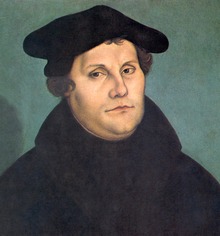
Martin Luther

C F W Walther

President of LC-C

District President

Me

Local Pastor

Other plebs.

The end.  And we, in the Christian church, very very rarely acknowledge the mites that actually get dropped off at the church, or honestly anywhere else.  You see, everyone ever has their own problems, their own bugbears that they have to deal with.  And the vast majority of people that I see have a bucket of problems that they just pretend that they don't, at least for the purposes of church.  But they do know what counts as a problem, and they are quick to point it out in others, mainly because, at least for the purposes of appearance, it sure looks like you're bringing a lot more to the table.  You've got a good German last name, you've got the Lutheran pedigree going way back, and you served on the board of Elders twice. Great.  That's the large sum you bring and drop off.  Your abundance of virtue and goodness.  And it's good stuff, don't get me wrong; it certainly looks like a lot more than anyone else brings to the table.  But that's where you and I always get into trouble.  You see, we have no idea how much anyone else is bringing to the table.  Do you know why?

Because we have no idea what anyone else has.

The only person whom you know sufficiently enough to be able to say 'he or she should try harder and be better,' is you.  Nobody else, mainly because you have no idea what is in anyone else's account.  You have no idea how many riches are stored up, if any.  The only person whom you have the slightest clue is you.  You know what your account is, both materially and spiritually, you know your abundance, and you know your weaknesses.  And sometimes, and you know this, it takes absolutely everything in you to surpass one moment of temptation.  It takes everything in you to not click a link, or to walk past the liquor store, or to not call that one girl, or to say 'no thanks, I'm good' when offered something, or to put your car keys down when you're about to drive, or to bite your tongue and say nothing when your wife or husband is leveling legitimate criticisms against you, or to go to church only once in a year.  You know what it takes.  And those are the mites.  Those are the offerings that look like nothing, but in reality are absolutely everything.  You put those on the line, and it looks like two small copper coins, worth less than a penny.  

But it's worth so much more, because it's giving everything.  

As someone's bathroom wallpaper once said, you'll never succeed until you make your weaknesses into your strengths.  The abundance that you have, it's not actually worth as much as your mites.  Your strengths are worth a whole lot less than your weaknesses, and it's on a case by case, moment by moment basis.  And the only points of comparison you have are

1 - You yesterday.
2 -  Jesus Christ, who actually did give up everything, to cover those moments of pride and arrogance, those moments of judgment, and those moments when you cling on tightly to those mites, afraid anyone should see that meager offering.  But your heavenly father, who sees what you do in secret, will reward you.  

PJ.

Monday, November 5, 2012

Putting the fun in funeral, putting the saints in all saints day.

Did you see that ice out there on Sunday morning?  It was craaaaaaaaazy.

For those of you who are in the Regina area, there's no way you could have missed it. It was bonkers.  Cars flying around like you wouldn't believe, cops directing traffic, semi trucks parked by the side of the road because they couldn't make it up inclines, all that.  If you would have been there, you'd know.

But this is that time of the year.  A time when winter gets going, and you realize just how at the mercy of the weather you are.  Oh sure, it seems simple enough when you're cruising along in the summertime when the living is hot, and it's all windows down and shorts.  But then all of a sudden, winter crashes in, and this is the time of the year when it does.

Now, we're at the time of the year in which winter is just getting going.  And it shows no sign of stopping.  And this is the time of the year when we as people tend to lose faith in things.  We tend to lose faith in the idea that it will ever be spring again.  We tend to lose faith in the idea that we'll ever just hop in our cars and just go, where you can go 50kph when the speed limit is 50.  Heck, you might even tempt fate and go 55!

But no.  Not now, not at the beginning of November.  You are stuck in the grip of winter, and it's not going to let go for half the year.  And it's just going to get colder.  It's summer for two months.  It's winter forever.

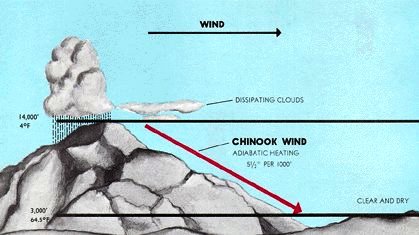
But then comes the curious story of what we in Calgary call the chinook.  You Saskies have probably heard of it, right?  The chinook?  It means 'snow eater' in latin.  But the chinook does something pretty precious for us Albertans.  It breaks winter up.

Now, to be absolutely clear for you Saskies who have no idea what I'm talking about, in this province, once the mercury dips below minus ten, it stays there for either six months or until the end of the world, whichever comes first.  And after a while, you start to feel as though ten degrees below zero is actually a pretty nice day.  And when you pile up snow all over your yard, you realize that it doesn't go anywhere, and you start to run out of places to stack it.  Because it doesn't melt.  It just stacks up.  And as Saskies, we spend half the year shoveling snow against our houses, and then a day furiously shoveling snow away from our houses, lest the foundation spring a thousand leaks come springtime.  But until spring, the snow just sort of hangs around.

In Calgary, you get a chinook.  And the temperature warms up.  Like, really warms up.  It gets super warm for about a couple of days.  And what happens when it gets warm like that?  People who have convertibles drive with the top down and the heater on.  Folks get outside and chip away at the ice on their sidewalks without wearing jackets.  And nobody in Calgary feels as though they have actually had spring arrive on January fifteenth, or whatever.  Nobody thinks that this warm spell is going to last for the rest of the year.  Everyone knows that the mercury's going to plunge again, no doubt.  But what the chinook does is to remind you that the winter doesn't last forever.  There is an end to it, and you get a little glimpse of it for a while.

And believe it or not, that's what a funeral service is, too.  When properly considered, that is.  Most of us think of a funeral as a time and a place to go and be sad.  And that would come as no surprise.  After all, we've lost someone incredibly important to us, someone who was a big player in our lives, someone who we're going to miss.  And it's like the onset of Canadian winter, the beginning of November, where you feel as though things are never going to be free and clear and easy again.  There's a hole in your heart all the way to China, and it's never going to go away.  It's going to be frosted over windows and plugging in the car from now to eternity.  The hole in your life is so big and so great and so immense, that nothing is ever going to make it better.


But then the funeral service happens.  And yes, you're sad.  But the point of the funeral service isn't to make you sad.  On the contrary.  It's to give you hope.  Think of the funeral service when your loved one passes away, as a chinook that enters the winter of your life.  Just when you think that winter's never going to end, just when you think that it'll be ice and snow and short days forever, all of a sudden, and out of nowhere, comes a reprieve. However brief.  What you do at a funeral service is not just talk about how great the person was who passed away, and I'll tell you why.

1 - You don't need any help remembering all the good things about that person.  It's all that's on your mind.
2 - Talking about how great something is that you've lost is a sure fire way to feeling even worse.

You know that's true.  Think about Canadian winters again.  You know how when winter really sets in, and someone always says the same thing:
"Remember in the summer when we were complaining about how hot it was?"
Yes, bozo, of course we do, and we are currently regretting it. Pretty much all you can think about when it gets to be about minus 30 is how cold it is.  It's all you think about, it's all people talk about, it governs your movement and your activity, your day is based around how cold it is.  It's all you can think about, until one day, when the brief warm spell happens, then you realize that there is a brighter day coming.  It's not here yet, but it will be soon. 

Not that kind of all saints day.
This is what a funeral is for.  It's not to make you feel more sad, it's not to forget about the person who just passed away, it's not for any of that.  It's that brief chinook in the middle of winter, it's the moment when, just for a second, the snow melts, and you can see the grass underneath.  It's the moment when you were sure that winter was going to last forever, and then all of a sudden, you could see the sky, a hint of green, the roads were safer and clearer and nicer.  Maybe just for one day, there was the promise of spring.  Winter was sure to set in again, but you knew it wasn't going to last forever.

That's what funerals, and all saint's day, are all about.  Not that our loved ones are standing right there beside us, or have risen from the dead on that day, but these are the days in which, for just a second, we can see the life beneath the death, the promise beneath the grief, the love beneath the sadness.  These are the days when we have the promise, the guarantee, that even though things seem more like forever than a Canadian winter, they're not. 

16“In a little while you will see me no more, and then after a little while you will see me.”


17Some of his disciples said to one another, “What does he mean by saying, ‘In a little while you will see me no more, and then after a little while you will see me,’ 
and ‘Because I am going to the Father’?”
 18They kept asking, “What does he mean by ‘a little while’? 
We don’t understand what he is saying.”

19Jesus saw that they wanted to ask him about this, 
so he said to them, “Are you asking one another what I meant when I said,
‘In a little while you will see me no more, 
and then after a little while you will see me’? 
20I tell you the truth, you will weep and mourn while the world rejoices.
 You will grieve, but your grief will turn to joy. 
21A woman giving birth to a child has pain because her 
time has come; but when her baby is born she forgets 
the anguish because of her joy that a child is born into the world.
 22So with you: Now is your time of grief, but I
 will see you again and you will rejoice, and no one 
will take away your joy. 23In that day you will no longer ask
 me anything. I tell you the truth, my Father will give you 
whatever you ask in my name. 24Until now you have not asked
 for anything in my name. Ask and you will receive, and your joy will be complete.

                                                   John 16:16-24.


And what is the little while?  Ah yes.  That is the mystery.  It certainly doesn't seem like a little while, but neither do the months between November and May.  But it is a little while.  And once in a while, we get a glimpse of spring, and the promise that winter isn't forever.


PJ

Monday, October 29, 2012

Reformation

Remember Blind Date, that show starring Roger Lodge?


Me too.  I loved that show.  Something about watching totally hapless folks who have essentially nothing in common crash and burn in their feeble attempts at a relationship.  Like most good reality TV, all it does is make you feel better about your own life.  Anyhow, if you're unfamiliar with the concept of a blind date, allow Therapist Joe to explain it to you:

A blind date is when you go out on a date with someone, without knowing anything about them, including what they look like, their interests, whatever, in the hopes that things will totally spark between you.

That's a blind date.  And with most folks (oooooh, I'd say almost the vast majority of folks), they end up blind dating churches.  And you know how blind dates work, don't you.  Of course you do. You've heard about them from complete strangers. The way blind dates work is that a friend of yours offers to set you up with the cute girl that he and his son know from work.  And you head out to the park / nightclub / library and meet up with her, and only after you've spent some time together do you actually find out what she's all about.

Now, one of the points that I made on Sunday was that being in a church is an awful lot like being in a relationship.  No, scratch that.  It is being in a relationship.  A relationship with a congregation is a lot like a relationship with a human being:  First of all, for a lot of us Lutherans, it was a sort of arranged marriage, where our parents brought us to church, and we stuck around.  But for a lot of other folks, churches get introduced to people in the same way that blind dates do, by saying "Hey, I know this Anglican down the street, and she's super-cute.  Maybe you should go check her out sometime."

And so it goes.  Like with the majority of relationships we enter into, church relationships are frequently not based on too much substance.  It's about looks, it's about music, it's about movies, it's about going bowling, hanging out in the park, whatever.  And then you find out what a person's really all about waaaay later.  Growing up, in high school (grades 10-12, saskies), the most important things someone could have going on were how they looked, and what kind of movies and mu sic they liked.  Aside from that, not much else mattered.  And we all thought, growing up, that if you found someone who shared your same values, your same beliefs, your same views on the future, all that, but they didn't like the same movies as you, then the whole thing was shot right out of the gate.

Well, in a desperate attempt to get things together, this last Sunday was our observation of Reformation day, the time in the church in which Martin Luther broke off from the church on earth as it had been at the time, and reformed it.


Seriously, these two guys are not the same guy.  How are you still getting them confused?


The idea was that the church was corrupt.  Big deal, I hear some of you saying, the church has always been corrupt!  Okay okay, but hold on a moment here.  The corruption of the church was at a spectacular high, partially due to the lack of belief in what the Christian church actually taught.  Yes, saith everyone, the church offered up a different reality from what was contained in the Bible, and in the words of Jesus Christ.  As it seemingly always has, right?


But the difference was, back then, nobody could possibly keep the church to account.  Because nobody else knew what was in the Bible.  The relationship that you had with your church was completely stuck permanently at the phase of admiring her beauty, without ever getting to know what she was all about.  If you do yourself a favor and take a stroll through the greater and more elaborate churches in Europe (less so here in Canada), you'll find a whole bunch of very pretty things.  You will find glorious, gorgeous sanctuaries, bedecked in tapestries, carvings, sculptures, paintings, and the like.  A lot of art, including the stained glass windows.  All of this stuff was put in place for a couple of reasons:  First of all, to look pretty, which it does.  Second of all, to tell the story of the Bible.  You should all know how picture books work by now, that children who are pre-literate can sit down with a book full of pictures, recognize the pictures, tell you what they are, and all that, without having to know a single word.  It was like that in churches too, in that a great many folks who were attending churches during those great middle ages period were functionally illiterate.  And even if they were literate, they sure weren't going around chatting to each other in conversational latin.  And with latin being the language of the church, folks who went to church on a Sunday morning didn't understand a word of it.  And so they got to go and look at the pretty pictures.

These days, if you go to our church, you don't have a whole tonne of pretty pictures to look at. Some, yes, but not too terribly many.  

Nice, hey?

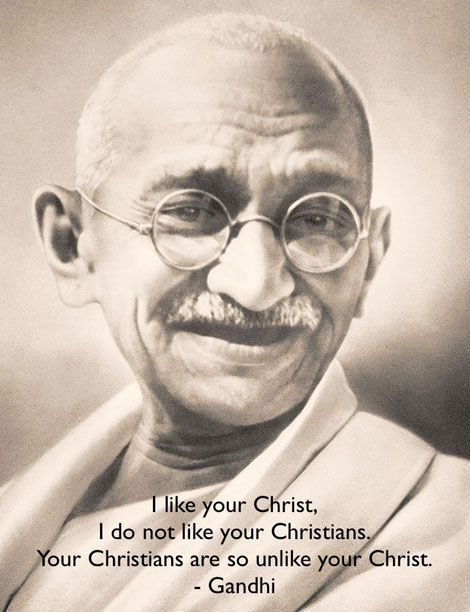
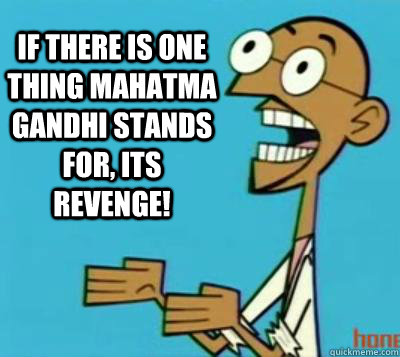
We have a couple of banners, some paraments, and those wooden carvings to either side of the cross.  That's it.  Why is that?  Because unlike pre-reformation stuff, you can listen to what's going on.  You can read the Bible for yourself, you can read the catechism for yourself, you can be up on absolutely everything, and perhaps most of all, we can get ourselves outside of the Gandhi view of Christians.  

If you get distracted by the bricks, or the paraments, or your smartphone during the service, it's not because you don't understand me, it's because I've gotten boring or irrelevant.  Both of those things, I'm sure have happened.  But the idea is that whatever you get from me, you don't have to just believe that I'm preaching the word of God.  You don't have to be here because of the prettiness of the place or whatever.  As far as blind  dates go, every week gives us a new opportunity to explore our relationship, both with the church and with God, based not so much on how everything looks, but more on the deeper content of character, of meaning.

Back in high school, deeper content seemed like the least important thing in the universe.  


Can you tell which one is pastor Jim?

When we were all young and silly, everything but values and culture and such and such seemed pretty important. Movies, tv, music, likes, dislikes, all of that stuff was super important.  But after the reformation, we can take some time to listen to the actual word of God.  Hear what he says, in our own language.  If the pastor of the church is mistaken, we can rebuke him.  If the church has fallen away from the teachings of Jesus, we can bring it back, because we can know what it says in the first place.  If our Christians are unlike our Christ, we can know that they are, because we know Christ and him crucified.  

Oh, and to disappoint Gandhi, Christians are always going to be unlike Christ. If they weren't, then they wouldn't need Christ.  But it's not incumbent on the Christian to be Christ (which is impossible), but to be genuinely honest about why they are not like Christ, and seek forgiveness for that.  So when someone says "you're not much like Jesus," we can say "I know.  Thank God he sent Jesus so that worthless screw-ups like me could have a chance."

PJ.

Tuesday, October 23, 2012

It's not for sale.

Yes, it was this time again.  The time for the camel, and the eye of the needle.  It's a good passage, mainly because it's from the Bible, and everything's good, because it's the good book.  But it does give us pause for thought, as to who the rich people in the world actually are.  To help you out with this, here are some percentages of people who live on less than $1.25 a day.  That's one dollar and twenty-five cents per day.  I'll let that sink in....... ready?  Let's begin.
Only one of these animals is not in poverty.
My vote is for the Hippo.

Bangladesh:  43%
Burkina Faso: 44.6%
Central African Republic: 68.2%
China:  13.1%
India:  32.7%
Indonesia: 18.1%
Madagascar: 81.3%
Pakistan: 21%
Swaziland: 40.6%
Uganda: 38%


Those are not small numbers.  And numbers don't lie.  Now here's an even more interesting activity that you can try in the comfort of your very own home.  If you're reading this on a library computer, or on your smartphone while riding the bus, don't do this activity yet, you'll probably get thrown out.  Grab your shirt, pull it up and over your head, and check out where your shirt was made.  Mine today was made in Cambodia.  Cambodia which has a ratio of 22% of people living on less than $1.25 per day.  Go ahead, check your clothes and see where they were made.  And then cross reference that nation with this data.  I'll wait.

Odds are, like myself, the nation that produced your textiles has some grindingly poor people in it.  And that seems like an awful lot of folks who have to live in poverty just so I can wear my fashionable polar fleece.  So, if you break it down, that means that 397, 277, 427 people live on under $1.25 a day in India alone.  In China, the numbers are 174,736, 900.  Combined, between the two countries, you have  572, 014, 327 folks in grinding terrible poverty.  These are the countries that make your shirts, your pants, your plastic toys, and your smartphones.  You know what that is?  That's sixteen times the population of Canada.

Wow.  You rich yet?  Rather, do you feel rich yet?  You should, because it's appalling, really, how rich we all are, and yet don't even think about it.  But like many other things in the Bible, you and I read it, and we read it to seek ammunition against other people.  Who's the guy that we're likely to be targeting as a rich man who probably won't get into heaven?

Hi guys!  Miss me?


Hey it's this guy.  He's rich.  And he's someone we can comfortably point to from our massive houses, with central heat and central air, and water that won't give us cholera if we drink it, and hot and cold running water, and hi-def tvs, and we can say "Look at that rich git.  How dare he claim to understand the plight of the common man? How dare he say he understands for a moment that he cares for the poor!"

But you're distractingly rich. And I mean that very sincerely.  You are distracted by your wealth, which, because you don't think about it too often, becomes a problem for you, and your camel, and the eye of the needle.

Why is it so difficult for the rich (including us), to enter into the kingdom of heaven?  Well, what do we do with our time, and how much time do we spend acknowledging our blessings?  The more you have, the more difficult it is to remain humble, and the more difficult it is to realize your place in God's universe.  I know I made this point on Sunday, but it's still a good one, so I'm gonna use it again.  If we have a life filled with distractions, if we have an experience in which we're constantly being pushed and pulled in a variety of directions, how easy is it to even see or hear God at all?

The psalms tell us how to recognize God.  Psalm 46:10 says "be still and know that I am God."  And that's so much harder to do if you've got a million and one things pushing you here and there and everywhere.  It used to be that the wireless radio was going to intrude into homes and debauch them.  And then it was tv, and then the internet, and then smartphones.  And with all these intrusions, it gets harder and harder to be still, to know that God is God.  We welcome distractions into our lives like crazy, we live our lives in a constant state of distraction, being pulled here and there, and even for some of us, when we sleep, we're still moving and grooving.  Ever used a sleep timer on a radio or TV to fall asleep?  Even in those moments leading up to losing consciousness, we're still busy.  Is it any wonder then that God, when he sent angels to people to communicate things, did so in dreams?  Those who are rich and powerful, who can afford a world of distractions, who feel as though they've earned everything, the only time they're still is when they're asleep.

That's when God talked to Joseph.
That's when God talked to Pharaoh.
That's when God talked to the king of Babylon.

For us, we who are wealthy, we spend a lot of time doing a lot of stuff, we're busy busy busy all the time, too busy to even listen to what God says to us.  If you're poor, as a lot of folks were in the time of Christ, it's a whole lot easier to listen.  Also, you recognize everything you have as a gift of grace.  You don't take much of anything for granted.  You can't afford to.  We rich, that's exactly what we do.

So what to do now?  Moving forward, how best to deal with your outrageous wealth that you have, but that you don't remember that you have?  Well, John the Baptist has some advice for all of us, or rather, he is telling us what will be happening.

"Prepare the way of the Lord,
Make his paths straight.
Every valley shall be filled,
and every mountain and hill shall be made low,
and the crooked shall become straight.
And the rough places shall become level ways,
and all shall see the glory of God."               
                                                                                          -Luke 3:4-6


Aha.  Another reason that the rich don't much care for the Gospel of God is that it has in it a promise to level things off.  It promises full and complete equality before God (In Christ there is no slave nor free, no male nor female, no Jew nor Greek.  All are one in Christ Jesus).  This is great news if you're desperately, grindingly poor, if you're living on less than a dollar a day, if you're suffering day in and day out with poverty.  This is bad news if you're wealthy.  Then the smelly, dirty people of Bangladesh, the textile workers of India, the malnourished of the Central African Republic, and the toy assemblers of China, you're equal to all of them in God's eyes.  all those fancy things you earned, all those toys you bought from them, all the houses and cars and wealth, all of it means nothing.  Because you are exactly equal in God's eyes.  He sees a sinner in need of salvation.  

Now to go off on a Lutheran tangent for a second, this is pretty much straight up Law/Gospel stuff.  Law and Gospel tell us something - namely that God seeks to redeem sinners.  When he looks at you, he sees a sinner in need of salvation.  That's good news if you have already seen your sin, then you see the salvation offered.  If you don't know that you have any sin, then it's terrible news, because it dares to mention that you're not perfect.  And that's a problem for you.  If you've been gliding along up until now with nary a thought to your sin, then it's a problem, because it tells you that you've got a problem, you've got a flaw that needs to be fixed.  You have to be humble, you have to be forgiven, beginning and end.  It's easy to do if you know that you're sinful, then the word of God is a joy.  If you think you're essentially okay, then the words of God are offensive and raw, even though they could be the very same words.  It's the same deal with wealth.  If you think you've earned everything, and it's yours by divine fiat, then you'll be disappointed when you depart this earth with nothing, just as you arrived with nothing.  If, however, you realize that everything you own is a gift, and every opportunity you have is a gift, then you're a whole lot more grateful for everything.  Lest we think that it only applies to material goods, the biggest blessing, life everlasting, is as much a gift as anything else.  Once you've worked out that what you have is a gift from God, then it becomes much easier to be thankful for everything.  House, home, family, and faith.  

PJ.

Tuesday, October 16, 2012

Inheritance, zombies, and wrestling moves.

I have a long and sad history of bringing something up with my parents every once in a while.  You see, they live in a palatial palace, which they earned through decades of hard work and sacrifice.  And whenever I go to their place, I like to mention that I have in mind to move them into a home, and to take their house for my own living quarters.  I know, for shame, right?  I'm a dreadful son.  

But here's the scoop.  I can either take what they own by force, or failing that, I can wait to inherit their stuff after they pass away and go to be with Jesus.  This concept of inheritance is one that crops up in an awful lot of the mystery novels my mother is fond of reading.  For those who are paying attention, I've mentioned her terrifying mystery novel covers before, but in case you're new here (and if you're new here, then welcome, Billy), here's another particularly terrifying one.  But here's the plot of a lot of murder mysteries:  Someone has something of particular value. You want that item.  You off that person, and get their item.  Lather, rinse, repeat.

But wait!  This is how the perp in question ends up getting busted:  it's not too hard to work out that if you inherit the sum of ten thousand dollars money shortly after your great-aunt Agatha has been bludgeoned to death with a golf trophy, you may come across as a bit suspicious.  If you've got something to gain from the murder of another party, and you subsequently gain that item, then it's a wee shade suspicious.  Now, that's the problem with inheritance.  It's the problem that lurked at the heart of the 'monkey's paw' story, which says that your wishes to have more money come at a terrible price: the death of someone you love.  

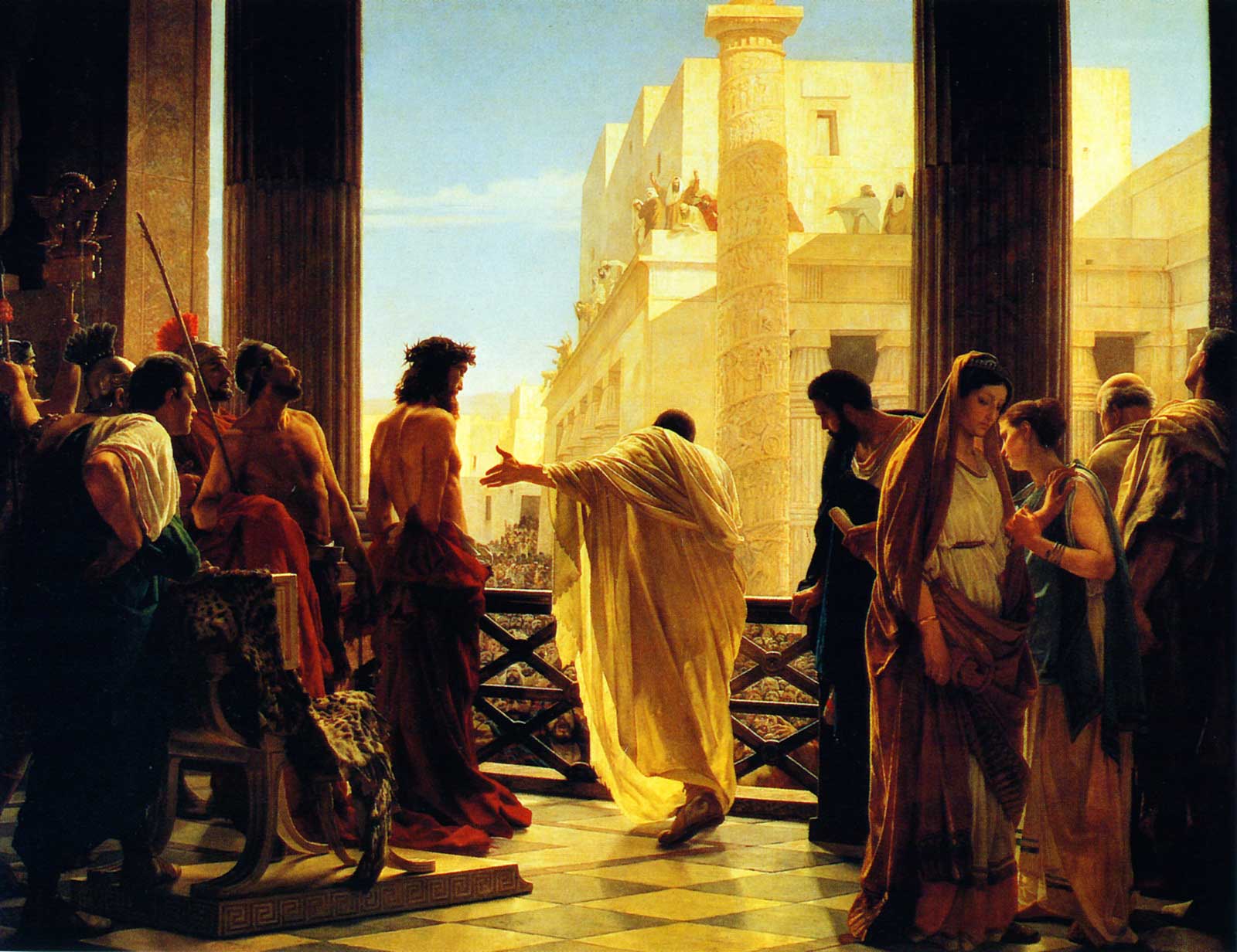
Now, let's extrapolate this to Jesus, because guess what:  his story is one of inheritance and murder.  Just because murder is accomplished through judicial means, that doesn't make it any less of a lynching sometimes.  When Jesus is arrested, it's in the garden of Gethsemane, where he had been praying with his sleepy disciples.  And the crowd who comes to arrest him is from the temple authorities, bringing him back to the temple courts.  And what gets decided there?  Only that Jesus gets railroaded, and that he has no defense.  But the temple authorities, legally, can't execute anyone.  They don't have authority under Roman rule to carry that out, for good reason.  The Roman government didn't get to be the leading empire of the world for five hundred years by allowing two parallel legal systems to run at the same time.  So they have to take him before Pontius Pilate, the Roman governor, who is well aware that Jesus has not committed any crimes against the Roman state.  If he's blasphemed against the Temple, or against the majesty of God's holy house, what problem is that for the Romans, who worship Jupiter, Apollo, and Uranus?  So Pontius Pilate is being asked to crucify Jesus of Nazareth for breaking laws that the Romans don't even have.  This is what I mean when I call this a judicial murder: just because you kill someone through ostensibly legal means, doesn't mean it's not murder.  

Now, this is where the story gets kind of funny.  Remember in the reading from Sunday where the rich young ruler asks 

"Good teacher, what must I do to inherit eternal life?" And he said 
to him, "Why do you call me good?  No one is good but God alone.  If you wish to
enter into life, keep the commandments." He said to him "Which ones?" And 
Jesus said "you shall not murder, you shall not commit adultery,
you shall not steal, you shall not bear false witness, honor your father and 
mother.  Also, you shall love your neighbor as yourself."
The young man said to him "All these things I have done from my youth.  What more 
do I lack?" Jesus said to him "If you wish to be perfect, go, sell
your possessions, and give the money to the poor, then you will have 
treasure in heaven.  then come, follow me." 
When the young man heard this, he went away grieving, for he had
many possessions.

Matthew 19:16-22

"Good teacher, what must I do to inherit eternal life?" Well, honestly, what do you to to inherit anything?  Normally, you wait until the person who has what you want dies.  Sometimes you kill them.  But hold on for a moment, because the story gets even stranger. The vast majority of people who had assembled to execute Jesus Christ, the vast majority of people who assembled themselves to shout for the crucifixion of Jesus, they had no idea what they were getting into.  Pilate tries to set them up for it, by saying to them 

So when Pilate saw that he could do nothing, but rather that a riot
was beginning, he took some water and washed his hands before
the crowd, saying 'I am innocent of this man's blood.  See to
it for yourselves.' Then the people as a whole answered 
'His blood be on us and on our children!'
So He released Barabbas for them, and after flogging Jesus,
he handed him over to be crucified.

Matthew 27:24-26


Pilate tells them as clearly as he can that he's not responsible for the death of Jesus that they crave so badly.  He's committed no crime, and can't be punished by Roman law.  But Pilate is savvy enough to know what happens when people riot, so he allows them to have their wishes, and turns Jesus over to be crucified.  So everyone's complicit in his killing.  Pilate lets it happen even though he knows that Jesus is innocent.  The Roman soldiers nail him to the cross, thus actually striking the fatal blows of nails and spear.  The crowd is responsible for calling for his death, and threatening riots all over the place.  Nobody gets a pass on this one.  Nobody gets to say that they had nothing to do with the execution of Christ, not even us.  Even now, if you've botched anything in your whole life ever, it was sufficient for Jesus to go to his death.  Even if you were the only one.  

For Christ also suffered once for sins, the righteous for the
unrighteous, that he might bring us to God.

1 Peter 3:18

You're as involved in the death of Jesus as anyone else, because you helped to make it necessary.  Remember what Jesus says to the rich young man: If you want to be perfect, if you want to have life, then you have to keep everything perfectly, and live a life of wiling service.  And we don't really do that that often.   But as I say, this is the really strange twist of fate: The people who killed Jesus, calling for his execution, crying for his blood, meekly allowing him to die, nailing him up, whatever, what they didn't realize was that they were killing someone who had willed them the greatest inheritance ever.  They were murdering someone who has a pearl of great price, beyond anything else that could be purchased, a treasure hidden in a field, something worth more than anything else, he had this.  And the only way they could get it was to have the person who owned it die.  And they did that through killing him, taking away everything he had, and leaving him to die on a block of wood somewhere in a middle eastern desert.  And as he died, Jesus had this to say:

Forgive them, Father.  They know not what they do.

Luke 23:34

He died.  And upon his death, what he owned, that is, his right to stand before God, his sinless life, his righteousness and holiness and grace and perfection, not to mention eternal life, is what we inherited.  

I mean that the heir, as long as he is a child, is no different from a slave,
though he is the owner of everything, but he is under
guardians and managers until the date set by his father.  In the 
same way, we also, when we were children, were enslaved to the 
elementary principles of the world.  But when the fullness of time had 
come, God sent forth his Son, born of woman, born under the law, to redeem 
those who were under the law, so that we might receive adoption as 
sons.  And because you are sons, God has sent the Spirit of 
his Son into our hearts, calling "Abba, Father!" So you are no
longer a slave, but a son.  And if a son, then an heir through God.

Galatians 4:1-7

We are inheritors of the greatest prize of all time, from someone we murdered.  And if that isn't crazy enough, take a second to go back to the story of the monkey's paw that I included earlier.  First wish, they wish for money.  For that to happen, the couple's son has to die in a horrific accident.  Then they get the compensation that they required.  Second wish, they wish their son back to life.  But he doesn't come back to life just right.  He comes back, presumably, as a terrible zombie, smashed by his accident, and having been buried for a number of days.  So they have to wish him back to being dead.  And thus are their three wishes.  End of story.  With the story of Christ, he has something we want.  We kill him. We inherit his life and grace and eternity, as the rich young man asked for.  And then he rises from the dead.  Not as a zombie, not as the walking dead, not as something less than human, not as an abomination, but as a resurrected being, put right again.  Not just dead flesh walking around, but a living body, risen to die no more.  And that's the inheritance we all get too.  

Good teacher, what must I do to inherit eternal life?  Kill the one who has it, and find out that he willed it to you.  And now, you are children, and heirs of the promise, and of the life won for you by Christ Jesus.  Through inheritance of what he has that we want.  Life.  Everlasting.

PJ.