The musings of the Pastor from Good Shepherd Lutheran Church, Regina SK

Welcome. If you're a member at Good Shepherd, welcome to more thoughts and discussion of the week that was, and some bonus thoughts throughout the week. If you're not a member, welcome, and enjoy your stay. We are happy that you're here.

If you like what you see here, consider joining us for worship at Good Shepherd Lutheran Church. Sunday mornings, at 8:30 and 11:00. You can also follow us on Facebook.

Monday, October 21, 2013

The stupidest story in the Bible

How much do you know about Jacob and Esau?  Odds are, pretty little.  But I was tooling around on the internet the other day, and I came across a youtube video of a long drawn out cartoon / commentary about how the Jacob and Esau story was stupid, and for a moment it made sense.  After all, that story always has seemed a little bit silly - somehow Isaac figures that goat skin all over his smooth son's arms in any way resembles his hirsute son?  It seems a little silly.  I am hardly likely to win fatehr of the year anytime soon, but oh my, I could tell the difference between my two sons no problem.  They're totally different in every way, aside from genetics, and I could tell the difference between them blindfolded.  

But maybe that's the point.  Perhaps the ludicrousness of this story underscores the ludicrousness of our faith.  You see, back in the day, Martin Luther figured something out about the Christian faith.  He figured out justification.  He figured out that the death of Christ on the cross justified us before God.  That our sins are forgiven, and that God no longer sees all our terrible sins when he looks at us.  And we are redeemed and forgiven.  And strangely enough, those of us in the church, we no longer see this as absurd.  'Of course,' we say 'why wouldn't we be justified?  Justification is the article on which the church stands or falls.'  Yes, it seems really simple, until you think about it.

How did the execution of a Jewish carpenter two thousand years ago affect you in the slightest?  How do his good works and his inherent goodness apply to you?  It's a straight up question, and one that most of us don't even think about for the overwhelmingly vast majority of our time.  Jesus gives good advice, he's a neat guy, he has interesting things to say, but does this in any way actually connect with us?  Yes.  And I'll tell you how.
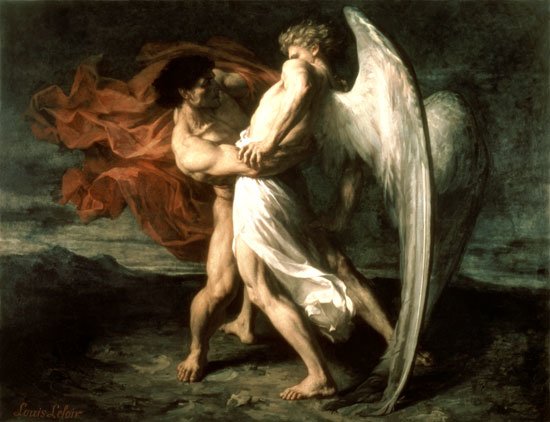
As mentioned on Sunday, the Old Testament reading of Jacob grappling with God, wrestling with God until morning, it happens at a key point in the scriptures.  It happens as Jacob is trying to figure out what will happen between him and his brother.  You see, Jacob, in case you didn't know, he'd stolen his brother's blessing under false pretenses, he'd taken his brothers birthright for a mess of pottage, and he was now on the lam, watching lambs, waiting for a chance to return.  But here's the problem .  Things with his brother were bad.  Really bad.  His brother had four hundred men with him, and his brother was big and mean.  Esau was a warrior, a fighter, a hunter, an outdoorsman, he was big and strong.  And Jacob, by comparison, was a creampuff, someone who got his way by talking his way into our out of things.  He could in no way hang with his brother and fight him.  He was going to have to run, or to make things work.  But if he was going to run, he was going to have to keep running forever.  He'd already been doing that, and now, it was time to face his brother.  And his prayer to God before he met his bother was that he might be saved from the grasp of Esau, his enemy.  

After wrestling with God all night, Jacob was changed.  His hip was put out of joint, and his name was changed, from Jacob to Israel.  And so when he went out to meet his brother, it wasn't to run, and it wasn't outfitted for war, it was to grovel and to beg for forgiveness.  You see, the thing is, that if you wrestle with God, wrestle with him all night, he's going to work on you and change you, through his word.  And to do that, you have to actually be connected and immersed within that word.  You can't start off with the idea of God that you want, the God of 'itching ears,' the God who tells you what you want to hear.  You have to start off with the actual God, and to get through what he has to say, you have to wrestle with him, all night if you need to.  

You have to grapple with what God really says, and know him for who he really is.  You have to get into the scriptures, and see what God has in mind for you and for your life.  You'll come across the very real truth that the way he wants you to resolve difficulties and broken relationships is through forgiveness and reconciliation.  It's through mercy, through asking for forgiveness where it is required.  It is through repentance, and through love.  And the Biblical requirement is that if you have overstepped, you must repent; and if someone else has sinned and repented, you must forgive.  You don't have a choice.  And this isn't the sort of thing you understand unless you actually do the work, and wrestle with God, and allow him to change you through his word.  Otherwise, your itching ears will make for you a God who says that you're tops, the problems you have in your life are problems caused by other people, and all you have to do is to steer the course and wait for everyone else to figure it out.

In other words, a lot of what you have to do as a Christian is to see God, and his word, for what they actually are.  You need to see God for who he actually is.  And this is the miracle of how justification works, and how it ties in with that story of Jacob and Esau.  For justification to work, you need to see God for who he actually is, and as Jesus says 'he who has seen me has seen the father.'  If you want to know who God really is, get to know Jesus Christ for who he actually is.  Not just the parts you like, either, but get to know the parts you don't like  Wrestle with him and realize that he promises grace, but requires repentance from each and every single one of us.  Realize that the gospel is offered to sinners, and those sinners need to know their sin, and confess it, and be done with it.  In doing so, we'll be seeing God for who he actually is.  

And he won't be seeing us for who we actually are.  That's the real kicker that we weren't expecting, isn't it?  For people who want to be seen as their real selves, to be known as who they really are, they really expect and desire to be recognized as their true selves.  But I have some bad news for you in that department:  When God looks at you, he doesn't see the real you in the way we'd expect.  In a way, the story of Esau and Isaac and Jacob gets less silly the more you consider the story of Christ.  You see, the story of Esau involves Jacob sticking some goat skin on his hands and neck, and fooling his father into thinking he was his brother.  In that, when Isaac touched his hands, he felt his elder son, not his younger.

And that's what happens with us too.  When God looks at us, to bless us, he doesn't see us.  He sees the merits of Christ.  When he reaches out to touch us and give us his blessing, he doesn't see our merits, he sees those of Christ.  He sees the work and righteousness of Jesus.  When you remember that, all of a sudden, the story of Esau being an hairy man is a way better story.  God gave a blessing to someone who didn't deserve it, just like Isaac did.  He gave it to us, because looking at us he saw Christ.  And just like Jacob, we don't get the blessing whipped away because it shouldn't have been ours to begin with.  We were blessed, we were blessed at baptism, and we are blessed at the Lord's Supper.  We are blessed through word and sacrament, we are blessed through God's love, we are forgiven and redeemed.  We are given all these things because God sees Christ when he sees us.  

And the so-called 'real us?'  The sin is removed, and the rest, God looks at, and says that it is good.


Thursday, October 17, 2013

Fresh eyes.

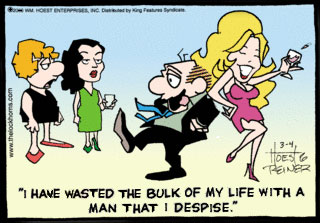
Does anyone remember the lockhorns?  Sure you do. And did you know they're still around?  Still married, still hate each other.  It's a sad state of affiars, isn't it?  Can you believe that strip is still running?  This couple has been in middle age since 1968, and has long since passed the seven year itch.  They're doing that thing
that you're supposed to do when you get married - hate each other.  It's such an expectation that we pepper even our good wishes for newlyweds with the same ideas, that they will end up hating the person that they're professing undying love to.

But have you ever wondered how that happens?  How does it transpire that couples who love each other to death end up sniping at each other constantly, and end up slagging each other off to mutual acquaintances and we think it's normal?  Shouldn't that be a pretty big deviation from what we're expecting?  Well, hold the phone, fibber macgee, because that's what this is going to be all about.  Because we're in the season of thanksgiving, and it's the season in which we, hopefully, will be looking a little closer at what we have to be thankful for.

You see, folks, it's really easy for us to fall out of love with stuff, be it each other, God, our nation, our family, whatever.  It's really easy for us to fall out of love, though.  And the biggest way in which we do that is when we take each other or anything else for granted.  It's a major, MAJOR problem.  In fact, facing people of our persuasion (white, middle class, living in the first world), it may be the biggest problem driving an awful lot of unhappiness.  We are people who are generally dissatisfied with the amazing lives we live.  Generally.  You may think this doesn't apply to you, but it almost certainly does.  And I'll tell you how I know this.

I know this because you are probably someone living in the first world, bombarded by advertising all day, and continually being told that your life up until this moment has been nothing but a failure, which could only be rectified by purchasing the latest product or service.  Think about this, as I've said many times,that 99% of ads these days say very little about the product or service in question, and usually just says a lot about your life as a failure.  You're not being sold the product, you're being sold the lifestyle, which weirdly enough never shows up after you purchase the product.  Weird right?


Anyhow, knowing that you're being marketed to in a certain way should explain something to you, or at least make it clear.  It should make things clear that you're being approached in your weakness as a satisfied person.  Have you ever asked yourself why it is that your house is like mine, a graveyard of thing that you thought would fill the gap in your life?  Well, it's for that reason, that you were sold them under false pretences.

What's the solution?  Well, it's not too complicated.  Have you ever found something in your house that you were sure you'd lost forever?  Ever been looking for something sensible, like a hammer or whatever, in your
house, and found something that you've lost a long time ago, like an old record player, or a gameboy, or a shirt that you haven't worn in forever?  And then, all of a sudden, you're totally delighted by this hitherto unknown treat, because you're seeing it with fresh eyes.

Seeing things with fresh eyes is fundamental to not just this story, but to the Christian experience in general.  Look at the reading that we had from Sunday, in which ten lepers asked Jesus for healing on the road to Jerusalem.


12 As he was going into a village, ten men who had leprosy[a] met him. They stood at a distance13 and called out in a loud voice, “Jesus, Master, have pity on us!”
14 When he saw them, he said, “Go, show yourselves to the priests.” And as they went, they were cleansed.
15 One of them, when he saw he was healed, came back, praising God in a loud voice. 16 He threw himself at Jesus’ feet and thanked him—and he was a Samaritan.
17 Jesus asked, “Were not all ten cleansed? Where are the other nine? 18 Has no one returned to give praise to God except this foreigner?”

As I mentioned on Sunday, part of what is important in this is that this is a foreigner, someone looking at Jesus and his ministry, and possibly the faithful God himself, with fresh eyes.  Someone capable of doing what we are incapable of doing, of looking at this relationship with fresh eyes, and seeing it perhaps almost for the first time.  Seeing Jesus from the outside instead of from the inside.  Because Jesus, like everything else, gets a little drab the closer we are to him.  As the saying goes, familiarity breeds contempt.  It's a real thing.  And we've lost that ability to see Jesus with those fresh eyes, instead seeing so many many other things rather than God in human form.  We see the pews, we see the potlucks, we see the narthex, the elders, the council, in fact, we see everything but God in human form.  His news about forgiveness of sins was great a while ago, but now, well, it's old, daddy-o.  But looking at things with fresh eyes is key to finding satisfaction not just with God, but with everything else, too.  Sure enough, as I said on Sunday, do you have any idea how paradisical your life would appear to someone from Syria?  It would doubtlessly be paradise.  Nobody would be trying to kill them, nobody would be trying to bomb them out, the government wouldn't be trying to gas them to death, there wouldn't be war all around them all the time, and it would be wondrous.  What do you think they'd thank God for on Thanksgiving?  Just pumpkin pie lattes?  Or that they live in paradise.  

Your life is pretty amazing.  It might not seem like it, because you're viewing it from the inside, but take a second to look at it from the outside.  Try to see your life as though you were a foreigner.  Try to see your wife or husband from the outside, as you used to.  Try to see your house not as someone living it, but as someone shopping for it, someone homeless, someone from Syria whose home has been bombed out.  Try to see your office not as your cubicle, but as someone who is unemployed, and desperately seeking work.  Try to see your cars not as the person who had to drive it, but as someone who has to walk everywhere.  When you look at your faith, at God, see him not as a lifelong Christian who is kind of bored with the whole thing, but as someone bent double under the weight of their sin, desperate to be free of it.

In a sense, at Thanksgiving, it's time not just to be thankful for big meals, but thankful for the regularity of our lives, the routine, and asking that we may find joy in it again.  Or, as GK Chesterton puts it:

A child kicks his legs rhythmically through excess, not absence, of life.
Because children have abounding vitality, because they are in spirit fierce and free, therefore they want things repeated and unchanged. They always say, “Do it again”; and the grown-up person does it again until he is nearly dead. For grown-up people are not strong enough to exult in monotony.
But perhaps God is strong enough to exult in monotony.
It is possible that God says every morning, “Do it again” to the sun: and every evening, “Do it again” to the moon.
It may not be automatic necessity that makes all daisies alike; it may be that God makes every daisy separately, but has never got tired of making them.
It may be that He has the eternal appetite of infancy; for we have sinned and grown old, and our Father is younger than we.
The repetition in Nature may not be a mere recurrence; it may be a theatrical encore.

Friday, October 11, 2013

The breath of God

Do you remember that part in the Last Crusade, when Indiana Jones is working out how to get through all the devious traps between him and the Holy Grail? Sure you do.  The first trap is the breath of God, and the clue is 'only the penitent man will pass.'


Now in this version, if you are not sufficiently penitent, then a massive set of whirling blades will first cut your head off, then presumably cut you in half.  But hold on a minute here, because that's not really what the breath of God is all about.  Or is it?

The point I was trying to make on Sunday was about fire and breath, specifically that almost all of us have a view of fire that is that it is extinguished by breath, by blowing on it.  This is how we are born and raised, since the first time we encounter fire, pretty much, we can make it go away by blowing on it.  Candles, matches, any of these things; they're all extinguished by blowing on them semi-forcefully.  But then comes the moment when you find someone with dying embers making up a fire, and they want to get the fire up and going again.  And so what do they do?  They kneel down before the dying coals, and do something that you never expected - they blow on it. Hard.  And what happens?  The fire springs to life again.

This is, as I said on Sunday, the most counter-intuitive thing in all of creation.  It's absurd, if you think about it as a child.  The most tried and true method of putting out fires that you've ever known and
there someone is using it to make a fire bigger.  But that's the crazy thing about how fire and air work.  Fire exists only in the presence of something called the 'fire triangle.'  What's the fire triangle? I'm glad you asked.  Fire can only exist when it has heat, fuel, and oxygen.  If you remove one of those things, then the whole thing collapses.  Any firefighting techniques are designed to do just that, to remove one side from the fire triangle.  And blowing a candle out removes the fuel from the fire.  But hold on there campers, because that same activity also adds oxygen to the fire.  So if it's a small flame, it'll go out.  If it's a big simmering fire, it'll get much bigger.  And this is the point.  The breath doesn't change at all, as you've only got one set of lungs to breathe with.  The breath doesn't change, but the fire does.

The reading from Habakkuk for Sunday was all about suffering, issuing forth the usual refrain of saying 'how long, O Lord, must we wait.  How long must we dwell in sadness and shame.  How long must we be put aside and passed over. Why must the wicked prosper, and why must the good be beaten down and messed around?  All good questions, to be sure.  And in these cases, we may very well feel as though we are a candle in the wind, We may very well feel as though we are a recently struck match that is threatening to go out with that kind of wind.  Buffetted on all sides, it may seem like the weak flame of our faith is threatening to go out.

But the Epistle reading talks about fanning into flame that gift of God that dwells in you.  Fanning into flame that spark, that gift, that spirit of God that is in all of us.  That spark that was given to us in our baptisms, when the Holy Spirit was given to you, and faith was created in your heart, that spark.  And that's the spark that we're asking to be fanned into flame.  If it's a strong faith, then the suffering you encounter will be like the suffering found in the book of Romans, which produces perserverence, and perserverence, character, and character hope.  And hope does not put you to shame.  That's what suffering does in the spirit of the great of faith, who, when they encounter suffering, have their faith fanned in to flame by it.

And is that you?  Yeh, probably not.  There's a good chance that when you see yourself, you don't think of a towering faith that can withstand all comers, and never cracks a smile, or flinches or cries for nobody, uh-huh.  You don't have that faith, do you?  No, you don't.  I'd bet that you have that faith when the days get short, and the chips are down, does that suffering fan you into greater faith, or does it threaten to stamp it out?
that wavers constantly between extreme clarity and desperate lack of belief.  Something vascillating and oscillating between knowing Jesus so clearly you could almost see him, and thinking that the Holy Scriptures and everything in them is a bunch of hokum.  That's you.  And when the storms come,

If you're a regular human being, then there's a good chance that your faith, your frail human faith, gets blown out, extinguished.  And what's left behind?  A smouldering wick, with smoke coiling towards the ceiling, and a tiny spark in the middle of it.

And that would be the end of the story, except for what Jesus has actually promised to do, and who he actually is.  This is a key difference, don't you know.  Jesus says quite clearly that he has come for the lost sheep of Israel, that it isn't the well who need a physican, but the sick.  He hasn't come to bolster the strong and uplift those who are honestly doing sort of okay.  He came for those who are browbeaten by the world, who are pushed around, who are ground into the dirt.  He came for the lost sheep, and will leave the other ninety-nine until he finds the lost.  He came for the sinners, the doubters, the liars, he came for the adulterers, he came for the frail, he came for the poor.

He came for you.

In all these discussions of candles and flames, lest we forget the words spoken of Jesus in the Gospels, where it says that he will not snuff out a smouldering wick, or break off a bruised reed.  Jesus is in the business of working with weak faiths.  He's in the business of working with what is smouldering, bruised, ready to break or go out.  He's in the business of working with one spark, one frail ember, and fanning it into flame.  And that spark, I'm happy to tell you, doesn't go out.

Have you been baptized?  Then you have received the Holy Spirit.  Luther's catechism says about it that 'when connected with the world of God, it as a gracious water of life and a washing of regeneration in the Holy Spirit.'  And what do you bring to your baptism?  Nothing but your sins.  What do you leave with?  That spark that will always be smouldering away, no matter how bad things get.  And if there's a spark, it can be fanned into flame again.  It's not too late.

PJ

Monday, September 30, 2013

Angels

It's a lesser known fact that I dislike Joss Whedon's entire catalogue of films and TV.  Do not care for it. However, I've never been one to miss out on the chance to toss in a cheap gag, so on Sunday, when I was talking about credits in film, I gave a shout out to someone being credited for being and assistant to Mr. Whedon.  In a sermon about Angels.


Gettit?  Oh, never mind.  Anyhow, I felt as though it was high time to dispel some frequently held thoughts about angels.  And angels, you see, are a bit of a tricky biscuit.  Here's why.  Describe an angel to me.  Without looking, without getting all up ins, describe an angel to me in your mind.  Now click this link.  Were you right?  Is that what you thought angels would look like?


Probably.  That's sort of the cultural idea of angels, and how they're supposed to look.  And this is, weirdly enough, how we figure we're going to recognize angelic beings.  You figure that they're going to have a 'look,' and that look is to be

1 - White
2 - Reasonably attractive
3 - Having an enormous pair of wings coming out of their backs.
4 - Bonus if they're dressed in togas or a suit of armor.


Now, this is a look that we've constructed.  Because here's the truth about angels.  Are you ready?  Because I'm about to drop something on you.  The Bible tells us, about angels, that they are purposefully unrecognizable.  That is, they're around, but you're not going to recognize them.  Hebrews talks about that, when it talks about hospitality, saying that


Do not neglect to show hospitality to strangers, for thereby some have entertained angels unawares.

No Kidding.  This is the way things go down in the scriptures.  There's a good chance that by you being hospitable, you have entertained angels without knowing it.  Now, that wouldn't be possible if they were walken around with whacking great wings coming out of their backs.  Not possible at all.  

But seriously, isn't that the point?  Of what purpose would the work of Christ, the work of God be, if this was all so obvious?  If' you're waiting for a time in which all these things will be totally obvious, in which you'll get to see first hand the angels and so on face to face, then you'd better wait for judgment day, because that's the only time that this stuff will or iundeed should be obvious.  Aside from that, well, you're going to have to mix it up a bit if you want to recognize the divine.  You're going to having to listen.

If you were paying attention on Sunday (and really, who wasn't?), you would have remembered that I talked about the meaning of the word angel.  Specifically, how it means messenger in the original Greek.  And what is important about a messenger?  Probably his message.  Ultimately, this is the most important thing, and like most good messengers, angels want you to be listening to what they say, not looking at them and admiring them.

As I've said many times before, Christianity is incarnational.  It is the essence of the faith, that God took on flesh and dwelt among us as we are.  And when he did, he did so in disguise.  He did so in a hidden manner.  He wasn't on display, he wasn't out there ruling from a throne, as many of us may have wished he was.  He was landing on hostile shores as the rightful king, disguised as a peasant, and dwelling amongst his people, beginning the revolution from within.  What's important about this is that Jesus came not in glory, but in humility, to serve and to teach.  If you were waiting for him to be here riding on the clouds, you will have missed something important.  It's not about what he looks like, it's about what he says.

For all of our best intentions, we're still really visual.  We still get really hung up on what people look like, we still have expectations as to where we should slot people based on what they look like.  And then the Bible drops three passages on us that should shake us up.  The first is the one from Hebrews 13 above:

Do not neglect to show hospitality to strangers, for thereby some have entertained angels unawares.

The second is from Jesus' image that he paints for us of the last Judgment, found in Matthew.

44 “They also will answer, ‘Lord, when did we see you hungry or thirsty or a stranger or needing clothes or sick or in prison, and did not help you?’
45 “He will reply, ‘Truly I tell you, whatever you did not do for one of the least of these, you did not do for me.’

The last is from the transfiguration, the one time while Jesus was on earth that he was fully seen in his majesty.

While he was saying this, a cloud formed and began to overshadow them; and they were afraid as they entered the cloud. Then a voice came out of the cloud, saying, "This is My Son, My Chosen One; listen to Him!"


The whole purpose of all of this is to not be looking for angels, but rather listening for them.  It's to not be looking for Jesus but to be listening to him.  All your expectations about what these people will look like, toss those expectations on the back burner, and don't worry about them.  Concentrate more on listening to what the Christ actually has to say to you and for you.  And if you want to listen to the angels, listen to this :


I, John, am the one who heard and saw these things. And when I heard and saw, I fell down to worship at the feet of the angel who showed me these things. 9But he said to me, "Do not do that. I am a fellow servant of yours and of your brethren the prophets and of those who heed the words of this book. Worship God."


That's the message of the angels.  Of all angels. Of all Christians.  Worship God.  The one who restores and makes whole.  The God who came in disguise for the salvation of the world.  The God who brings justice and peace.

Worship God.


PJ.

Monday, September 23, 2013

All the small things


There was a band, back in the day, called Blink 182.  You probably don't remember them, but it case you do, they had a brief yet memorable time in the spotlight, where they were the coolest gig in town.
 That was based, in part, on the funny videos they made.  Remember when Much Music showed music videos?  Yeah, those were the days.

Anyhow, one of the songs that they had was called 'all the small things,' and it had basically nothing to do with the Gospel reading today.  Or did it?

You see, the Gospel reading had a lot to do with cash, and investments, and debts, and all that.  And, as I said at great length on Sunday, debt and financial ruin doesn't usually happen overnight.  It happens because bad decisions get made every day, and they add up quickly.  It's never a matter of just buying a boat, or buying a car, or a motorcycle, but it's almost always about the little shopping trips.  That's what adds up.  It's always what adds up. Now, I mentioned a show on Sunday, and I'd like to show you a relevant clip from it now, the show being called 'til debt do us part.'  Now, this shouldn't surprise anyone, but the number one reason that families get into trouble and fight is based on financial stuff.  If the money is gone, the relationship tends to hit rocky patches pretty darn quickly.  Here, enjoy this clip of Gail Vaz-Oxlade ripping into people, and then we'll discuss.


Right, so you get the idea.  The nice young gentleman who is featured doesn't earn enough money to satisfy their rich tastes in stuff.  But the problem isn't that.  It's not just that he doesn't earn a lot of money.  The problems are bigger than that, and they're close to what Jesus was talking about in the Gospel reading.  'Til debt do us part deals not just with the poor, it deals with the very very rich as well.  People who have massive earnings, people who have all kinds of disposable income, people who have no end of cash, and they still seem to run out of money every month.  How on earth do they do it?

Simply enough, it's about being bad at the small things.  It's perpetually the small things that get you into trouble.  If you are bad at the small things with a small income, it'll just snowball the more money you have.  The more you have, the more you'll spend, and just earning more money isn't a solution if you haven't learned how to manage a small amount.

This is a basic, and it applies to all aspects of life, too.  If you are faithless in a little, that won't be improved if we have a lot to deal with.  Think about your lives, and how you operate.  Now, you and I may very well from our comfortable spaces disparage Hitler and Mao and Stalin, we may tut-tut about the various dictators and gun runners, the drug lords and captains of malice.  We may even glower at our politicians and police, and insist that they have a long way to go before they get up to our standards.  Well, that may be true, but here's the problem, is that many of us, too many of us, are trusted with very little.  How do you think wars and devastation and poverty get started?  It's just the way of things?  Why do you think that after the Arab spring, the situation in Egypt went right back to the way things were?  Why do you think that things haven't improved significantly in Afghanistan in the twelve years that our forces have been stationed there?  Why do you think that there is always widespread corruption in places like Haiti that never seems to change no matter who is in charge?  I'll tell you why - because if you can't be trusted with a little, you can't be trusted with a lot.

Understanding this is key to understanding the larger message of the Gospel reading from Sunday: When Jesus says 'One who is faithful in a very little is also faithful in much, and one who is dishonest in a very little is also dishonest in much.'  You and I, we look at the drug lords and war lords, and tut tut at them from a position of smug superiority, while all the while being involved in countless little tiny
indiscretions in our own lives that seem less damaging, but ultimately are leading in a similar direction.  Honestly, it's almost always the little things that turn us into disasters.  None of us are going to turn into Satan worshipers overnight, but it's the small things.

Have you ever wondered why the Bible ,why God himself, seems to care so much about what you think?  He does.  He really does.  Everything from coveting to lust, God seems to care about.  He cares about hate, he cares about anger, he cares about words exchanged and thoughts thinked.  He cares about it all, because God knows that your problems start in your mind, and increase from there.  It's so small, and yet that's where all the large stuff comes from.  This is the reason why Jesus talked about the purity laws, and told people that it's not what you eat that makes you unclean, it's what you think and say that makes you unclean.

So you and I, average Christians, need to think about this principle.  Gil-Scott Heron once famously said that if everyone wanted peace as much as they say they want peace, we'd have peace.  All of us want world peace, a solution to world hunger, pollution to go away, health for every human being, all
that, and we're inevitably stumbled when none of it happens.  But here's the deal with the Christian faith: World peace is not your job as a Christian.  Peace in your neighborhood and family and workplace is.  World hunger is not your job as a Christian, but feeding your family, the poor in your city, that is your job.  Your job is the small things.  Caring for those who are around us, those who are near to us, those who have been placed in our path.  We have got to be faithful in the small things.

Why?

Because then the big things will take care of themselves.

It's the old adage of pinching the pennies and the dollars taking care of themselves.  It works for all sorts of things too.  If your sin is out of control, and really whose isn't, then the best way to go about things isn't to make a pledge to keep the commandments, because you'll fail drastically.  But if you confess your sins when they occur, the small ones, the words spoken in anger, the thoughts that shouldn't have been thinked, if you confess those to Jesus as the problem that they actually are, then he'll forgive them.  And the more you're concerned about your small sins, then likely the fewer big issues will come up.  And this holds for the overall picture of the world as well.  If you, instead of concentrating on the big issues of world poverty work to aleviate poverty in your community, then hopefully there will be less poverty.  This is how it's supposed to work, and work properly.  This is what Jesus places before us, saying to us 'care for the smaller things.  Worry about that.  Let me take away your small sins, let me work on your small stuff, and that should take care of the big stuff.'

Jesus is really concerned with all the small things.

Tuesday, September 17, 2013

The Beat up Good Shepherd

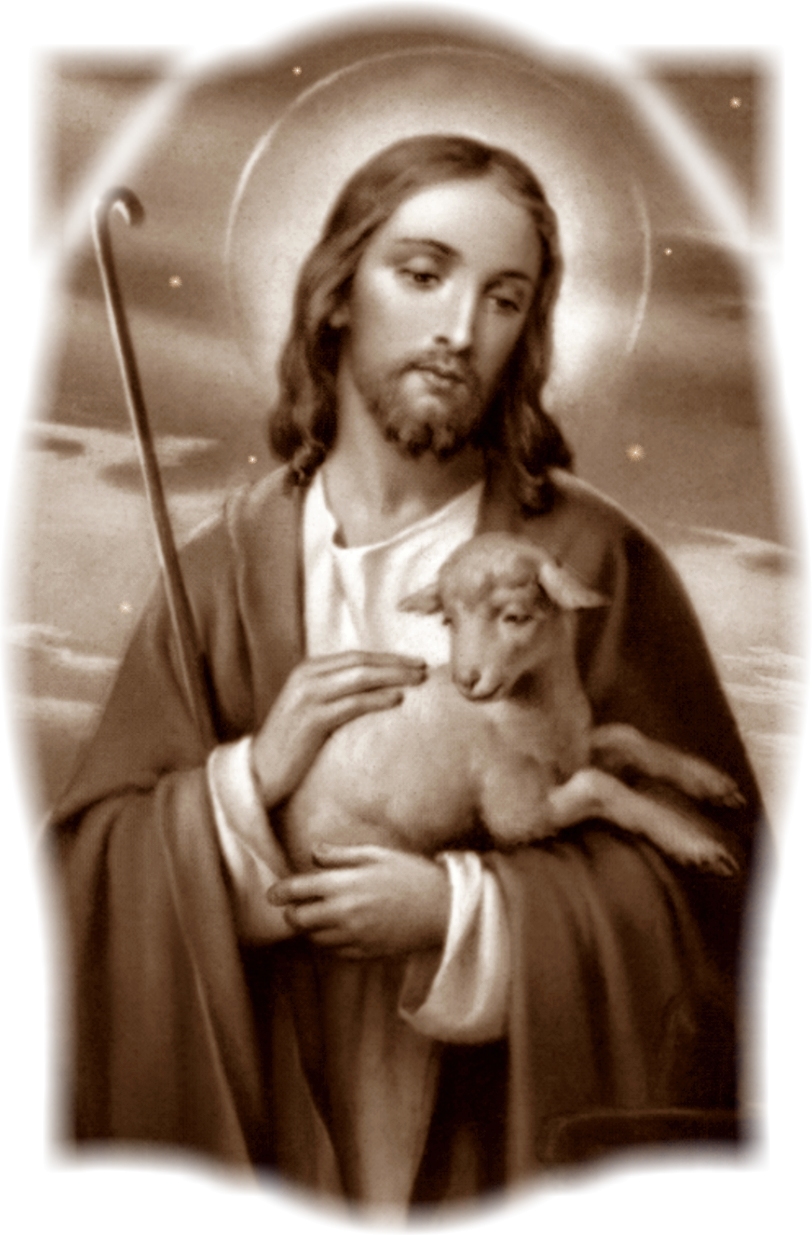
We have an image in our heads about the Good Shepherd, don't we?  Or, at least, those of us who go to Good Shepherd do.  That is, that he looks like this:


This is a great picture, mainly because it shows the real lack of understanding that we have about incarnational Christianity.  There are two key things to notice here.  First: look at Jesus.  And yes, all the pictures of the Good Shepherd are pretty much like this.  Notice what he look like.  Look at his pristine robe.  Look at his white garment, which goes all the way to the ground, and is intensely unstained.  He looks great, like he just got dressed that moment.  He looks for all the world as though he just hopped out of a tide commercial and walked into the first century AD.  I hate to be this guy, but I don't care for the pristine Jesus on a good day, and even less so in the story of the good shepherd.  The whole idea with the good shepherd, and specifically in this week's reading is that Jesus goes to retrieve the sheep from where it has gotten lost.
Now, unless I'm much mistaken, and I rarely am, sheep don't get lost in convenient places.  That's sort of a misnomer, really.  If you've lost your sheep, odds are fair to amazing that that sheep has gotten lost somewhere drastically inconvenient.  Jesus talks about it in other places, saying:

 "If any of you has a sheep and it falls into a pit on the
 Sabbath, will you not take hold of it and lift it out?

Matthew 12:11

The Good Shepherd has to take hold of a sheep and lift it out of a pit.  Have you ever tried to lift an animal out of a pit?  In the images of the Good Shepherd, he's always walking back with a sheep in his arms, and the sheep is clean, and Jesus is clean, and nobody looks like they've just been in a pit.  Now, you may question why this is such a big deal, but it is:  It's a big deal because it plays very heavily into our notion of what it means to have an incarnate Christ.  What was he incarnated into?  Was it a beautiful world in which everything was nice, or was it this world in which all sorts of things were bad and rotten? Was it a world in which people told dirty jokes, were racists, and hated each other? A world in which people didn't think too much of ripping each other off, and did their best to avoid working too hard?  Yes, he came into that world, because that world is this world, except with less toothpaste, soap, or deodorant.  And if a sheep wanders off, where is the sheep going to wander off to? Somewhere gross, probably.

I've said it before, but the single worst smell I've ever smelled in my entire life was out at Stan and Chris Vuksic's cabin, where their dog, Deacon, rolled around in what I assume was dead fish.  It smelled so bad that I thought I might actually vomit, and that's the first time I've ever felt that way from smelling something.  It was unbelievably, shockingly bad.  Deacon didn't seem to mind, but that's the deal with having an Australian Shepherd: They're going to get into some grossness.  
Sheep are doubtlessly going to be the same way.  Every image we have of a sheep on Jesus' shoulders or whatever, always has the sheep looking placid, and spotless, like the worst that it did was to just get a bit confused and stand in a pristine meadow, waiting to be picked up by the shepherd.  But the Bible tells us specifically that these sheep are wandeirng into pits, they're getting themselves caught up in thornbushes and brambles, they're muddying things with their feet, and trampling down the good pasture land until it's a muddy mess.  This is exactly what the sheep do.  They're gross, and they're going to wander into gross places.  That's what they need to get rescued from.

Okay, and there's a second problem with the picture we all know of the Good Shepherd:  He's in too the cat will fight you.  Most of the injuries I get from this exercise aren't from the thorns or brambles, they're from the cat himself.  The image we have of the sheep passively sitting in the Good Shepherd's arms being escorted back home, and everyone's as calm as anything, and the Shepherd is in great shape, well, I don't know about that. I figure it would be much more like this:
good of shape.  No, not that he works out too much, something else.  Now, I've never tried to get a sheep out of a pit, but I do have a cat, and I do know that my cat, uh, how to politely say this, he's an inside cat who drastically overestimates his ability to be outside. If he sees an open door, he flings himself at it with hopeless abandon, only to stop his wild charge as soon as he gets under the bushes at the side of the house.  He has been doing this since he was a kitten, and he really hasn't gotten much better at it.  But there's something else that happens.  Cats aren't dogs.  They don't really come when they're called, with any reliability, at least.  And if you try to get a cat down from a tree, or from under a bush, or from, essentially anywhere, not only will you get messy, but, and this is important here,

Did you see that ram?  He wasn't messing around!  And this is how we react to Christ, as well!  When the Good Shepherd comes to bring us home, we don't want to go!  And we'll fight anyone who comes near to us, regardless of whether they're there to help or not.
I hadn't thought much about this until I heard the reading from Ezekiel for this last Sunday, which said 
21 you pushed with flank and shoulder, and butted at all the weak animals with your horns until you scattered them fa
r and wide,
Ezekiel 34:21


The rams have horns, and they have them for a reason - to fight, to thrust with horn and push with
side and shoulder.  And, and here's where the juice is loose: the juice gets loose where the sheep, the rams, heck, us, we cause the injury to the one who is trying to save us.  We're so used to the idea of the good shepherd being attacked only by the wolves, but honestly, that's only part of his difficulties.  He's being set upon by the sheep he came to save, too.  He's probably going to be every bit as beat up as Steve-O and Ryan Dunn, trying to soothe the savage beast.  Long story short, the very real risk that Jesus runs is the risk to himself from us.  Think about who called for his crucifixion, and who nailed him up.  Think about who was wanting to stone him to death, and who was seeking to throw him off a cliff.  Not Satan, or some vague spirit, or some prowling lion, or whatever.  No, it was people, the sheep he came to save.  If he's beaten up and dead by the end of the Gospels, it's because the sheep, no, the rams, have been roughing him up as he tried to save them.  This is a trustworthy saying, and true, that when Jesus came to save sinners, they didn't recieve him well, and still don't.  The image of the Good Shepherd, that sheep should have horns, and the shepherd should be waaaaaaay more beaten up.  

So why the rescue?  Why bother bringing back to safety an animal who wants you to crumble before him?  Why any of it? Because he loves us and cares for us, even as we hurt him.  It's the same reason I continue to coax my cat out of trees even as he claws my arms.  It's the same reason that the Vuksic family washes their dog gently with pert plus even as he reeks so bad folks down the block feel uneasy.  The shepherd is good.  He loves the things that hurt him.  He has to fight not only the wolves, but the rams themselves.  And he does this becasue he loves us, and loves us extremely.  

PJ.

Monday, August 19, 2013

Not peace, but division

If you were paying attention on Sunday, you'll know that I spoke at length about the passage where Jesus says that he has not come to bring peace to the world, but division.

This passage is actually key in understanding the general cultural unfamiliarity with Jesus, and where that leads us.  Allow me to explain, because I didn't understand this for a long time either.  The idea that the larger culture has, is that Jesus, when he came to earth, had a totally great message all about peace and love, man, which his disciples then turned around and promptly ruined.

The notion is that Jesus existed and was a real guy, and he had a lot to say about a lot of things, but over the course of time, they all got twisted up and messed around, to the extent that the only thing that the church ever held on to was the angry mean vicious and twisted things that Jesus never even said.

There's only one problem with that idea, though.  It's absolutely not true.

Not that I'm going to tell you what Jesus did or did not say.  If you're here and you're a Christian, you probably believe he said all of it.  If you're not a Christian, you may very well not care.  But go to your local church for a moment, and have a look around.  Have a peek at the artwork of Jesus Christ.  Go ahead.  I'll wait.  Odds are, it falls into three categories.

1 - Jesus with long hair looking off into the distance looking dreamy.

2 - Jesus dying on the cross for the sins of all mankind.


3 - Jesus cuddling sheep or children or looking like a consumptive girl.


In all these images, where is the one of Jesus looking mad?  He may look hurt, he may look introspective, but he sure isn't angry.  Now, in the time that the church has been in operation, it has presented a lot of moments in which Jesus Christ cuddles sheep.  Or cuddles children.  Or goes out of his way to be blandly and generally inoffensive as much as possible.  To my mind ,there exists no statues of Jesus with his brow furrowed in rage at the Pharisees.  There are no statues of Jesus flipping over tables in the temple, driving everyone out with a whip.  I have never been into a church in which the art has featured prominently a Jesus, face twisted in rage at the brood of vipers crowding around him, or giving Peter the look that caused Peter to break into tears.

And this is actually to our detriment.  Because guess what, the world still feels as though Christians are awfully judgmental, no problem there, right?  And here's the deal.  Because the church has done such a good job of promoting nice Jesus, and yet still talks about sin and shame, people have the quite reasonably opinion that Jesus had nothing to do with all that angry talk, and that this was all something the church had added later.  We are, I suppose, a victim of our own success on that one.  So it's no wonder, I suppose, when Jesus says stuff like he said on Sunday, that he did not come to bring peace but division, that people would get a little bit strange about it.  It seems normal that if people went to Sunday School or VBS for the first few years of their lives and then never again, that they might get the notion that Jesus is just a super cool guy who loves to hang out.  And then the church talks about sin and wrath, which seems to go against what Jesus talked about in VBS.

The point I'm trying to get at here, in a roundabout way, is that the whole story is consistent.  Part of the trouble is that we're teaching only the super nice super stuff, and not about the need for that stuff to begin with.  The trouble is that Jesus is nice, and God and the clergy are mad.  But that's not how it works in the Bible.  Jesus did not come to earth to be nice.  He wasn't, as Douglas Adams theorized, nailed to a piece of wood for saying we should be nice to each other.  He was nailed to a piece of wood for daring to claim that we're not as nice to each other as we believe we should be.  He was nailed to a piece of wood for saying to the world that would listen that they had a gnawing hunger in them that they weren't who they wanted to be, and that saying 'God is love' wasn't fixing that.

And so Jesus came not to bring peace, but division.  Not to be nice, but to be good.  Not to tell people that they were okay, not to be the muzak of the theological world, but to tell people the truth about themselves, about God, about all that.  And this is big.  This is big huge.  Here's the at issue, superfriends, is that Jesus is Good.  Not nice, not pleasant, but good.  And good divides right from wrong.

You wouldn't think a doctor was a good doctor if she was just nice, would you?  If she just gave you polite compliments about your hair while ignoring the incredibly serious possibly fatal health problems you've got.  You wouldn't think much of a dentist who said how pretty you were while your teeth rotted out of your head.  No, to be good is to be more than nice.  To be good is to be good.  It is to divide good from evil, the wheat from the chaff, the silver from the slag, and to dispense with the waste, and gather the greatness.  If you sit down and think long and hard enough, isn't this exactly what you want Jesus Christ to do?  Not to bring peace to your life the way it is, but to divide you from all the junk you have crawling all over everything you do.  And this is what Jesus is actually for.

If you think that Jesus agrees with you on everything, then you've only gotten as far as Sunday School, friends.  But if you believe that Jesus forgives you, even for the stuff he hates, then you're right on the money.

PJ.