The musings of the Pastor from Good Shepherd Lutheran Church, Regina SK

Welcome. If you're a member at Good Shepherd, welcome to more thoughts and discussion of the week that was, and some bonus thoughts throughout the week. If you're not a member, welcome, and enjoy your stay. We are happy that you're here.

If you like what you see here, consider joining us for worship at Good Shepherd Lutheran Church. Sunday mornings, at 8:30 and 11:00. You can also follow us on Facebook.

Monday, June 22, 2015

Calming all our storms.

The passage from the Gospels for last Sunday is the passage where Jesus calms the storm.  Great.  Now you can stop reading, because you know this story.  Wonderful.

No wait.  There's more to it than that.  There's always more to it than that.  The story, if you look at it, is always bigger than it first appears.  In this case, what we're looking at is Jesus in the boat, having a nap while a storm rages on outside.  What you need to know about this story is that the disciples are ostensibly good sailors, or at the very least capable ones.  Or at the very least, better than you.  I've never been out at sea during a storm, especially not in a tiny boat, so I wouldn't even know what to do.  I'd panic, and I've got things like life jackets, outboard motors, and all that noise.  Of course, if we didn't have all that, then being out at sea would be a daunting prospect if it starts to get dark, and the wind and the waves start up.

It's when you're in a storm that you realize that there's nothing you can do to control it.  We're like that with weather.  We've become so adanced that we can accurately predict the weather 20% of the time, we can tell what's going to happen, map weather a month in advance, but we still can't do anything about it.  We can see it coming, we can see the storm clouds coming in, but we can't stop them from hitting us.  And when you're in the throes of the storm, you realize that there's nothing you can do to stop it.  If you're a farmer, and the hail starts coming down, all you can do is watch the ice pellets shred your crops.  If you live in Lakeview here in Regina, and the dark clouds gather, all you can do is get the ol' shop vac out, and get ready to suck water off your floor.  But you can't stop the storm.  You're powerless against it.

The disciples were powerless against the storm.  The clouds had rolled in, the waves had sprung up, and things were getting bleak.  They really had no escape.  And again, these were seasoned, professional fishermen, people who made a living off of sailing and fishing.  They had likely been out in storms before. They'd likely been out in storms, and had been dealing with the threats of wind and waves.  They'd been sailors for long enough to know what it was like to encounter storms, and long enough to know how storms work. And this is where we have to deal with who the disciples are.  The charge usually laid against them is that they're illiterate fishermen, You know, children afraid of the dark, they don't know how the world works, they don't know about science or physics or that noise, so they'd believe that anything was a miracle.  Maybe.  But here's what I do know about them. I have an ipad, I have two cars, a garage, a phone that takes pictures, and all that, but I would much rather be with someone like the disciples in a storm than someone like me.  I'm standing on the shoulders of giants, but in terms of practical, real world ability, they far outstrip me.  So when the storm starts coming up, they know they're in trouble.  They know what they can and can't handle, and they know they can't handle this.

By the time they rouse Jesus to action, they are a quarter past desperate.  They are in trouble, and they know it.  They're in a real fix.  And so looking to Christ, they ask him a simple question 'don't you care we're dying?' But when Christ does rouse himself, and speaks to the storm, the storm ceases.  Not just that it slows down, or peters out, but stops.  It reminds me of that page from Sylvester and the magic pebble, which, if you haven't read it, go read it.
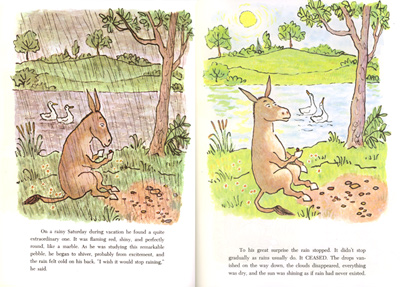
If you can't read it, it says that Sylvester, with the wishing pebble, wishes for the rain to stop, and it stops instantly.  'To his great surprise, the rain stopped.  It didn't stop gradually as rains usually do, it CEASED. The drops vanished on the way down, the clouds disappeared, everything was dry, and the sun was shining as if rain had never existed.'  Look at Sylvester's face in the above picture.  That face, that's the face that you would expect to see on the disciples.  But it goes beyond that.  The disciples are sore afraid of what they see happen.  As the wind ceases, the rain stops, and all that, the disciples ask the question 'who is this that even the wind and the waves obey him.?'

Well, Jesus is God.  He is their Lord and their God.  And they can tell it by what Jesus does, when he causes the storm to cease, he is showing mastery over creation in a way that humans can't.  Sylvester knows what it is like for a storm to suddenly cease, and he's a mule! Imagine what it is like for seasoned fishermen, a crew of men who sail for a living, to be around in a storm that instantly stops.  It's kind of a big deal.  And they're terrified, because maybe for the first time, they have gathered who this Jesus actually is.  Not just a teacher, not just a healer, not just a compassionate man, but the speaker of the reading that we had from Job on Sunday.  God.  The God who spoke the universe into existence, the God who made everything, who fashioned everything from microscopic organisms right the way up to the solar system.  That God.

And like the disciples, we too forget about how big our God is.  We forget that the God we worship on Sunday mornings, and throughout the week, is really REALLY big.  That's what he is, and who he is.  He's the God who made everything, who made heaven and earth, and who has control over everything in creation.  That's the God we pray to and believe in.  But we tend to forget that he is actually able to do things, that he is actually capable of acting in our world.  We forget that he is interested in what we do and who we are, and that he can and will and does work on our behalf.

Too often, we wait.  We wait for far too long.  We wait until things get really bad before we'll start to discuss things with Jesus.  Then, when things are at their blackest, when the waves are threatening to swamp over the side of our boat, when our storm is at its darkest, that's when we start to ask Jesus the big question 'don't you care that we're dying?  Do something!'

Yes.  Do something.  We've tried everything else, we've tried bailing, we've tried rowing, and now that we've exhausted our options, now it's time to call out to God.  The same God that we'd been
ignoring the whole time, now we need him.  Now we rouse him from his slumber.  Now, all of a sudden, it''s a big deal.  So we call out to him in our distress, when our kids are in trouble, or our relationships are failing, or someone is desperately ill, or whatever, and when we call out to him, it is to ask him if he cares.  Because it doesn't seem like he does.

But Jesus does care.  He cares a lot.  He cares so much that he would, and did, die for you.  He cares beyond ordinary human limitations, he cares beyond the stars.  He cares so much that he was willing to restore your relationship with God, ensuring that nothing would separate you from his love.  No matter what you're going through, even up to and including the point of death, is a storm that is passing.  It will pass.  This all passes.  All of it.  Even the stuff that doesn't seem as though it will.  We are forever people, we are not temporary, but the storms that come, they are temporary.  We feel as though they are the real deal, that they can and will flood us and kill us, but Jesus promises us that we have a hope that transcends death.  We have a hope that goes beyond the possibility of permanent separation from God and from each other.  Whatever storm you're in, it's passing.  I promise you.  Though it might not seem like it is, it is.  Though it may not seem as though the storm you're living through is passing, but it is.  And it will come to an end.


That's why Jesus died you know.  He died for you of little faith, you who are in the boat, panicking about the waves that are washing over the side of the boat, unsure of your ability to make it through the storms that are coming.  You panic, and call out to Jesus 'don't you care that I'm dying?  What are you, asleep?'  It's not because he doesn't care.  He just knows that it's passing.  Your storms even the ones that seem to be impossible, are passing.  Yes, things will be bad, yes we will perish, yes everything around us is running down, and the universe is slowing down and dying, but these storms are passing.  These too shall pass.  In many ways, our panic, our desire to see things work out, and our concern for the storm, they're all tempered by the quiet confidence of Christ, who, even as he stills our storms, chides us for our small faith.  The small faith that he himself died for.

Monday, June 15, 2015

green is the colour

Welcome to the time of green stoles.

You may or may not know this, but the season of green stoles, green paraments, the colour green, it lasts forever.  We are in the beginning of what is politely known as 'the time of the church,' and impolitely known as 'green stole purgatory.'  Yes, that's right, the scourge of common time.  We are looking at months, from now on, of green stoles, green paraments, and no change.  This comes on the
heels of the season of Easter, the season in which there has been massive change, where there has been purple stoles, red stoles, white stoles, and everything in between.  And now, well, now it's green.  Green forever.  There are no festivals coming up, no variety, no big celebrations, just church.

Coming on the heels of big monumental changes, coming on the heels of the time of high highs, what do we do with just going to church.  Not building towards anything, just going to church?  Well, that's the situation that we get into now, and we tend to not overly care for it.  We can get people into church on Christmas and Easter, but it's much harder to get people into the church in the green time.  Heck, it's harder to get us into the church in green time too.  With it not being a big high holy day, a big festival, the craving that we have for variety, it gets squashed.


But Jesus has promised us that the kingdom of God grows slowly.  We sort of want instant results like we do with everything else.  We want things to be quick, to grow massively and to be there right away.  Both with our faith, and with our plants.  We want faith to spring up from nothing and be a fully fledged faith that can move mountains in an instant.  But it doesn't work like that.


Think about your garden at home.  And if you don't have one, then go put a bean between some pieces of wet blotting paper and come back to it in a few days.  You know what it takes to have a seed grow into a plant, and to have flowers come up.  You know it takes water, sunshine and time.

And nobody among you will look at someone's garden, with pretty maids all in a row, and say 'boy, they sure are lucky that all those plants just happened to grow there.  They sure are lucky that those sunflowers, those peonies, those beans, those peas, just happened to grow up right in those spots.  Lucky.


Yeah, you know gardens don't work like that.  A beautiful garden doesn't just happen to people.  The only flowers that just happen to grow somewhere are the ones you don't want, like the ever popular dandelion.  Or South African Capeweed.  Those grow without your input, without your help, and will take over.  everything else, you have to work at.

But even though Jesus talks about slow and steady growth, as he does, we still expect faith to be instant.  Not only that, we expect it to be instant, and we also expect it to be something that just happens to people.  Like the gene for rolling your tongue, some people have it, others do not.  We feel as though faith in God is inexorable, that you were born with it, will live with it, will die with it, and if you don't have it, then you won't ever get it.  We feel about it like the gardens mentioned above, assuming that if someone has a garden then they were just destined to have a nice garden.  But you know it doesn't work like that.  And nor does your faith.

This time of green, it's the time where we work on our faith.  How does our faith grow in this time? Well, like the man in the Gospel Reading who plants and sleeps, we know not how.  We don't know how our faith grows, not really.  We don't really know how our faith grows in a time of worship and communion and prayer and participation in the Lord's Supper and the body of Christ.  But it does.  And just like you can't grow a garden with anything but water, sunlight and time, so too do we need time to grow in our faith right now.  Bit by bit and piece by piece, Day by day and moment by moment, that's how faith grows, growing from something as small as a mustard seed, starting small in infants at their baptisms as it does, then growing up into the great, fully fledged faith that we see in our staunchest people.  None of the people you see around you who seem to have it all together, who seem to have it totally figured out, who believe with a deep and rich and abiding faith, none of those people just got lucky, or just happened to have a rich faith, or had it be enormous and deep out of nowhere.  All of those people had to grow it, week by week, devotion by devotion, moment by moment, prayer by prayer, spending time with their Lord in his word and in his church, developing and fostering that faith ,planting and watering, and allowing God to provide the increase, they know not how.

Now, you may be saying to me 'pastor Jim, I don't have faith.  I wish I did, but I don't.' Okay.  But faith that can move mountaints, faith that is so big that even the birds of the air build their nests therein, that doesn't just happen fully grown.  It grows from something small. Just like plants grow from seeds, your faith starts small too.  And you may be feeling about your faith that it is dried out, withered, broken and twisted.  It's no good anymore, it's not up to much, it isn't like the faith you see in other people, who are doing great, who don't let the world get in the way, who say 'God said it, I believe it, that settles it.'  Your faith doesn't seem like that.

Well, good news.  Good news for you who are weak and heavy laden, cumbered with a load of care.  God is in the business of breathing life into things that were long thought to be dead and gone.  Think of the valley of dry bones from a few weeks ago, or think of Adam being created from the dust of the ground.  Think of the stump of Jesse from whence a shoot sprang up, or think of Lazarus having life spoken into him.  and think about the reading from Sunday, where we heard Ezekiel talking about taking a shoot from the cedar and planting it again.  Taking a branch and grafting it, planting it and making it secure and safe, letting it grow up again.  Think about your faith like a seed, as Jesus describes it.  And seeds, well, they look dead.  They look inert.  They look dry and gone, useless.  But in each of those seeds, dried out as they are, dessicated as they are, is the promise of a new plant, new growth, new flowering of life to be found even where it looks like no life can be.  God can take even what we would assume is dead and gone, and give it life, life abundantly.  That's what he's in the business of doing, taking dried plants, plants that bear no fruit, plants that we would assume are dead, finding the life in them, and saying to them 'behold, I make all things new.'

Pascal's wager deals with this, you know.  After making his case that in the wager, it makes more sense to have faith in God than not, no matter the outcome, Pascal deals with objections to his thesis, so here following is the text of the objections, followed by Pascal's answer to them.

'My hands are tied and my mouth is gagged; I am forced to wager, and am not free; no one frees me from these bonds, and I am so made that I cannot believe. What then do you wish me to do?'

 That is true. But understand at least that your ability to believe is the result of your passions; for, although reason inclines you to believe, you cannot do so. Try therefore to convince yourself, not by piling up proofs of God, but by subduing your passions. You desire to attain faith, but do not know the way. You would like to cure yourself of unbelief, and you ask for remedies. Learn of those who were bound and gagged like you, and who now stake all they possess. They are men who know the road you desire to follow, and who have been cured of a sickness of which you desire to be cured. Follow the way by which they set out, acting as if they already believed, taking holy water, having masses said, etc. Even this will naturally cause you to believe and bunt your cleverness. 

‘But that is what I fear.’ 

Why? What have you to lose?


Your relationship with God is the same as your relationship with everyone else, which is that it grows and develops not just on the big days, but over the days and weeks that go into regular daily interaction.  We grow in our relationship with our families, with our friends not by talking to them once a year at Christmas, but by growing and sharing with them even and especailly when there's not an event going on.  That's how we grow in our relationships with those we know, by daily watering, tending, weeding, and care.  And that's how we develop our relationship with God, too.  Not a matter of it just happening to people, but a matter of daily, weekly care and growth.  Here in the time of greenery.  The time of green stoles.  The time of the church.

PJ

Monday, June 8, 2015

A family affair.

Remember Star Wars Episode One?  Sure you do, unless you've blocked it from your minds because of its abhorrent dreadfulness.  But if you don't remember it, here's a brief reminder of the absolute worst part of that film.

Yes, the worst part of that film.  It basically undoes the entire Star Wars Mythos, with a fun bit of Jar Jar Binks at the end.  What a dreadful clip.  I have actually upset myself even watching that for the sake of the blog.  But what it does, is it takes the Force, the ancient, mystical power that permeates the universe, and turns it into something you can take a blood test for.  Something that you can, and in the film, that they do take a blood test for.  It's shameful, and really corrupts the rest of the narrative, and it turns the story of the Jedi into a story of genetic inevitability.  You are going to be a Jedi because of good breeding.  That's it.

I bring all this up because of the Gospel reading from Sunday, the one that talks about the mother and brothers of Jesus as though they had that same kind of Midichlorian inevitability towards the divine that Anakin Skywalker does in Star Wars.  That is, the mother and brothers of Jesus come to find him while he is out preaching, with the assumption that they will be able to modify his speech.  They are closer to Jesus than his disciples, so they can inform his dialogue, mainly because they find him to be embarrassing.

And this is essentially the plot to the Davinci Code, that Jesus had a family with Mary Magdalene, that they left the Holy Land and settled in France, and that the family of Jesus, his bloodline, continues today.  That's the plot, and I've happily just ruined it for you now.  But here's the thing,
which is that the family of Jesus, well, like everyone else in the scriptures, they don't come off looking fantastic.  They come off looking like sinful people, which they are.  And the Gospel reading is very much like that.  The family of Jesus come over essentially to stop him from talking.  Jesus is saying a few key things, and people don't want to hear it.  Jesus is drawing a lot of attention.  A lot of undue attention.  He's making a scene, and saying controversial things, and so they, his family, want to stop the conversation.  As any of us do when we have a nice dinner party.  We want to stop the conversation from going to anything too controversial.  Like religion.  Or politics.

But we spent hours, heck the majority of our conversational time dealing with pleasantries.  Small Everbody love Everybody.  We don't let him speak about other things.  We shut him up, ignore those parts of his word, and generally neuter the conversation so that he is only ever represented to the outside world, as well as the inside world, as saying the most tired platitudes on earth.
talk.  Even in couples.  Even in churches.  Even in safe spaces.  And in an effort to reduce Jesus to something we can talk comfortably about, we've declawed him.  We've removed from him all the words that are offensive or biting or difficult or dangerous.  We make sure that Jesus will say only one message,

Essentially what we're doing is binding the strong man.  We're tying Jesus up, to make sure he won't embarrass us in front of other nice people. We who are in his family, who are adopted into his family through Grace, we who are in the inner circle in much the same way as his mother and brothers and sisters, we want to stop things from getting out of control.

The problem there is that Jesus will not be bound.  At this point I need to bring up the classic line from the Lion, the Witch and the Wardrobe, where Lucy is talking to the beavers. She mentions that she would be scared to meet a lion, and hopes that Aslan, the lion, is safe.

“Safe?” said Mr. Beaver; “don’t you hear what Mrs. Beaver tells you? Who said anything about safe? ‘Course he isn’t safe. But he’s good. He’s the King, I tell you.” 
― C.S. LewisThe Lion, the Witch, and the Wardrobe

Aslan isn't safe.  But he's good.  And that's what Jesus is too.  Not safe, but good.  Those two things aren't the same.  They often go together, but to be genuinely good, to be capital G Good, it means you can't be safe.  And Jesus is going to say some things that his family will be embarrassed, both his biological family and his spiritual family.  Including us.

You're tempted to hush him up, neuter him, stop him from talking about divorce, sexual ethics, charity, fasting, love for family, love for the people you see around you, all that.  You're tempted to hush him up, tie him up, and get him to stop embarrassing you in front of all your friends.

But hushing him up comes with an unintended consequence.  If you strip Jesus of any ability to speak about the things you don't want to consider, then you declaw not just the law, but the gospel, too.  If you want Jesus to speak about love, about forgiveness, about God's grace, then you're going to have to listen to him talk about sin, and your part in it.  You're going to have to listen to him discuss how far you've gone wrong, and where you have to go right.

It's in every way like a doctor.  If you want the doctor to talk about cures and moving forward, said doctor will also have to talk about your illness, and how it is going to be treated and avoided in the future.  The doctor will have to talk about your sickness, not just tell you to go on your way and be well.  In that same way, if Jesus is to speak of heaven, life, grace and truth, he is going to have to talk about sin, and your sin in particular.

Don't try to shut him up.  Don't slam the Bible.  Don't close the book, plug your ears and ignore Jesus.  And don't assume that he's only speaking to other people, people who aren't you.  Realize that his words are for you, for your sin and for your shame.  His words are for you in your deceit, in your rebellion against God and each other.  His words are for you and your anger at those you know, your own family, at God himself.  The words that he has to say are designed to call you out, designed for you to deal with them and know them for what they are.  And ultimately, the words he has to say are to set the stage for him to lavish his forgiveness on you.  But that only works if you have something to forgive.  So instead of hiding the words of Jesus, or hiding yourself like Adam and Eve, or pretending that Jesus doesn't say what he says, you ought to sin boldly, that the grace of God may be all the more apparent.  Know your sin for what it is, deal with it, confess it, and turn it over to God, that he might forgive it, and blot it out.  Because that's how law and Gospel work.  Yes, the law is embarrassing, but the promise of the Gospel makes it all worthwhile.

Monday, June 1, 2015

whispers in the darkness

You know what we are as human beings.

I've talked about this before, but we get fairly innoculated against our own happiness.  It happens every single time, and we're always left thirsty.  It's the feeling when you bring home that thing that you wanted really badly from the store, let's call it the brand new iphone 7.  You bring it home from the store, hook it up, install itunes and garage band, get your headphones out, and you're in absolute app bliss for a goodly number of minutes.  All is well.  But then something happens.

They release the iphone 8.

All of a sudden, that phone that was supposed to solve all your problems is now no longer meeting your needs.  It was supposed to do everything.  Now you hate it.  We get awfully much like this in the face of everything, looking at what we've got and no longer being remotely satisfied with it anymore.  The pages of old Sears catalogues are full of a graveyard of the latest and greatest things that you can't give away anymore.  They're absolutely useless now, from calculators to VHS players, they have zero residual value.  But they used to, at one point, be the latest and greatest, only available to the extreme early adopters who were willing to pay far out the nose for the latest and greatest.

Now, we tend to get bored, and we tend to forget that the things that we have are a big deal.  Running water, refrigeration, even votes for women, these things used to be a big deal that would revolutionize the world, and now we're bored with them.  The ultimate example of this is clean running water.  The most basic stuff for life next to oxygen itself, you can't live without it, any more than three days without water and you keel over and die, and yet we're so bored with it by now that we would get upset if a restaurant suggested that we pay for it.  Think about that for a second - you're so used to it by now that you no longer think of it as amazing that you just turn on your tap and clean, safe running water pours out, and you can drink as much as you want.  Not only are you bored with it though, but your situation has progressed to the point that your thirst signals don't even work anymore.  Good grief are we a broken people.

Skip back, then, to the Gospel reading, in which Nicodemus sneaks over to hear the gospel truth from Jesus in the night, under cover of darkness.  He hears from Jesus all about the love of God, about how people must be born of water and the spirit, born again through Holy Baptism, and it's good news.  It's great news, and that's the core, the essence of the scriptures.  We know this, because the verse of the scriptures that we tend to think of as being the centre of it all, the verse that stands as the entire Bible in one verse, John 3:16 - 'for God so loved the world that he gave his only begotten son,  that whomever believes in him shall not perish, but have eternal life.'  That's what we would call the essence, the core of the Christian faith, and where was it spoken?  It was spoken to Nicodemus under cover of darkness.


The verse that many people think that Christianity is all about, the Golden Rule, do unto others as you would have them do unto you, that verse was spoken at the sermon on the mount.  Spoken surrounded by people, in broad daylight.  Why was Jesus able to say the Golden Rule in full view of everyone, but John 3:16 under cover of darkness?

Well, everyone thinks the Golden Rule is great.  Everyone thinks the Golden Rule is great because everyone assumes that they keep it.  Everyone looks at the Golden Rule and feels as though they're doing a good job on it.  Everyone believes that they treat other people really well, and that the problems in the world are becasue other people don't do it. It's a big thing to realize that almost everyone has cast him or herself as the main character of their own story, and that the Golden Rule is good and wonderful, and would work better if all those other people were doing a better job.  The reason Jesus has to speak John 3:16 under cover of darkness, the reason Nicodemus had to hear these words in secret, was that John 3:16, that whole discourse with Jesus, deals with sin.  Deals with sin, and the Gospel, and it deals almost exclusively with what God does for you.

What does Jesus tell Nicodemus?  That which is born of the flesh is flesh, we who are fleshy creatures are going to give birth to flesh.  Other people, as well as felshy decisions, decisions focused on us, because our god is in our belly.  If you read through the conversation that Jesus has with Nicodemus, Jesus makes it clear that Nicodemus, and the rest of us, are broken. We are flesh, and flesh rots.  It breaks down.  It is temporal, it is fickle.  But the spirit, it gives birth to the spirit.  If we want to kick the flesh, the decay, the rot, we have to be born again.

This is a bigger deal because it's not something that you can do, and therefore is not something you can fool yourself into thinking that you're doing.  It's not like the Golden Rule where you can look at it, shrug, and insist that you're doing it right, because you're not doing it at all.  You're not and you can't.  It's up to God.  To reap the benefits, it's not about you doing more, it's about God doing things for you, giving his son do die for the world to take away their sin.  And that's the sort of thing that is whispered in the darkness.  It's the sort of thing that doesn't go well in a crowd, doesn't really do well in a space crowded around by people, but it demands to be heard in the still silence, where you can be still and know that God is God.

Sometimes, and by sometimes I mean frequently, the loudest words are the quietest ones.  we are surrounded all day every day by noise, by sound, by dialogue and for a large part, we become immune to it.  We don't even listen anymore, which is why advertising has to get bolder and brasher,
because we have stopped listening to yelling and shouting.  It doesn't even affect us anymore.  But for us to listen, sometimes the quiet whispers, the words whispered in darkness, in quiet, when we are finally ready to listen, they are the loudest.

In many ways, it's a lot like the quiet stillness of Christmas Eve, when the church is quiet.  Outside, the world is going to be getting much louder, but in that moment, when all is calm, all is bright, the words we say to each other in a hushed whisper are amongst the loudest on earth.  'Christ, the light of the world, has come to you.'

Monday, May 25, 2015

dry bones

Allow me to get super mario on you for a second.  I promise it won't take long.  Back in Mario 3, they introduced an enemy called dry bones.  Here he is in all his glory


He's basically a mummified koopa troopa, and since his introduction in Mario 3, he's become a bit of a mainstay.  He's been in Mario Party, Mario Kart, and a great number of other Mario sidescroller or 3D games.  Now, why oh why are we talking about this mario brothers enemy?  Because this last Sunday, Pentecost Sunday, featured the story of Ezekiel at the valley of dry bones.

You'd think this was just an excuse for me to talk about an identically named enemy in Mario, but it's not, not really.  It's not because Dry Bones has one other trait that separates him from just being a re-skinned koopa troopa.  He doesn't stay dead.  Yes, you heard me correctly, that Dry Bones, after you stomp him, will stay down for a while, then will rattle, and come back together.  How perfect is that?  The story of Ezekiel at the valley of dry bones is very similar to that story, now, isn't it  Bones that are very dry, have been stomped flat by Super Mario, and then there is a great rattling, and the bones come together.  And they don't stay down, either.  Although Mario can stomp them into dust for forever, they will perpetually come back to life.


This is great, because it is exactly what happens in the valley of dry bones with Ezekiel.  The people that were thought to be dead are brought back to life.  Their bones come together, bone to bone, and then there is flesh, and muscle, and organs, and then they are standing there, a great army.  But Dry Bones from Mario tells us something else, which is that Mario can stomp them down all day, and they can come back together all day.  In other words, there is no such thing as dead.  Dry Bones will perpetually come back to life.

This is what happens in the valley of dry bones.  Ezekiel overlooks the valley, and sees that the bones are very dry.  So God asks him 'can these bones live?' Ezekiel responds by saying 'Oh Lord, you know.'  In other words, no, no they cannot.  But Ezekiel is instructed to prophecy to these dry bones, to speak God's word to them.  It is his job to preach God's word to the dry bones, to corpses long dead.  And you can best believe that Ezekiel probably thinks that he's wasting his time.  Why bother preaching to someone who is not only not going to listen, but cannot listen?  If you go with what you think, what you feel, then you're going to come to the conclusion that you probably shouldn't waste your time on preaching to bones that are, in Ezekiel's own words, very dry.

But Ezekiel goes, preaches, and the bones come together, bone to bone, with a great rattling sound.  Contrast that with the day of Pentecost as shown in the book of Acts.  In that story, the disciples were together,  and then there was a great rushing wind, and divided tongues of fire became seen over their heads, and they began to speak. And when they spoke, all the people who were assembled, no matter where they were from, were able to hear and understand the preached word, and take it to heart.  If the disciples had been looking at things from a limiting view, they would have been unlikely to preach to the people assembled at Pentecost, thinking, as they well might, that it would be a waste of time to do so.  Why bother preaching to a group of people who aren't going to listen, and so most of us, looking at it, would just as well not bother.  Which is what we do now, right?


These days, though, we're tempted to not bother not because of language barrier necessarily, but usually because we feel as though nobody is going to bother listening.  People have already made up their minds, so what's the point of talking to them about it?  The bones are very dry.

Right.  But what kind of God do you believe in? What kind of God do you believe in, and what does the spirit do?  Here. we see the word of God reanimating corpses, we see the Spirit of God making it so the disciples can be heard and understood in all the languages of the world.  You believe in a God who spoke the universe into existence, who spoke, and the world was formed, who spoke and the creatures of the world popped into being, who made everything from K2 all the way to the mitochondria in your cells, you believe in all that, but you don't believe that the Spirit of God, the word of God, can change someone's mind?

Really?

We have a way of limiting God's power in our own minds.  We have in mind what God can and can't do, we feel as though there are certain things that are impossbile with Him, and those things are usually based on what people are or are not feeling or thinking about their position vis a vis God himself.  Once someone has made up their mind to reject God, we tend to view that as dry bones.  Unfertile ground.  It's something that's not worth preaching to.  And if Ezekiel or the disciples had viewed things that way, then they would not have bothered preaching where God had told them to.  But they did.  And when they did, bone came together with bone, and the people who were there to listen at Pentecost, three thousand of them were baptized that day.

If you just wait to preach to what you think is fertile ground, then you'll never get anywhere.  God isn't asking you to do that.  He's asking you to go to the valley of dry bones, to go to an unbelieving world, and bring Christ to them.

It's that, and it's more.  It's more than that relative to what you think the spirit of God can and can't do.  Your life is full of dry bones, isn't it? You may not want to admit that it is, or that you have valleys of dry bones around you, but you do.  You have plenty of dry bones occupying your time, your space.  You have broken relationships, broken over time with neglect or hurt feelings, and after a while, you look out over them, shrug your shoulders, and say to yourself when God asks you to get back to work with them 'the bones are very dry.'  There's no point in working on these relationships, right?  Dead is dead, gone is gone, too late is too late.


But it isn't.  Back to Mario, you can stomp on Dry Bones all day, but it'll keep on popping back up. reconciled to each other; to go back to the valley of Dry Bones, and preach there, to speak God's forgiveness, to be humbled and to repent, and to not ever think of calling unclean what God has called clean.  You've been forgiven by God, so you ought to forgive each other.  You were enemies of God, and were reconciled to Him.  You were dry bones, dead in your trespasses. That's when Christ died for you.
 What is God in the business of?  He's in the business of forgiveness and renewal, of rebirth and new beginnings.  That's what He's all  about.  That's why he wants us to lay down our weapons, leave our gifts, and go and be

You think it's too late?  You think things are too far gone?  Ezekiel probably thought the same.  And then the dry bones came together.

PJ.

Tuesday, May 19, 2015

Duck duck goose.

The question that we ask ourselves, after a while, is 'why am I here?'  Granted, you don't have to ask yourself that question, and most species don't ever ask themselves that question.  Ducks don't ask themselves that question, they just get on with the business of being ducks.  But people, we do ask ourselves that question, and in asking ourselves that question, we need to think not just about the question 'why am I here,' but also the other question of 'why can I think about why I am here?'

And to get to the root of these questions, we have to talk more about ducks.  At this time of year, you're going to see a whole bunch of cute, newly hatched ducklings, waddling around being cute.  Aren't they adorable?  Yes they are.  And you know they're adorable, too.  You may say to me 'I don't really care about ducklings,' but I would consider that you're fibbing.  I know you're fibbing, mainly because of the phenomenon of the mammatus clouds.  Remember that day in Regina when the mammatus clouds showed up?  Remember that day that we all went outside, and all took pictures of the same thing?

You probably remember where you were that day, and you probably did what we all did, which was to take pictures, share them to facebook, and all of a sudden, everyone's wall was innundated with pictures of the exact same shot.  That shot.  With ducklings, it's the same.  You see a row of ducklings waddling after their mama duck, and you rush to snap a picture, tweet about it, facebook it to everyone you know, and all that.  We do this because ducklings are adorable.  Goslings are adorable.

But nobody snaps pictures of full grown Canada Geese and goes 'awwww.'  They have an adorable phase when they're tiny and yellow and fluffy and sweet, and then that goes away, and they become full grown monsters.  They get big, they get loud, and they get mean.  This is what the geese do, and how they mature.  And we say of them like we say of puppies, kittens, ducks, that we wish they would stay small forever.  We say that of puppies, kittens, ducklings, and gosh, human beings too.  Why can't they just stay small and sweet forever?

But they don't and they don't for good reason.  If a duckling, or a human being, was to stay small and cute forever, they would stay small and helpless forever.  They would require their mothers to do everything for them perpetually, forever.  That's the tradeoff.  Think of dogs, because that's always a good place to start.  People love puppies, but those puppies grow up eventually, don't they?  And when those puppies grow up, they become less cute.  You might love them all the same, but they're not as cute.  So what we've done is to make the dogs small and cute forever.  They remain tiny and small and purse-sized for all time.  And we want that for all our stuff.  This is why we have dogs like chihuahuas, which are companion dogs, toy dogs, dogs not designed for work, not designed for productivity, but just designed to hang out and be cute.

That's what puppies are for with us, not designed to work, designed to hang out and be cute and adorable.  And we've managed to do that with certain dog breeds for eternity.  So when we ask ourselves what is the purpose for us being here, well, what's the purpose for these dogs being here?  What's the purpose of ducklings?  For Goslings?

The puppies are there to grow into dogs, to be shepherds, to be guards, to be guide dogs, or hunting dogs, to get to work.  The ducklings are there to grow into ducks, the goslings are there to grow into geese, they're all there to get to work.  They're there to be productive, to work, to get down to business.  They do that when they grow, when they mature, and when they get kicked out of the nest.


When we think about ascension Sunday, it's the day when Jesus ascended to the heavens, and left his disciples there, still probably half covered with metaphorical yellow down, wondering what to do next.  They were so used to being with Jesus, so used to him doing everything, so used to him doing all the healing, all the preaching, all the evangelism, all of the everything, that like ducklings, like puppies, they had no idea what to do next.

But the disciples weren't there just to follow around after Jesus like ducklings after mama duck forever.  The great thing about ascension Sunday is that the readings stem from the end of the Gospel of Luke, but also the beginning of the book of Acts.  And they speak about the exact same event, the ascension of Jesus.  But in Luke, that's the end of the story, whereas in Acts, it's the beginning.  It's the start of it all.

When the disciples are standing there at the ascension of Jesus, it's both the end of one story and the beginning of another.  It's the conclusion of the chapter of Jesus being present here on earth, and the beginning of the chapter of the disciples getting to work, shedding the down, and moving out into the world to accomplish the work that they had been placed on earth to do.  Not being puppies anymore, but becoming the workers that they were designed to be.

We are God's workmanship, says the scriptures, created by him to do good works which he has prepared in advance for us to do.  We were made by God to get to work, to do his work in the world, to spread his gospel and to do the work that he has given us to do.  And this is the same with us today.  God has not given you a spirit of cowardice, but of power, and of love, and of self-discipline.  He has placed us here to do his work, and to carry the weight that he has given us to carry.  And we weren't going to do any of this if we still had in mind that Jesus was there, mama duck style, to do it all for us.  Then we were going to be moribund, weak, and disinterested in getting anything done at all.


So Jesus ascended into heaven, but gave his disciples a promise.  Because it wasn't just that he was leaving, but that he was actually going to be more present than he was before.  If you think about this, he told them that where two or three were gathered in his name, there he would be in the midst of them.  So not only does Jesus make it possible for us to get to work without becoming moribund, but he has also promised to be present with us all.  Whenever we gather together for worship, whenever we gather as Christians for devotional time, whenever we assemble together, Christ is there with us.  So his ascension comes with two benefits.  It gets us to work by kicking us out of the nest, and it means he can be in all places at all times, to be with his people whenever they gather.

So yes, why on earth are we here?  We are God's workmanship, created by him to do good works which he has prepared in advance for us to do.  How are we going to do this?  Getting kicked out of the nest, shaking off the downy fluff, and becoming wise as serpents, and gentle as doves.  Going out as lambs among wolves.

PJ.


Tuesday, May 12, 2015

Fruit vs Veg.

In case you were wondering, yes, we do like to play this game at home.  The ever-popular fun game of 'fruit or vegetable.'  It's a scream.  Here's how it's played: You look at a plant based thing on your plate, and say whether it's a fruit or a vegetable.  Hilarity ensues.

Now, you may very well claim something important here, which is that this isn't fun, and if you'd claim that, you don't live in my house.  We love this game, even though it only has one rule.  Does
the plant based item in question have seeds?  If it has seeds, it's a fruit.

That seems too simple, really, but it's not.  That's the definition for a fruit, period the end.  There is nothing else to say on the subject.  And I know, you may kick and scream, but it's true, that's what fruit is. Fruit is what the plant gives you that has a seed in it.

I'm aware that this all seems pretty simplistic, but it stands in opposition to how we use the things in question, which is why this game is so hard.  This game is so hard because how we use the botany in question.  We use fruit for tasty snacks, and we use vegetables as things to avoid because of how gross they are.  But that doesn't change the base botany of the situation as much as we might like to.  This is why, when it comes to Subway, when they offer you the chance to top your sandwich with fresh 'veggies,' there are only three veggies in the list.  The rest is fruit.  But you'd find it strange if they offered to top your sandwich with delicious fruit, wouldn't you?  Nobody goes into a steak restaurant and asks for a side of fruit, even though their seasonal veggies are primarily composed of fruit.  And as I say, there's only one rule here;  Does it have seeds?

As bad as you are at determining botany, you're every bit as bad at determining spiritual fruit as well.  You don't think you are, but nobody ever thinks they are.  Nobody ever thinks that they can't tell one from the other.  We assume we've got this figured out.  Now, when Jesus tells us to bear spiritual fruit, that's the question that we have to ask ourselves about what we're doing - is it fruit?  In other words, does it have seeds in it?  This is why the plant produces fruit to begin with, because it wants you to eat that fruit.  The plant wants you to eat the fruit, snacking on the fruit and dropping the seed somewhere else, which, when it is buried, will grow up into a new plant.  This is what is intended by the idea of spiritual fruit that Jesus wants you to bear - that it should feed people, and plant seeds.  That's what we're supposed to do when we do the things we do, when we do charity, when we care for God's people, when we nurture and cherish them, we are supposed to be nourishing them, and planting seeds.


It's that that we are designed for.  We are designed to bear fruit.  As Jesus tells us, he is the vine, we are the branches, and through him we bear fruit.  And the great thing about grapes, figs, tomatoes, other things that grow on vines, is that they can be harvested again and again, and the plant isn't harmed.  It can grow for years, continually bringing forth fruit, and that fruit is eaten, and the seeds are planted.  And this is what we are asked to do in the scriptures.  The charity we do, the good works that we offer up, those are fruit.  We bring them forth, they nourish others, they plant seeds, and we can keep on bringing forth fruit for decades.

But we don't.  We offer up vegetables.  And this is where we run into problems.  Because, as mentioned, if fruit is what the plant offers up voluntarily to get its seeds planted, then what are vegetables?  Vegetables are leaves, roots, stems, all those things that aren't fruits.  So, what happens to the radish when you harvest the radishes?  The radish dies.  You harvest the plant to eat not the fruit, not the part the plant wants you to eat.  You harvest the plant to eat the root, pulling it up.  And the radish dies.

This is what we do all the time, because we can't tell the difference between fruit and vegetables.  We don't stop to check to see if what we're doing actually has seeds in it or not.  Are we planting seeds of the Gospel, or are we not?  When we do the charity that we do, is it to plant seeds, or is it to draw attention to us?  Is it a fruit, or is it a vegetable?

The people that Jesus discusses, albeit unfavorably, in the sermon on the mount, they're not going out of their way to make sure that people aren't being fed, but they're not thinking about whether or not they're planting seeds.  When it comes time to think about how charity is done, about how prayer is done, about any of these things, the people that Jesus was talking about weren't pondering through whether they were planting seeds or not.  They were thinking about themselves.  They were offering themselves up as the centre of attention.  They were offering up the branches instead of the fruit.

So what happens when we present ourselves up as the best and brightest thing for people to consider? It's a vegetable situation.  We get chewed up, and no seeds are planted.  The absolute opposite of what we would want to happen.  Instead of the goodness of the fruit that nourishes and plants seeds, we allow people to devour us and our efforts, and no seeds are planted.  Nobody comes to believe in God because you tell them you're a great person.  They do so partially because of the planting of seeds that you do.  Jesus is no different.


We are told to love each other as Christ has loved us, and in keeping with the fruit vs vegetable theme, how was it that Christ loved us?  It was first and foremost through forgiveness.  As Jesus says in the Gospel reading from Sunday, we did not choose him, but he chose us.  He sought us out while we were still sinners.  He came to find us in our sin and in our shame.  It wasn't as though he waited for us to be good before he would love us.  He came and found us while we were still sinners.  He loves us through forgiveness.

We are called by Christ to love one another as he loves us.  And the only way to do that is to think about how it is that Christ loves us, and to do so accordingly to each other.  It means to love each other not because we are great, not because we are fantastic, not because we do well, but because the people we are called to love aren't that loveable.  And neither are we.  Christ loves us in spite of that.  He loves us in a spirit of forgiveness.  He loves us even in our sin; and this is how we are called to love each other.  Not because the people you're called to love are great.  They aren't.  Nor are you.  Not because the people you've been called to love are easy to love.  They aren't.  They're as disastrous as you are.  But this is how you bear fruit, and this is how you plant seeds.  We feed each other with charity and forgiveness, and we plant the seeds of the Gospel, culminating with the notion that we love becasue he first loved us.