The musings of the Pastor from Good Shepherd Lutheran Church, Regina SK

Welcome. If you're a member at Good Shepherd, welcome to more thoughts and discussion of the week that was, and some bonus thoughts throughout the week. If you're not a member, welcome, and enjoy your stay. We are happy that you're here.

If you like what you see here, consider joining us for worship at Good Shepherd Lutheran Church. Sunday mornings, at 8:30 and 11:00. You can also follow us on Facebook.

Monday, August 10, 2015

Satiety

Okay, brief sidebar before I continue.

I've been losing weight recently, and so a lot of the discussion from Jesus about bread, never being hungry again, it resonates particularly hard.  For you see, here in 21st Century North America, we have a quite different issue from that of the people of Jesus' time and place.  They lived each day working very hard to get enough food to survive the day.  There was no convenience store, there were no convenience foods, there was no industry set up to make sure that corn was plentifully produced and went into everything, there was just food.  And most of what food was, was bread.  Every day you would bake it, and it wasn't as though you could just toss the ingredients into a breadmaker and walk away.  You would have to build and tend a fire, grind the wheat into flour, knead and fashion the dough, and bake it on hot coals until it was done.  The reason that bread was so vital (and still is today) was that it was cheap, the ingredients could be stored essentially indefinitely, and it was versatile enough and filling enough to go with everything.

But now, we have a problem not with eating too little, but with eating too much.  Our world is awash in cheap food, laden with salt, sugar and fat, and then at the other end of it, purported ways to extract yourself from the effects of that cheap food.  And it brings us to a problem, which is that food, all food, is not created equal.  If you're trying to lose weight, one of the first things to wrap your head around is that a calorie is a calorie.  It doesn't matter where it comes from as far as weight loss goes, if you eat more calories than you burn, you will gain weight, and if you do the opposite, you will lose it.  And the source of those calories doesn't matter.  Your body neither knows nor cares if you eat a bucket of celery or two tablespoons of peanut butter, it will process that energy the same way. 

These are all 200 calories


What does this mean?  It means that the system of calories is inherently unfair.  You  can tell it's unfair from the word go, because two slices of wonderbread (63 grams) are a lot less filling than 50 grams of raw lentils, even though they're the same calorically.  In other words, part of your job as a human who eats food is to eat the right things.  That is, choose food that is filling and satisfying.

Ah, yes.  Satiety.  It's a bugbear, and is the reason that low carb diets work.  Not that I'm on one.  The basic tenet states that high fat high protein foods have a higher satiety rating, and will keep you satisfied for longer than simple carbs which are rapidly broken down.  In other words, the more simple carbs you have, in theory, the quicker you'll be hungry again.  Why do I mention all this?  Because this information is important towards understanding what Jesus is talking about when he talks about satisfaction.  Eternal satisfaction. 

When Jesus speaks of himself as the bread of life, the promise that he makes is that if you eat of this bread, you will never be hungry again.  You will be fully  and completely satisfied.  And the people who heard this were excited, as food acquisition and preparation were enormous time hogs, demanding a lot of people, and making their lives a bit of a drudge.  What Jesus was promising (in semi-parable form) was that they would experience, for perhaps the first time in their entire lives, satisfaction.  They would be filled and satisfied, and they wouldn't go hungry anymore.  Their lives would no longer be a succession of moments in which they desperately seek after the next meal, but rather, that they would be filled, satisfied, and comforted, freed from the need to be on that rollercoaster of filled then empty.

For us, though, it's a little bit different.  Very few of us here in this great nation have been what anyone could call genuinely hungry.  Oh, sure, we get a little bit peckish, but food is never too far away, it's as close as the phone, the pantry, the fridge, and if you get desperate, you could eat fruit.  It's not hard to get food, in fact in many cases it's too easy.  And so we as North Americans tend to overindulge in empty calories, which wind up making us feel worse.  It's the mirror of the issue faced by the New Testament listeners to Jesus' words, that they were seeking after food and it occupied all their time.  In our case, we seek food, but find that what we eat is dangerously unsatisfying for us.  We consume, and are still hungry at the end of it.

When Jesus talks about never being hungry again, his words echo what we hear in Isaiah chapter 55, where it asks us why we spend our money on that which does not satisfy, and our effort on that which does not fill us.  We are essentially, for the most part, consuming spiritual junk food.  The same epidemic of food choices that lead to us all being stuffed yet still hungry physically is the parallel to how we are spiritually, filling up on that which does not satisfy, and leaving ourselves constantly famished.  We are ravenous, starving hungry, and yet always filling up.  Why is that?  Why is it in an age in which we have all sorts of spiritual outlets, in which self help and associated issues are at an all time high, an age in which we have access to all the spiritual learnings since the dawn of time, are we still hungry?  Because we are filling up on the wrong stuff.  As usual, St. Augustine of Hippo says it best when he says 'You have made us for yourself, and our hearts are restless until they find their rest in You.' 


All that other stuff we fill up on doesn't do the job.  It will make us bloated, sure, as it tend to do.  As the scriptures say, knowledge puffs up, and lots of us are very puffy these days spiritually.  We are full, but still seeking, taken but still looking.  Our hearts are so prone to wanderlust, and we find that everything we are consuming, everything we are taking in, leaves us unsatisfied, wanting more all the time.  We seek more, and though we take more in, we are unfulfilled.

What Jesus promises, though, is satisfaction.  Imagine, if you will, a world in which you are satisfied.  You are no longer hungry or thirsty.  You neither marry nor are given in marriage.  Every tear is wiped away from your eyes, there is no more want, you are free from that treadmill that has been governing your life from the moment that you were born, wresting yourself from sleep with your infant cries of hunger.  Imagine a world in which you are no longer a slave to those needs, but can do what you want.  That notion of satisfaction is what Jesus promises, giving to us in semi-parable form, an image of paradise.  One in which we are free from those needs, one in which the questions we ask have answers, and one in which our wandering souls, prone to seek after things that do not satisfy, will be made whole and satiated. 

PJ.


Tuesday, August 4, 2015

Bread

You know how you feel about bread.  You hate to love it.

Isn't that true?  We are in the age now where gluten is of the devil.  You know it.  You're made to feel like a criminal every time you consume the devil's treat of wheat.  Wheat belly, atkins, gluten free, the catch words and buzz phrases fly fast and furious, falling over each other to eliminate wheat from our world. Gluten is a bit of a villain these days, which is funny, because for most of history, wheat, gluten, have been the engine upon which civilization has run.


We forget about this, because, of course, we have refrigerators, and canned goods, and year round apples, so we forget about the fact that for the majority of history, there were times of abundance and scarcity.  If you were a hunter-gatherer, you spent your time hunting and gathering.  that was it.  And everyone had the same job.  It wasn't as though you could be a dentist and your neighbor could be a nail tech.  No no, if you were alive, then you were a hunter / gatherer.  That was the only job there was. I know, I know, studies have shown that the hunter / gatherer people were happier and worked fewer hours, but here's the kicker - they worked fewer hours, but all at the same job.  They were hunter / gatherers, and that was their job.  Every day, you worked to make sure you didn't starve, and that was that.

But with the advent of grains, of crops that you could harvest, all of a sudden you could develop a surplus.  You could develop more food than anyone would eat that day.  and enough of a surplus
meant that you could have specialized labor.  And specialized labor meant that you could have dedicated construction workers, dedicated priests, dedicated bureaucracy, and dedicated military.  That meant that you could have all the workings, for good or for ill, of a modern working civilization.

Why do I bring this up?  Because in our modern times, we need to remember that Jesus as the bread of life is actually a good thing.  Yes, if you're gluten intolerant, or low carb, you might run shreiking from the room at the mention of bread, but Jesus is identifying himself as the greatest of all staple crops, the thing that keeps civilization going.  You may not like wheat yourself, but you must realize that staple crops have changed everything as we know it.

Now, here's the thing about staple crops.  if you Bing 'staple crops,' it should take you to the wikipedia page on staple crops, which will tell you all about the staple crops around the world, and how they are made into peasant food.  And the staple crops of the world, they're not very exciting on their own.  If there's one thing you should pick up on, you should know that the things you get, they're not going to set your tastebuds ablaze with excellence.  Corn, rice, wheat, potatoes, soybeans, yams, that's what you're looking at with staple crops.  They used to dominate the menu for all the people of a given place, who used to eat overwhelmingly that thing.  Corn or wheat or rice, that used to be the majority of what was consumed.  I mention this, because this is how Jesus presents himself - the bread of life.  and for the people in the ancient near east, bread was the source of life.  This is what you ate. The widow of Narin, she and her son had only enough food left for one last loaf of bread, then they were planning on dying.  When the flour was gone, so were they.

Jesus, as always, knows what he's doing when he does things.  He knows what he's saying, and when he tells his disciples who he is, he tells them that he is the bread of life.  And as the bread of life, he forms the bottom of the food pyramid, the foundation of what the disciples will be building their lives upon.  That's what Jesus was always intended to be - to be the base for everything we do but not the only thing that we experience.  Think about bread.  think about bread in your home, and how you eat it (assuming that you're not gluten free.  If you are, imagine if you ate bread).  You have it alongside meals, in a breadbasket.  You have it under your eggs in the morning, You have it enveloping your meat and lettuce at lunchtime.  You have your peanut butter on it in the middle of the night (don't lie).  You have bread, but you have bread all the time and in conjunction with many many other things.   Rarely do you have a meal of only bread, undoctored and alone.  Usually, you have bread with other things, sometimes a great many other things.  This is who Jesus is.  He is the source and foundation for us spiritually.  He wants to be part of what we do, to be part of our daily experience.  Sometimes, he is the only thing, like he is on Sunday, but frequently, he is involved with the other stuff of our lives.  He is part of everything we do, making us in the world, but not of it.  This is how he is supposed to be, and if he is not, then something has gone wrong.  We are supposed to run on God, he is the source and norm of what we do, and who we are.  In him we live, and move, and have our being (preach it duck brother).  That's what we are for.  We are not supposed to be cloistered away, never seeing the outside world, nor are we supposed to ignore God for the remainder of the time that we are not in the church building.  He is supposed to be in and with everything we do.

The Lutheran understanding of Holy Communion is helpful here.  There are churches that say that the bread and wine just represent the body and blood of Jesus, so there is only bread and wine there.  There are churches that say that the body and blood of Jesus are the only things there, and that the bread and wine are totally gone.  And then there's the Lutheran church, that tells us that the body and blood of Christ, the true body and true blood, are in with and under the bread and wine.  And that's how Jesus is supposed to be in our lives.  Coloring everything, being a part of all our life experiences.  Not the only thing, but having his words, his blessings, his gift of forgiveness and salvation be part of all our experiences, and permeate them all.  The love of God that is in Christ Jesus affects, or should affect everything we do, otherwise our faith is just a hymn and a homily, just so much feel good chat, and nothing that actually moves us or changes us.

But Christ deigns to change us, from the temporal to the eternal.  He desires to have us be not here for a while, but with him forever.  To do that, he gives us himself as the bread of life, the bread of life that will be in, with and under everything that we do.  And surely, he will be with us always, giving us his grace in abundance, to the very end of the age.

Monday, July 27, 2015

Roy G. Biv.

Before I start this discussion, I want you to know that I talked about this topic with a physicist.  If you disagree with any of my statements, you need to know that you either a) disagree with physics, or b) I got it wrong.  Either of those two things are possible, perhaps likely.


Now, let's talk about rainbows for a second.  Not the Julie Andrews version, not the Kermit the Frog version, but the actual rainbows you see and encounter on a daily basis.  You all know by now the lore about rainbows, yes?  The lore that says that there's a pot of gold at the end of it?  Yes, you know that leprechauns, those crafty devils, they hide their pots of gold at the ends of rainbows.  As a child, I was told the same legends that everyone else was, that if you could find the end of the rainbow, you would find the pot of gold that the leprechaun wanted to hold onto.  Sounds good in theory, but of course, the facts of the matter drag it down significantly.

There is no end of the rainbow.  I'm sorry to tell you this.  The end of the rainbow doesn't exist.  It doesn't exist, because the rainbow is round. It may not look like it when you look up at it in the sky, but trust me, and trust physics, what you see as a rainbow is actually a rain-circle.  Completely round. If you've been up in a plane or on a high building, and have seen a rainbow, you will have seen it as a circle. Believe it or not, though, that's just one reason that you can't find the end of the rainbow.  First of all, there is no end, and secondly, the rainbow moves with you.

I know, I know, there are stories of people flying over rainbows, of people seeing be being next to the place where the rainbow ends, but it's not true.  You can't get to a rainbow.  It depends on the angle of your eyes and the water falling through the sky.

Why do I mention all this? Because the rainbow is a far better show of a covenant than you'd possibly think.  Oh sure, on the surface, it's a nice origin story for rainbows, but it's bigger and deeper than that, and to get to that, we have to ask ourselves what a rainbow actually is.

So what is a rainbow?  It's an almost illusion.  That is, it's a real thing, that doesn't exist.  If that sounsd elusive, then buckle up, because we're just getting started.  For the rainbow, though it looks real, you can't grab it, and wrap your hand around it. It's ephemeral, and that's important for how God, and God's promises work.  Think about the rainbow that you see up in the sky.  Think about how you look up, and see it there.  Now think about all the smaller rainbows that you see in your life.  Think about the rainbows that you see with your sprinkler, at the splash pad, behind speed boats, anywhere that there is light and water droplets.  If you move around, you will see the rainbow in different places.  And if you move and see the rainbow in a different place, you will know that the people who are with you will all be seeing the rainbow in a different place from you.  Do you know why?  Because the rainbow depends on your angle of view.

This is why it is such a good reminder of God's promises.  It's such a good reminder of them because of the way the rainbow works.  The magnificence of the rainbow is that everybody who looks up at it will see their own individual rainbow. The rainbow you see is both the same as, and at the same time different from everyone else's.  The principles are the same, the colours will always be the same, but the rainbow you see, based on where you are standing, will be only for you.  Everyone else will be seeing a different one.

This applies to the promises made in the scriptures, and the aspects of the worship services, by showing us how God is experienced.  The Bible, it's only one book.  Everyone gets the same Bible.  If you join a church, and get a wonderful presentation Bible, the cover may be different, but the contents will be the same as everyone else's.  If you go to church, you will be part of the same
worship service that everyone else present will be.  If you listen to a sermon, everyone around you will be hearing the same words.  If you encounter Christ, you will be encountering the same Christ as everyone else, the same yesterday, today, and forever.  If you are baptized, it will be with the same words and water as everyone else, and Holy Communion works the same way.  All these things are identical, in the words, in the physical elements, in everything.  So what makes them unique?

When Jesus speaks to his disciples about Holy Communion, he tells them that the bread is his body, and the wine is his blood, given 'for you.'  It's the same as the promise, the covenant, made through the rainbow, where God tells Noah that he is making that covenant with everyone.  And sure enough, as we all look at the rainbows, we realize that we each see our own rainbow, reminding us that the covenant was made with each and every one of us.

And there's something else that helps with this being the means to remind us of the covenant.  As Christians, we count on the faithfulness of God's promises.  The Christian belief was never an exchange between us and God.  It was never as though we bring something to the table, God brings something to the table, and then we make an exchange.  No no, the way it works is that God makes a promise, and is trustworthy and true, and keeps his promises to us.  And the rainbow is a fantastic marker of that.  It's a fantastic marker, because it is regular, it is predictiable, and it is constant.  God's promise to his people to never again flood the earth, is marked by a rainbow, which is a permanent thing.  There have to be raibows, because that's how light and water when refraction happens.  You know what else depends on those same properties?  Your eyes, your vision, everything about their interplay depends on the same forces and laws that show you rainbows.  That' the way light and fluids work. The reason this is such a great marker for God's promises is that he can't just stop rainbows cold.  Stopping them cold would essentially require an unworking, or a reworking, of the way matter and light interact.

And this is how his promises work.  Once he's made them, he doesn't go back on them.  He holds fast to those promises, and does not back down.  The appearance of the rainbow doesn't happen as long as you say the right words or do the right things.  The rainbow appears when there is rain, sun, and you to witness it.  You don't make it appear, but you have a vital part to play, since if there is nobody around to witness the rainbow, it doesn't exist.

When God speaks to his people, when he gives his body and blood to eat and to drink, when he pours out his love in holy baptism, when his words are spoken in his Holy Church, these things need to have people as a vital part to play.  Given and shed for you.  I baptize you.  I forgive you all your sins.  In the service, in the scriptures, you realize very quickly that none of this happens in a vacuum.  God's words are for his people.  And the words may always be the same, but they are all individually for us.  There's only one Bible, and yet it speaks to us all individually.  There's only one Christ, and yet we all encounter him individually.  One Lord, one Faith, one Church, and yet all the believers are spoken to individually.  Just like how there is one refraction, one ROY G BIV, and yet we all see our own, personal rainbow, just like everyone else's, yet only for you.

Just like the rainbow.

PJ.

Monday, July 13, 2015

Little Orphan Us

Adoption.  The word ought to bring forth a flood of emotions, to be sure. It's a wonderful gift that people can give, opening their home and their family to a stranger, to an outsider, someone who wasn't born there and raising them as a child in that household with all the rights and responsibilities that naturally born children would have.  But adoption is also a bit of a scary process, and one in which you're not exactly sure what you're going to end up with. Now, to be fair, you're not sure what you're going to end up with when you conceive as a couple either, but you at least have some idea, given that the child is half of both of the parents.  And at this point, we have to go back to movie trailers again.  I know, for the second time in a row.


This is the trailer for a movie called problem child, which I saw in the theatre when it first came out.  In 1990.  And the plot of this movie is that the older child that is adopted is the spawn of satan, and is dreadful to the nuns in the orphanage, and to his adoptive parents, and, gosh, everyone.  As the mother superior says 'good little boys get good homes, bad little boys get something else.' The tendency is to want to adopt younger children, right from when they are neonates, but if you were to adopt an older child, you'd want to adopt one that was sugar and spice and everything nice.  You most assuredly wouldn't adopt one like Junior from problem child, whom his adoptive parents had to be tricked into bringing home.  And yes, once they discovered what kind of child he was, they tried to return him.


Who would choose Junior?  Nobody would choose Junior.  You could be tricked into taking him, deceived into it, but nobody would take him on purpose, knowing anything about him.  And this is something that comes up a few times through the scriptures, the notion of adoption.  Adoption and inheritance.  We think about ourselves as being adopted into God's family as infants, as precious babies who are just lovely and sweet.  But we weren't.  We were rebellious, dangerous, and wicked.  Incorrigible.  We were rotten, rotten to the core, and disastrous, and our adoptive parents knew it, were well aware of it.  Why would they take us in to begin with, what was the purpose?

What's great is that the Bible talks about families because we know about families.  We all know about families because we all grew up in them.  And the best family story that we know about from the Bible is the story of Hosea, Hosea who took a wife and had some children.  Nice story, right?  Well, not quite.  Hosea's story was one about a man who was asked by God to take a wife, but a wife of adultery.  He was asked to take a wife of prostitution, a wife who was going to be unfaithful to him, and whose children might not be his.  And Hosea was asked to raise these children who may or may not be his, and to be faithful to his unfaithful wife, and to have that wear on him and grind him down over years and years.

Unfaithfulness is prettty much the universal exit hatch for relationships, the one thing that nobody's supposed to put up with.  If you get  advice from anyone about when it's time to get out of a relationship, unfaithfulness will pretty much always be the time to get out and run.  And when you look at the story of Hosea, you want to grab him and scream at him 'Don't marry this woman!  She's going to cheat on you and use you up!'  Yes. Yes she is. And that's the point.  Just like in Ephesians, where we have been predestined for adoption, knowin that we are rebellious problem children, people who are up to no good, who will wreck things and use things up.  We're not going to be good and sweet, we never were.  We're going to smash things, we're going to bust the place up, be rude and disrespectful, we're going to be rotten.  And God is well aware of this.  But he's going to adopt us anyway.  He's going to adopt us and make us sharers in the inheritance that the natural born children get.


All in all, as usual, we expect things from God that we wouldn't do for each other.  Funny, isn't it?  We expect God to forgive, though we are stingy with forgiveness for each other.  We expect God to love, but we are reserved with our love for each other.  We expect God's care, but we won't care for one another.  We most assuredly expect God to respond to our needs, but we won't change things to fit his commands.  In other words, we're unwilling to do the things God wants us to do, while expecting him to meet our needs constantly.

If you will, the Gospel reading from  Sunday is part of this whole thing.  Think of Herod's promise to his daughter, promising her anything that she would want should she happen to dance for his party.  She danced, and then was allowed to choose whatever she wanted.  And so, on the prompting of her mother, Herod's daughter asked for the head of John the Baptist on the platter.  And Herod gave it to her.

This ludicrous request was honored by Herod.  Herod had John killed, and his head delivered to his daughter on a platter.  Horrible.  It's like the blessing given by Isaac to Jacob, like the inheritance given to the prodigal son, like Jephthah's vow in the book of Judges, like the marriage given to Gomer by Hosea, where we as readers ask 'why don't you stand up for yourself, and walk out?  Why don't you just take your self respect, and go?' Good question, right?  But the level of commitment that is shown by any of these people, it's something that we can't even understand.  We think about all our relationships, including our one with Jesus, as what we can get out of it.  What's in it for us?  Not about the commitments we make, and our requirements to see it through no matter what.  It's about wanting to quit when things get bad.

And so when you see this moment where John the Baptist is slain, where Herod's promises are met, think about what God has promised for you.  Think about what God has promised for you, think about what he has offered to you as his child, a stubborn, rebellious child.  All his promises are to his detriment.  Whatever he offers to you, he follows through with not because you were good, but because of his love for you, and his comitment.  The Holy Scriptures tell us about this constantly, the services of God's house reinforce this, that we bring nothing but our sins, and we end up receiving the grace merited by Christ.

Why would a parent choose a rebellious adoptive child?  Why would a man choose to stay with a wife of infidelity?  Why would Herod choose to offer a sacrifice on behalf of his daughter?  Because of their commitment to their vows, not because of anything the other party offered.  We are of inestimable value to Christ our Lord because of his love for us, because of his commitment to us as his rebellious adoptive children.  And ultimately, it comes down to him saying to his disciples

'In my father's house, there are many rooms. If it were not so, would I have told you that I go to prepare a place for you?'

He prepares a place for us.  If it wasn't so, he would not have told us that it was.  This all falls on commitment, and it's God's commitment to us.  The stories that we hear in the scriptures, where people promise things that they would rather not deliver, well, that's sort of the best image of the promise that God gives to us through Christ.  Even though it costs him everything, everything that there is, family, friends, health, freedom, the clothes from his back and even his own life, he follows through on the promise that he made to us, that a savior would come, and free us from our sins.

So yeah, back to Problem Child.  Problem child is the story of a kid that, if the parents knew how dreadful he was, then they never would have adopted him.  True, true.  But the deal with our adoption into Christ is that God knows exactly what he is getting, and decides to bring us to himself anyway.  Or if that's too abstract for you, think about fruit.  Which you were doing anyway.


When you go to superstore, you have your pick of fruit.  Nice firm plums, and softer, mushier plums.  And then the local Superstore special, where the plums are spoiled beyond repair, and in a bag with a pink triangle sticker on it.  Almost like used fruit.  Now, when you're picking plums up, you're probably going to pick the nice, firm, beautiful plums, yes?  You're going to squeeze them, feel them, and prepare to pop them into your plastic bag.  As you're scanning over the plums, you'll find plums with rough skin, a little on the older side, a bit too soft, a bit too juicy, and you do what the rest of us do, which is to leave them there, and to scan over for firmer plums.

And so does everyone else.

If you were to take one of those plums home, it wouldn't be because you wanted that particular plum, nor would it be because you cared to have that plum at that moment, but because those are the plums that need to be eaten.  The other ones are good the firm plums are fine, and will be chosen and eaten by other people.  The soft ones are the ones that need to be chosen because they need to be eaten. You were chosen not because you were good, but because you were the one who most needed to be chosen.

Monday, July 6, 2015

#humblebrag

As I mentioned on Sunday morning, whenever people ask me if I've seen any good movies lately, I have to reply that I have not.  I have two young children, so if we see a movie, it'll be a kid's movie.  And kids' movies are rarely good movies.  There are exceptions, true, but the vast majority of them tend to tell the same story, with the same message.  And that message ain't great.  The message that you'll come across with the vast majority of films for children is that you should be yourself.

Take Brave, as an example.  I saw this film with my eldest in the movie theatre when it came out, and the message, the take away, was that you should be true to yourself, that the world just needs to be able to handle you, in all of your awesomeness.  That's the issue, not that you need to change, but that you need to be true to yourself.


If that was true, then why is the world so busted up?  What is the issue?  If we're all so great, and realizing ourselves was what was standing in the way, then now that we've all realized ourselves, why have we not gotten any better?  Why has this world not improved by leaps and bounds?

Well, simply enough, Paul seemed to have something worked out, that he is not as good as he ought to be.  And nor are you.  But it goes deeper than that, of course, which is that you are not only not as good as you ought to be, but you're not as good as you believe other people should be.  This is so incredibly key, and yet we seem to overlook it all the time.  You have in mind the way people ought to behave, and then you don't do those things.  You rationalize it away, of course, and dismiss it.  But in every way, it's like the last few lines of the trailer for the movie Frost / Nixon (a presumably good movie that I didn't see, because I have young children).  Nixon saying 'I'm saying if a president does it, it's not illegal.'  We look at that line, and are a bit shocked, shocked by the ability of Nixon to say and believe that as a president, he can do what he likes, and it's not illegal because he does it.  And that's exactly where we are too, understanding morality as we do.  Not that it's okay for us to do stuff, but stuff becomes okay because it's us doing it. Strangely, though we work through this on our own ,we remain surprised when other people feel the same way.


It's a bit of a bonkers world, one in which everyone is the same, but we all rush to tell the same lie, because it makes us all feel better.  It's the same lie that all of us tell ourselves, tell each other, tell the world, because it comforts us all - that we are the exception, and everyone else is the rule.

You can believe this for a long time, to be sure, until something happens.  Until you get a thorn in your flesh.  And this is what happened to Paul, who really did believe that he had cause for boasting, as well he might.  Paul's words changed the world, formed the doctrine for church bodies, gave a framework for the belief of billions, and his words are memorized, recited, and believed all over the world.  Very few people enjoy that kind of distinction, really almost none.  And yet, here is Paul, with all the reason in the world to boast, to call attention to himself and his achievements, who could summon attention to his activity, and his excellence, and yet here he is talking about boasting only in his weakness.  The usual internet term for this is the humblebrag, in which you mention something great about yourself in the guise of humility, but it has zero humility attached to it, or perhaps fishing for compliments, but here, it isn't.  It isn't, because Paul mentions, and confesses, his thorn in his flesh.  His weakness.  His illness.  His sickness.  Paul is here to confess that he has some problems that need to be addressed, and these problems make him humble.  What is his thorn?  Perhaps only Paul knows.  He knows, and he's not sharing exactly what it is.  It could be a temptation, it could be an illness, it could be a proclivity for a certain type of sin, it could be anything, but whatever it is, it keeps him humble.


There's a good chance that you need a thorn in your side too.  There's a good chance that you need something poking you every once in a while, to remind you that you are a frail child of dust.  You need this reminder because you're tempted to forget.  That temptation is there in your mind all the time, and you probably tend to want to follow the path that leads to you feeling better without having to be better.  It's a problem that affects all sorts of people from you all the way to the clergy, none of whom want to grapple with their own imperfection, and almost all of whom will lead a double life, whitewashed on the outside, and death and spiders on the inside.

But to paraphrase Hardy, if there's a path to the better, it begins with a full look at the worst.  When Jesus speaks to us in the New Testament, as he does, he says 'be perfect, just as your heavenly Father is perfect.' - And he means it! Jesus does have in mind for you to be perfect, that's what he lived and died for, is for all your sins to be forgiven, and for you to be presented to God as whole and blameless.  That's the plan, it's the idea, and for that to happen, your sins, the real ones, must be confessed, which you're not going to do if you believe that you're perfect.  So God has likely sent to you a thorn for your flesh, an irritant, a sickness, an illness that will remind you that you're not as good as you think you are, or as good as you believe other people should be.  You may not want this thorn, you may feel as though you were better without it, but you weren't.  You were ignorant, and you were likely a liar.

The thorn has been placed there to humble you, and you may not want to be humbled.  But you need to be.  You need to be reminded, on a regular basis, that you're not as perfect as you'd like to be.  You already know everyone else is far from perfect, and it's useful to be reminded of the fact that you yourself still have a long way to go.  It will remind you of that, and it will also point you towards the only source for your salvation, the one who had no sin, who is in fact perfect, and promises to take away your sin.  The thorn in your side should point you to Christ, for when it illustrates your weaknesses, it should remind you of the presence of Christ, who forgives sins, and cleanses us from unrighteousness.  Then you can say, as Paul does, that when you are weak, then you are strong.

Monday, June 22, 2015

Calming all our storms.

The passage from the Gospels for last Sunday is the passage where Jesus calms the storm.  Great.  Now you can stop reading, because you know this story.  Wonderful.

No wait.  There's more to it than that.  There's always more to it than that.  The story, if you look at it, is always bigger than it first appears.  In this case, what we're looking at is Jesus in the boat, having a nap while a storm rages on outside.  What you need to know about this story is that the disciples are ostensibly good sailors, or at the very least capable ones.  Or at the very least, better than you.  I've never been out at sea during a storm, especially not in a tiny boat, so I wouldn't even know what to do.  I'd panic, and I've got things like life jackets, outboard motors, and all that noise.  Of course, if we didn't have all that, then being out at sea would be a daunting prospect if it starts to get dark, and the wind and the waves start up.

It's when you're in a storm that you realize that there's nothing you can do to control it.  We're like that with weather.  We've become so adanced that we can accurately predict the weather 20% of the time, we can tell what's going to happen, map weather a month in advance, but we still can't do anything about it.  We can see it coming, we can see the storm clouds coming in, but we can't stop them from hitting us.  And when you're in the throes of the storm, you realize that there's nothing you can do to stop it.  If you're a farmer, and the hail starts coming down, all you can do is watch the ice pellets shred your crops.  If you live in Lakeview here in Regina, and the dark clouds gather, all you can do is get the ol' shop vac out, and get ready to suck water off your floor.  But you can't stop the storm.  You're powerless against it.

The disciples were powerless against the storm.  The clouds had rolled in, the waves had sprung up, and things were getting bleak.  They really had no escape.  And again, these were seasoned, professional fishermen, people who made a living off of sailing and fishing.  They had likely been out in storms before. They'd likely been out in storms, and had been dealing with the threats of wind and waves.  They'd been sailors for long enough to know what it was like to encounter storms, and long enough to know how storms work. And this is where we have to deal with who the disciples are.  The charge usually laid against them is that they're illiterate fishermen, You know, children afraid of the dark, they don't know how the world works, they don't know about science or physics or that noise, so they'd believe that anything was a miracle.  Maybe.  But here's what I do know about them. I have an ipad, I have two cars, a garage, a phone that takes pictures, and all that, but I would much rather be with someone like the disciples in a storm than someone like me.  I'm standing on the shoulders of giants, but in terms of practical, real world ability, they far outstrip me.  So when the storm starts coming up, they know they're in trouble.  They know what they can and can't handle, and they know they can't handle this.

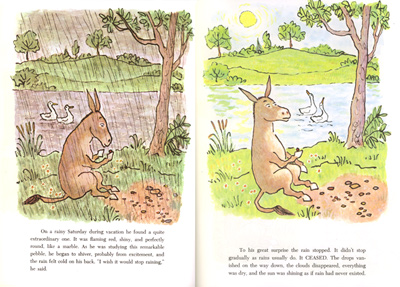
By the time they rouse Jesus to action, they are a quarter past desperate.  They are in trouble, and they know it.  They're in a real fix.  And so looking to Christ, they ask him a simple question 'don't you care we're dying?' But when Christ does rouse himself, and speaks to the storm, the storm ceases.  Not just that it slows down, or peters out, but stops.  It reminds me of that page from Sylvester and the magic pebble, which, if you haven't read it, go read it.

If you can't read it, it says that Sylvester, with the wishing pebble, wishes for the rain to stop, and it stops instantly.  'To his great surprise, the rain stopped.  It didn't stop gradually as rains usually do, it CEASED. The drops vanished on the way down, the clouds disappeared, everything was dry, and the sun was shining as if rain had never existed.'  Look at Sylvester's face in the above picture.  That face, that's the face that you would expect to see on the disciples.  But it goes beyond that.  The disciples are sore afraid of what they see happen.  As the wind ceases, the rain stops, and all that, the disciples ask the question 'who is this that even the wind and the waves obey him.?'

Well, Jesus is God.  He is their Lord and their God.  And they can tell it by what Jesus does, when he causes the storm to cease, he is showing mastery over creation in a way that humans can't.  Sylvester knows what it is like for a storm to suddenly cease, and he's a mule! Imagine what it is like for seasoned fishermen, a crew of men who sail for a living, to be around in a storm that instantly stops.  It's kind of a big deal.  And they're terrified, because maybe for the first time, they have gathered who this Jesus actually is.  Not just a teacher, not just a healer, not just a compassionate man, but the speaker of the reading that we had from Job on Sunday.  God.  The God who spoke the universe into existence, the God who made everything, who fashioned everything from microscopic organisms right the way up to the solar system.  That God.

And like the disciples, we too forget about how big our God is.  We forget that the God we worship on Sunday mornings, and throughout the week, is really REALLY big.  That's what he is, and who he is.  He's the God who made everything, who made heaven and earth, and who has control over everything in creation.  That's the God we pray to and believe in.  But we tend to forget that he is actually able to do things, that he is actually capable of acting in our world.  We forget that he is interested in what we do and who we are, and that he can and will and does work on our behalf.

Too often, we wait.  We wait for far too long.  We wait until things get really bad before we'll start to discuss things with Jesus.  Then, when things are at their blackest, when the waves are threatening to swamp over the side of our boat, when our storm is at its darkest, that's when we start to ask Jesus the big question 'don't you care that we're dying?  Do something!'

Yes.  Do something.  We've tried everything else, we've tried bailing, we've tried rowing, and now that we've exhausted our options, now it's time to call out to God.  The same God that we'd been
ignoring the whole time, now we need him.  Now we rouse him from his slumber.  Now, all of a sudden, it''s a big deal.  So we call out to him in our distress, when our kids are in trouble, or our relationships are failing, or someone is desperately ill, or whatever, and when we call out to him, it is to ask him if he cares.  Because it doesn't seem like he does.

But Jesus does care.  He cares a lot.  He cares so much that he would, and did, die for you.  He cares beyond ordinary human limitations, he cares beyond the stars.  He cares so much that he was willing to restore your relationship with God, ensuring that nothing would separate you from his love.  No matter what you're going through, even up to and including the point of death, is a storm that is passing.  It will pass.  This all passes.  All of it.  Even the stuff that doesn't seem as though it will.  We are forever people, we are not temporary, but the storms that come, they are temporary.  We feel as though they are the real deal, that they can and will flood us and kill us, but Jesus promises us that we have a hope that transcends death.  We have a hope that goes beyond the possibility of permanent separation from God and from each other.  Whatever storm you're in, it's passing.  I promise you.  Though it might not seem like it is, it is.  Though it may not seem as though the storm you're living through is passing, but it is.  And it will come to an end.


That's why Jesus died you know.  He died for you of little faith, you who are in the boat, panicking about the waves that are washing over the side of the boat, unsure of your ability to make it through the storms that are coming.  You panic, and call out to Jesus 'don't you care that I'm dying?  What are you, asleep?'  It's not because he doesn't care.  He just knows that it's passing.  Your storms even the ones that seem to be impossible, are passing.  Yes, things will be bad, yes we will perish, yes everything around us is running down, and the universe is slowing down and dying, but these storms are passing.  These too shall pass.  In many ways, our panic, our desire to see things work out, and our concern for the storm, they're all tempered by the quiet confidence of Christ, who, even as he stills our storms, chides us for our small faith.  The small faith that he himself died for.

Monday, June 15, 2015

green is the colour

Welcome to the time of green stoles.

You may or may not know this, but the season of green stoles, green paraments, the colour green, it lasts forever.  We are in the beginning of what is politely known as 'the time of the church,' and impolitely known as 'green stole purgatory.'  Yes, that's right, the scourge of common time.  We are looking at months, from now on, of green stoles, green paraments, and no change.  This comes on the
heels of the season of Easter, the season in which there has been massive change, where there has been purple stoles, red stoles, white stoles, and everything in between.  And now, well, now it's green.  Green forever.  There are no festivals coming up, no variety, no big celebrations, just church.

Coming on the heels of big monumental changes, coming on the heels of the time of high highs, what do we do with just going to church.  Not building towards anything, just going to church?  Well, that's the situation that we get into now, and we tend to not overly care for it.  We can get people into church on Christmas and Easter, but it's much harder to get people into the church in the green time.  Heck, it's harder to get us into the church in green time too.  With it not being a big high holy day, a big festival, the craving that we have for variety, it gets squashed.


But Jesus has promised us that the kingdom of God grows slowly.  We sort of want instant results like we do with everything else.  We want things to be quick, to grow massively and to be there right away.  Both with our faith, and with our plants.  We want faith to spring up from nothing and be a fully fledged faith that can move mountains in an instant.  But it doesn't work like that.


Think about your garden at home.  And if you don't have one, then go put a bean between some pieces of wet blotting paper and come back to it in a few days.  You know what it takes to have a seed grow into a plant, and to have flowers come up.  You know it takes water, sunshine and time.

And nobody among you will look at someone's garden, with pretty maids all in a row, and say 'boy, they sure are lucky that all those plants just happened to grow there.  They sure are lucky that those sunflowers, those peonies, those beans, those peas, just happened to grow up right in those spots.  Lucky.


Yeah, you know gardens don't work like that.  A beautiful garden doesn't just happen to people.  The only flowers that just happen to grow somewhere are the ones you don't want, like the ever popular dandelion.  Or South African Capeweed.  Those grow without your input, without your help, and will take over.  everything else, you have to work at.

But even though Jesus talks about slow and steady growth, as he does, we still expect faith to be instant.  Not only that, we expect it to be instant, and we also expect it to be something that just happens to people.  Like the gene for rolling your tongue, some people have it, others do not.  We feel as though faith in God is inexorable, that you were born with it, will live with it, will die with it, and if you don't have it, then you won't ever get it.  We feel about it like the gardens mentioned above, assuming that if someone has a garden then they were just destined to have a nice garden.  But you know it doesn't work like that.  And nor does your faith.

This time of green, it's the time where we work on our faith.  How does our faith grow in this time? Well, like the man in the Gospel Reading who plants and sleeps, we know not how.  We don't know how our faith grows, not really.  We don't really know how our faith grows in a time of worship and communion and prayer and participation in the Lord's Supper and the body of Christ.  But it does.  And just like you can't grow a garden with anything but water, sunlight and time, so too do we need time to grow in our faith right now.  Bit by bit and piece by piece, Day by day and moment by moment, that's how faith grows, growing from something as small as a mustard seed, starting small in infants at their baptisms as it does, then growing up into the great, fully fledged faith that we see in our staunchest people.  None of the people you see around you who seem to have it all together, who seem to have it totally figured out, who believe with a deep and rich and abiding faith, none of those people just got lucky, or just happened to have a rich faith, or had it be enormous and deep out of nowhere.  All of those people had to grow it, week by week, devotion by devotion, moment by moment, prayer by prayer, spending time with their Lord in his word and in his church, developing and fostering that faith ,planting and watering, and allowing God to provide the increase, they know not how.

Now, you may be saying to me 'pastor Jim, I don't have faith.  I wish I did, but I don't.' Okay.  But faith that can move mountaints, faith that is so big that even the birds of the air build their nests therein, that doesn't just happen fully grown.  It grows from something small. Just like plants grow from seeds, your faith starts small too.  And you may be feeling about your faith that it is dried out, withered, broken and twisted.  It's no good anymore, it's not up to much, it isn't like the faith you see in other people, who are doing great, who don't let the world get in the way, who say 'God said it, I believe it, that settles it.'  Your faith doesn't seem like that.

Well, good news.  Good news for you who are weak and heavy laden, cumbered with a load of care.  God is in the business of breathing life into things that were long thought to be dead and gone.  Think of the valley of dry bones from a few weeks ago, or think of Adam being created from the dust of the ground.  Think of the stump of Jesse from whence a shoot sprang up, or think of Lazarus having life spoken into him.  and think about the reading from Sunday, where we heard Ezekiel talking about taking a shoot from the cedar and planting it again.  Taking a branch and grafting it, planting it and making it secure and safe, letting it grow up again.  Think about your faith like a seed, as Jesus describes it.  And seeds, well, they look dead.  They look inert.  They look dry and gone, useless.  But in each of those seeds, dried out as they are, dessicated as they are, is the promise of a new plant, new growth, new flowering of life to be found even where it looks like no life can be.  God can take even what we would assume is dead and gone, and give it life, life abundantly.  That's what he's in the business of doing, taking dried plants, plants that bear no fruit, plants that we would assume are dead, finding the life in them, and saying to them 'behold, I make all things new.'

Pascal's wager deals with this, you know.  After making his case that in the wager, it makes more sense to have faith in God than not, no matter the outcome, Pascal deals with objections to his thesis, so here following is the text of the objections, followed by Pascal's answer to them.

'My hands are tied and my mouth is gagged; I am forced to wager, and am not free; no one frees me from these bonds, and I am so made that I cannot believe. What then do you wish me to do?'

 That is true. But understand at least that your ability to believe is the result of your passions; for, although reason inclines you to believe, you cannot do so. Try therefore to convince yourself, not by piling up proofs of God, but by subduing your passions. You desire to attain faith, but do not know the way. You would like to cure yourself of unbelief, and you ask for remedies. Learn of those who were bound and gagged like you, and who now stake all they possess. They are men who know the road you desire to follow, and who have been cured of a sickness of which you desire to be cured. Follow the way by which they set out, acting as if they already believed, taking holy water, having masses said, etc. Even this will naturally cause you to believe and bunt your cleverness. 

‘But that is what I fear.’ 

Why? What have you to lose?


Your relationship with God is the same as your relationship with everyone else, which is that it grows and develops not just on the big days, but over the days and weeks that go into regular daily interaction.  We grow in our relationship with our families, with our friends not by talking to them once a year at Christmas, but by growing and sharing with them even and especailly when there's not an event going on.  That's how we grow in our relationships with those we know, by daily watering, tending, weeding, and care.  And that's how we develop our relationship with God, too.  Not a matter of it just happening to people, but a matter of daily, weekly care and growth.  Here in the time of greenery.  The time of green stoles.  The time of the church.

PJ