The musings of the Pastor from Good Shepherd Lutheran Church, Regina SK

Welcome. If you're a member at Good Shepherd, welcome to more thoughts and discussion of the week that was, and some bonus thoughts throughout the week. If you're not a member, welcome, and enjoy your stay. We are happy that you're here.

If you like what you see here, consider joining us for worship at Good Shepherd Lutheran Church. Sunday mornings, at 8:30 and 11:00. You can also follow us on Facebook.

Monday, August 29, 2016

Lord it's hard to be humble

Recently, it was my birthday, and for my birthday, my wife took me to the Weird Al concert.  Yes, he was in town, and yes he was fantastic.  of all the modern artists, Weird Al is probably the hardest working one.  There were about seventeen costume changes, the older songs were reworked to continue to be good, the whole thing was super duper fun, and we all enjoyed it.


And one of his 'older' songs is Amish Paradise, which is, as usual, a great song, which skewers things, as Weird Al tends to do.  The verse that sticks in my head from this song is as follows:


Ha!  What a great bit!  It's a great bit, because trying to out-humble someone is impossible, and ridiculous to contemplate.  You can't be humble to be seen as being humble, that's nonsense!  Or is it?


You'd be surprised at how many people think that they can fake humility.  Spoiler alert, it's a lot.  Lots of folks assume that they can fake humility, that you can get away with pretending to be humble, and pretending to be meek and nice.  

But attempting this is trying to square the circle, it's going through the impossible.  You're trying to put two mutually exclusive things together, pride and humility, and whichever one is really there will bubble to the surface remarkably quickly.  And here's the issue, we have all run into people who are faking humility.  People who try to make it appear that they are humble, that they are self-effacing, but are actually looking for near constant approval.  This is a real thing that happens, and it's one of the more unpleasant things to witness.
  
 Now, why is this?  Well, it's not too hard to figure out. You know that we all love people who are humble, who are good, who work hard and who are genuinely interested in what we have to say.  And when we see the admiration that these people get, often we want a little bit of that ourselves.  But here's the problem, which is that if we want the attention, then it takes all the humility away from us, and turns it into pride.  And the pride never works out. 

So how do the genuinely humble people of the world manage it?  How do they get away with being humble and self-effacing?  How do they manage to be nice, to be kind, to think of others before themselves?  Because they're not thinking about themselves.

This whole attitude links in with Matthew Chapter 25, where the sheep on the right hand of Jesus Christ hear from him that when he was hungry or thirsty or in jail or sick that they took care of him, and the sheep had no memory of this.  When did we do this, they say.  And the answer is that whatsoever we do for the least of these, we do for Jesus. 

This isn't a throwaway, nor is it a minor detail.  It's actually quite central to understanding good works, charity, humility and all that stuff from a Christian perspective.  For in the Christian faith, you don't get to heaven by good works, by doing good things, by being a good person, that's not how it works.  Faith in Christ and his atoning grace is the ticket, not works, lest any man should boast.  And if that is the case, then why would any good works in the Christian faith exist (and goodness, some might argue that they don't)?  We in the Christian faith would say that the good works that we do, the charity that we offer, the humility that we have, is in response to the work that Christ has done.  The sheep on the right hand of our Lord said as much, when they vocalized that they had no idea that they were doing things that would factor in on judgment day, they were just doing things in response to the work of Christ on their behalf. 

And that's how Christian humility works.  You can't concentrate on being more humble, because that'll just draw more attention to yourself so that you can be seen before men, sounding a trumpet before your charity.  The only real way forward, honestly, is to not think about yourself at all.  CS Lewis talks about it like falling asleep, in that if you're concentrating on falling asleep, you're going to stay awake.  You can only really fall asleep if you're concentrating not on falling asleep, but probably on nothing at all.  Just drifting off into sleep and contentment. 

"About sleep: do you find that the great secret (if one can do it) is not to care whether you sleep? Sleep is a jade who scorns her suitors but woos her scorners." ~ C.S. Lewis

If you're focusing on how humble you are, then you're always going to be thinking about yourself, and the humility will be gone, at best you'll have a simulation of humility. At best.  But if you are thinking of Christ, of his majesty and glory, of his kingdom and his righteousness, then humility will be a natural side effect of that.

As the scriptures say, seek first the kingdom of God, and his righteousness, and all the rest will be added unto you.  All the legitimate humble Christians that I have ever met have been like this, you know, and no, I don't count myself in this number.  There are legitimate humble Christians, Christians who are empty of their own opinions and dedicated to service.  People who don't think about themselves and how they look, but who instead would wash feet, feed thousands, and never let on that they were doing any of it.  Which is the point.  How do they manage it?  Because they aren't thinking about themselves.  They're thinking about Christ, and responding to his grace.  That's all.

It's so simple, really, but incredibly profound.  And as usual, you can't fake it.  There are no oven settings for this, no Shariah finance to help you shortcut around it.  None of it can be put on, and you've probably seen enough people try to fake it to know when they're doing it.  You can't sit at the worst place with the expectation that you're going to be moved up higher.  That's not how it works, it's more false humility, and it never works out. You have to sit at that low place because that's where you feel you ought to sit.   You've looked at yourself, you've mused on the concept of God and his majesty, you know how great he is and how small you are, and so you sit at the lowest place because that's where you feel you should be.  And it is there that Christ whispers those comforting words to you 'Friend, move up higher.'

If you've placed yourself at the best possible place you can, then there is nowhere to go but down.  If you are at the highest high, if you've placed yourself in the prime place, higher than anyone else, if you are up there, then there is nowhere else for you to go but down, to be moved down in the esteem of others, to be placed in a lower spot.  If you're in the lowest spot, then there's only one direction to be moved, which is up.  I know, it seems so simple when explained like that, but that's how simple it is.  Most of the time, we end up making things more complicated than they have to be or need to be.  When humility comes up, don't think about how humble you are, don't think about how humble you can be, don't think about how great it would be to be seen being humble, none of that.  Just think on Christ.  Seek first his kingdom and his righteousness.  The rest will follow. 

To close, it all reminds me of a book by Terry Jones called 'Fairy Tales,' which was a book of fairy tales written by Terry Jones. I know, what a synopsis.  One of those fairy tales had to do with a castle
a long way away, that a man was trying to get to.  He spent a long time trying to get there, but never ended up getting any closer, always retreading over the same ground, and never making any progress.  Eventually, he gave up, and found that when he gave up, he had arrived at the castle.  He was there.  THe moral was that sometimes giving up is the best way of getting to where you want to be.  I know that seems strange, like it's the exact opposite message from what we are usually given, but that's what was so special about it - it's true.  Never quitting is a silly way to try to run things.  So too, the only way to be humble is to not think about being humble.  The only way to be humble is to think of others, think of Christ.  Thinking of yourself and how humble you are will lead to self-reflection and self promotion, and being moved down from the place of honor.  Thinking on Christ will lead to grace, humility and charity.


Tuesday, August 9, 2016

As numerous as the stars in the sky.

There's a great line from the Old Testament reading from last Sunday, where God says to Abraham 'Look toward heaven and number the stars, if you are able to number them.'  To Abraham, that would have seemed like an insurmountable task - to number all the stars, to count all the stars in the sky.  Surely not!  The milky way sort of goes on forever, and you can see the stars twinkling far away into the night sky.  It's a beautiful and humbling thing to see.


When you can see it.

Most of us can't.  Most of us can't and don't see it all that often.  We fall prey to something called light pollution, and no, that doesn't mean pollution that isn't too heavy.  That means that we have put so much light up from our cities that we can't see the stars anymore. They get crowded out.  It's the same principle that governs why you can't see a flashlight in the middle of the day, that sort of thing.  And when we look up in our cities now, we can see, what, twelve stars, total?  Look up and count the stars, if you can number them.  Sure, no problem.  I only just barely need to use both hands.


Now, we have set up a great many lights up in our earthly dwellings these days, you know.  We have set up a great many lights, a great many things that threaten to cloud out the promises of God to the point that we can't see them anymore.  God has told us a great many things through his word, he has informed us of his care for us, how much attention he has for us, what he seeks to bring to us, what he wants to give to us.  The reading from the Holy Gospel from Sunday discusses that at great length, with the account, the words of Christ about how we ought not be anxious.  We ought not be anxious about what we should wear, not about what we should eat, nor about what we ought drink.

You know, all those things that occupy almost all our thoughts.

All the ads that we see are concerned with those sorts of things, the base things of this world that occupy almost every single surface that we look at.  Surfaces are covered with advertisements, smeared with messages designed to pique your interest, to get you to consider how bad your life is right now, and how much better it would be with a big mac, or a coke zero, or a new blouse, or a new car, or whatever else they're hawking to jam into your heart and rend it asunder with want.  This is what occupies essentially all our thoughts, all our motivations, is all this stuff, and each thing that diverts us, that occupies us, that draws our attention is one more lightbulb that we light up that drowns out the stars of the promises of God.

Now, if you've ever gone camping, or have gone outside the city at night, maybe out to grasslands national park or whatever, then you will see the stars.  And when you get back into the city, you'll notice that the stars are all gone.  But they haven't gone anywhere.  You just can't see them anymore.  Now, this is the issue that we have with the promises of God.  God has made a lot of promises to us, promises of daily bread, which promises to give us house and home, wife and family, clothing and shoes, and all the things of this world that give us the life that we have enjoyed.  And what we see happening on a regular basis is that we have clouded things over so heavily with our own pollution that we absolutely cannot see the promises that have always been there, and which are not going away.  Jesus tells us clearly in his word that heaven and earth will pass away, but his words will never pass away.  And we have to believe him.

Now, ignoring the promises of God doesn't mean that they go anywhere, they're still there, and still as effective as they ever were, just that we can't see them.  And every once in a while, it's incumbent on us to listen to the words spoken to Abraham in the Old Testament, and to hear the direction that God gave him, which was to trust in Him, to believe him, to go to a destination that he could not see, to take steps away from what was comfortable, and to live and reside in the promise of God almighty himself.  And he took those steps.  He believed in what God was saying to him, and that is what sets Abraham apart from everyone else.  He wasn't better or stronger or holier than everyone else, but he did believe in what God said.  And God credited it to him as righteousness.

Us now?  We have a hard time believing God on anything at all.  He tells us in a most straightforward way what he has promised to do for us, how much he cares for us, and he follows that up by giving us this encouragement:  'Sell your possessions, and give to the needy.'  Wow.  That's in straight up black and white, with not a whole lot of room for wiggling out of it.  Sell your possessions and give to the needy, and most of us just really don't want to do it.  Most of us don't really feel like going through with that kind of initiative.  We would rather hang onto our bucks, and not get too deep into giving what we have to someone else.  We can talk in glowing terms about love and trust for God, about what Noah and Abraham and the rest of the Biblical heroes were able to accomplish thanks to their faith in God, and yet, and yet, our trust for God gets hung up on relatively simple things, like not really trusting that he will take care of us.

So what's to be done?  Back to the stars, at night, all our lights and smog and clouds have a way of obscuring those stars so we can't see any of them.  Sure, we know they're there, but we honestly don't see them too readily.  Everything we have made and built blocks them out, and they're hidden from our eyes based on what we've done.  And living in cities means that we are in a situation where we never really see that rich tapestry spread out before our eyes.  Oh sure, we could pull an Abraham, and go far outside the cities and towns, head into dark sky preserves where the stars can finally be seen, but very few of us are going to do that.  And knowing that, God decided to do something entirely different.  He decided to break right the way through the issue of our concealed hidden stars, and get us to the point where we would finally see the stars again.

You know, it blew my mind when someone finally explained to me that the sun, our sun, is a star.  That's what stars look like when they're up close.  That's what a star looks like, and it's massive, and all the planets in the solar system orbit it. And it doubly blew my mind to hear that our solar system only has one star in it, namely the sun.  It seems strange that at night, you can stars from way far away all the time, but during the day, you can't see any star except one.  And that one star, not only can you see it, but thanks to it, you can see everything else.  At night, you can go way out to a dark sky preserve, you can go far from the works and worlds of man to go and find the stars lighting up the sky, or you can wait for the morning, and see the one star that illuminates everything.

Abraham was asked by God to look up in the sky, and to try to count and number the stars, numbering and counting all the promises of God.  He couldn't count that high.  Today, we have blocked out not just the real stars, but the promises of God get crowded out by the various things we say and do.  We have blocked out the stars in the sky and thanks to what we built, the blessings of God seemed very small.  So God sent his son, Jesus, to break through all the things we have brought and built, to show us the promises of God large as life, that illumine, warm, comfort and light the way.  Think about those times where you have noticed that street lights are still one during the day, and you can't see the light coming from them almost at all.  Or when traffic lights lose their little hoods during the day, you can't see the light, not because it's not there, but because the light from the one star you can see is so bright. You see, you can either cloud out all the promises of God with what you're worried about, what you're concerned about, or you can look to Christ, to the son, and let him crowd out all your worries, all your cares and concerns, and let you see exactly how small your concerns really are.  All your anxiety, all those tiny lights that you light up, they are small and worthless next to the massive presence of that great promise, which lights up and overshadows all the issues and concerns, all the lights you've lit up for yourself, it blocks that out.


The reading that comes up for this is the one that comes up for Christmas, talking about Jesus Christ as the light of the world, the light that shines in the darkness, the light that illumines everything, that casts light and in whom there is no shadow.  What God asks, that we put all of our worries behind us, that we focus on him, that we look to the stars and number our blessings with them was proving to be impossible to this and all other weak and faithless generations, and so God sent his son, blessing us and cutting through all our worries and cares, and pointing us to the one who holds the future, and who prepares a place for us, an eternal place, where all the lights we have lit for ourselves can be seen for what they are: not enough to block out the love of God that is in Christ Jesus our Lord.

Thursday, August 4, 2016

Cheeseburger and paradise

Vanity of vanity.  All is vanity.

Boy, that is NOT how you want a book of the Bible to start. You want it to start with some sort of actualized message about how great everything is, about how you're a treat, and how you're doing a good job so don't worry about it. And yet, the story of the book of Ecclesiastes tells you that all is vanity.  Everything is vanity, it's all chasing after the wind.

Now, that sounds glum, but give it a second, because you may well realize that this is one of the more self-evident truths about the scriptures.  How many times have you found yourself running from pillar to post, chasing hither and thon, trying to make sure that you have everything figured out, and
making sure that everything is exactly where you want it to be, when all of a sudden, you find yourself at the end of the day, the lights have gone out, it's dark outside, you have been chasing about all day, you're thoroughly exhausted, and you have nothing to show for it.  Nothing at all.  It shouldn't be that way, of course.  It shouldnt' be that way where you are exhausted, burned out, and you don't feel like you've accomplished anything, but there you frequently are.  You get to the end of the day, every day, feeling like you're totally run down, the house is still a mess, the kids are still cranky, and you only just barely managed to get by.

You know, the Good News Bible, though not the favorite of everyone, still has the best illustrations of a Biblical topic.  That is, we see in those illustrations the simplicity of a concept.  And one of the
ones I still remember is of a man chasing after the wind from Ecclesiastes.  In simple line drawings, it shows the total futility of pursuit of something you can't nail down. And that's the real thrust of the reading that we had from Ecclesiastes - that we spend our lives trying to chase the wind, trying to pin down something that is by its nature fleeting.  Hammering down the wind is massively impossible.  You can use it, but you can't keep it, can't secure it.  It's going to go wherever it's going to go.

Now, most of what we busy ourselves with is chasing the wind.  That is, it's fleeting.  It's vanity.  It drifts away, and you can't secure it.  But we think we can, that's why we chase it.  The majority of what we're hunting is the physical stuff of this world that is impossible to pin down, impossible to secure.  The illusion is that you can secure it, but in practical terms, you can't.  It's always going to be chasing after the wind.

All the money, all the possessions, all that noise ends up being clutter that we think we can secure, but this is the realm that theives break in and steal, and moth and rust destroy.  The thing about the way the world works is that it is all running down, winding down, and whirling towards destruction.  All the physical stuff of this world is collapsing and falling apart, eventually.  That is, the things, the stuff of the earth, and the entire universe, is running down and falling apart.  There will come a time when the universe cools to nothing, and then that's it.  All the things you have ever owned will be dust and ashes, or will be sucked into a black hole, or will just cool to nothing whatsoever.  It's all running out, and it's not just that everything you ever earned will go to someone else eventually, as the Preacher opined, but that it will go to nobody.  It will just turn to dust eventually.

Boy, that's depressing.  It's the theme for the first chapter of a great book called 'the skeptical approach to religion,' which tells you that given that nothing you have ever done is ever going to
matter long term, how do you possibly get through the day?  I'm over-simplifying, of course, but that's the nature of our long term existence, which is to say that if you sit down and really think about the purpose behind your life, it will amount to nothing but pursuit of the wind.  Just flailing around.

But what Jesus tells us is something truly exciting.  Something that is of massive importance that can't be overstated.  In the Gospel, Jesus tells us that the things that we think of as permanent actually aren't.  They're not forever things.  The man who accumulates the grain into his barn, who tells himself 'self, you're doing fine, eat drink and be merry,' must realize that he is running out of time, and all the stuff he viewed as permanent is fleeting.  What is it that matters, after all?

The man at the beginning of the Gospel reading is calling on Jesus, saying to him 'Jesus, tell my brother to divide the inheritance with me.'  Sure.  And like most of us, when money gets into the picture, even family goes out of it.  Family can wear down and break down when faced with money, which we prioritize as being more important even than those whom we love.  We'd rather lose brothers and sisters than inheritances.

But Jesus reminds us that the money that we prize so much, it's all just chasing the wind.  Life is not what you buy, and what you have.  Focus on those two commandments of Christ - Love the Lord your God with all your heart, mind, strength and soul, and love your neighbor as yourself.  Everything else can and will sort itself out.  For those two things, unlike all our stuff, are forever, and they never go away.  If you truly believe what the Bible says about human beings, you will know that everything else in creation eventually goes away, it disappears, but people are all forever people.  Including us.  AND including the people that you don't like all that much.

That's the difference between the vanity promised in Ecclesiastes and the fulfilling life that he talks about at the end.  If you're running after the things of this world, then it will be exactly like chasing after the wind.  You're never going to pin it down, it's always going away.  The reading from Ecclesiastes ends with this most excellent passage "For to the one who pleases him, God has given wisdom and knowledge and joy."  Yes indeed.  And as you have noticed, life itself isnt' different between the Christian and the non-Christian, so what is different?  What ends up being different is the grounding of the faith, the base for the life that carries on.  If your life, as Jesus says, is based on the accumulation of possessions, then it's all vanity and chasing after the wind.  But if it's based around love for God first, and love for each other second, then each decision, each interaction each moment you spend with other human beings becomes of phenomenal importance, because those are the forever decisions that matter.  The cheeseburger is of momentary pleasure, but the server who gave it to you, who you may never see again until Paradise, is forever.  Of the two things, which one do we normally feel is more important, vs which one actually is?

Ultimately, part of what we perhaps unfortunately need to consider is the people we see are forever people.  That's the big lesson of Christianity, and understanding that means that your life doesn't consist of chasing the wind.  If the prioirities shift away from the things, the stuff of life, the monuments that are naturally moving towards destruction, and towards the people, then everything we do, every encounter we have with people, carries more weight and punch because those interactions, no matter how small, are of eternal consequence.  You can't look at anyone and say that they don't matter, that they aren't important, that the way you treat them is irrelevant, because as Jesus says:

"Truly, I tell you, just as you did it to one of least of these who are members of my family, you did it to me." (Matthew 25:40)

That's  a double edged sword.  If we refuse to treat each other well, then we are neglecting our divine calling as human beings, rejecting the good works which Jesus has prepared in advance for us to do.  But if we take that seriously, if we realign our priorities, then we notice that all the things of this world, the things we busy ourselves with, the things that the nations run after, all that is chasing after the wind.  Our priority is love for God, and love for each other.

And if we're not doing that perfectly, which, if we are honest, we aren't, then the scriptures still have some good news for us.  Some good news that tells us that God knows better than we do what is important.  Think of the moment where he was standing on top of an high mountain, and Satan showed him all the kingdoms of the world in all their splendor.  And Satan said to Jesus 'I will give you all this if you just bow down and worship me.'  And Jesus responds by telling Satan to get away, for all the kingdoms of the world are less important, less durable, than God, and his people.  Jesus came, shed his blood, and died to give you eternity, to make you into something that lasts longer than the stable earth, the great salt sea, around the old eternal rocks.  He came to make you, you child of dust, into something that lasts longer than the pyramids, than the monuments that are designed to stand forever, which are all falling apart and going away.  Heaven and earth may pass away, but his words will never pass away.  Take comfort in that, in the knowledge that his words of grace, of compassion, of love even for the wayward sinner are eternal.  He does not lose focus on what is important, on what is eternal, and he does not lose focus on you.


Monday, June 20, 2016

Father's day

Hey kids.

I say kids, because we are all God's children.  And what does that mean?  Jesus, in his earthly ministry did a lot of communicating with parables, communicating with parables to make sure that we could understand the incomprehensible through things we do see around us on a daily basis.  Object lessons and all that.  And when he tells us to talk about God, he does as our father.  Our Father.  Unpack that for a second.

Think about your earthly father here.  Think about your father and what he has in mind for you. Jesus Christ talks about this, when he mentions that God is our heavenly father, and that he does good things for us.  And for us, who are earthly fathers, if our child asks for bread, will give that child bread instead of a stone.  And if our child asks for an egg, we will give that child an egg, instead of a
scorpion.  We, who are evil, know how to do good things, how to give good things to our children, so how much more will our heavenly father give good things to those who love him?  But we are children still, through and through, and Jesus tells us to speak to God as our father, and about him as our Father.  When the disciples speak to Jesus and say to him 'teach us how to pray,' he responds with the Lord's prayer.  We also call it the Paternoster, or in English, the Our Father.  What that moment in the scriptures represents is God telling you how he wants to be spoken to.  This is how he has chosen to be viewed by us, the relationship that he has chosen to have with us is as our Father.

Now, people will bring up a dichotomy in the scriptures, something that doesn't seem to add up.  People will look through the Bible and see in there a split between the Old and New Testaments.  People will look at the Old Testament, and say 'well, look, there's angry God there, and the God I like is the nice God, the happy God, the New Testament loving God.  It's like they're two different guys.'

Sure enough.  It says something about us that we can't figure this out, given that it is in every way analogous to our own lives.  It falls in line with our own experiences as we grew up and matured.  For you see, when you were a child, you had to do what your parents said to do or there would be consequences.  "Wait until your father gets home" is a threat that is leveled against children, and it incubated the idea within them that they should do what their parents want them to do, because they would be punished if they were caught. You avoid breaking rules because of the punishment that would fall on you if you got busted. 

Well, then you move out, you grow up, and things change.  When you're on your own, when you're in your own space, with your own rules, maybe with children of your own, and then your father can't make you do anything.  He can't force you anymore, and there are no threats of punishment.  But one would hope that if you have been taking him seriously so far, then you would follow his counsel and guidance because, well, because it's the right thing to do. 

Your Father will go through a lot of effort to try to guide you, to shield you from yourself, from your own decisions that you believe that you are smart enough to make. As a child, and especially as a teenager, you figure that you know everything, and that you know what is right to do.  The Bible has a term for that, you know.  It has a term for that, and we saw that term being used in the Old Testament reading on Sunday, where people 'Walk in a way that is not good, following their own devices.'  That's what we are prone to do, because we are still children, and we figure that we're all about making good choices, and we don't need God's help anymore.  We're baptized children of faith, we're not going to be kicked out of the family and devalidate our baptismal promises by not being nice to each other, surely not.  But our earthly parents do something for us that we need to remember.  They give us advice and guidance, they will help and direct us, will give us all the counsel and aid that we want, but they won't force us, can't force us, into doing what we ought.  And there are natural consequences for our actions.


Galatians speaks to that, telling us that the heir, as long as he is a child, is no different than a slave, though he is the owner of everything.  The child is no paid for his work, receives no recompense for it, cannot earn more of his parents' love by doing things, none of that works at all.  Instead, there is a matter, a simple matter of being subject to their wills and rules.  That's Law, to be sure.  But when the time comes for inheritance, for us to be redeemed by the will of Christ, then we were freed indeed.  It's exactly like it is in your homes, in your own families.  Why do you do the things your parents want you to do? Because you want to earn your way into the family?  Not likely, you're arlready there, and you can't get more there.  Instead, you follow their counsel and direction because you're convinced that it's the right thing to do.  In the Christian church, in our faith, salvation has been won for us by Jesus Christ. We don't have the law as something we need to observe or we're out of the family.  It's not a threat that if we don't do what Jesus would tell us to do, then we'll be out on our ears, that's not how it works.  Because he has fulfilled all righteousness for us, because he has fulfilled the law, not cancelled it out but fulfilled it, then we are all of a sudden in a position where we look at the rules and guidance and counsel of our Lord, and are not compelled to do it, but free to.

Most of the problems we run into in our lives are because we wilfully ignore what it is our Lord has told us to do.  He told us how to live, how to operate, how to function, and we expressly decide not to do it.  We look at the situation, and decide not to be involved, not to follow up with his advice, to say to and about ourselves that we know best, and we know what the best action is to take, always.  We follow the advice of our own hearts, we follow our own desires, and we're not interested in what God has to say.

But Father legitimately does know best.  He's not going to force you into doing what he has set aside for you, he won't make you do it, but he will let you know over a lifetime that following his rules and ordinances was a good idea for a reason.  If you don't clean up, you'll get vermin.  That's true. You can avoid cleaning up, leave things out for forever, leave filth all over your home, and guess what, dad's never going to show up and yell at you.  But the roaches and mice might just move in.  If you smoke two packs a day, then you'll likely have health complications down the road.  Maybe back in the day you had to hide your smoking from your father, but if you're own your own, daddy won't catch you.  Cancer might.


It's usually only after our fathers have long since stopped raising us in their homes that we genuinely appreciate what they were trying to do.  And it's usually at that point that we realize that he had a good idea of what he was talking about all along.  He knew how we should avoid calamity, he knew how we should steer clear of trouble, he had a good idea of what we should be doing all along, and usually as children we were too stubborn to see it.  It's the same with God.  It's worth our while to remember that we, though fully grown, are really still children, because we will always be children.  We will always be his children.  And even though we are heirs, and can do what we want with our rich ineritance, it's always worth consulting with what our father has advised us to do.  He knows best.


Happy Father's day, everyone.

Sunday, May 22, 2016

The Trinity

The Trinity.


This is perhaps the stickiest subject in Christianity, possibly because it is the most other-worldly.  That is, it is the thing about the nature of God that seems to be the most difficult to get our heads around, precisely because it is the matter that is the least like the things we see around us.

Think about this for a second.  Consider the following.  Jesus was a great believer in teaching with parables.  That is, he would use the things we see around us on a daily basis to explain the things that
we can't possibly understand.  He would use lost coins, wandering sheep, pearls in the ocean and money buried in a field, all to talk about the kingdom of God.  He would discuss himself as a good shepherd, as the door to the sheep pen, as the vine whilst we are the branches.  All good stuff, because it uses things that we know to explain what we don't.

But somewhere that Jesus doesn't use images, doesn't use metaphor or simile, doesn't use parables, is with the Trinity.  Now, obviously, if it was as simple as giving it the shamrock shake, or as straightforward as explaining it like an egg, then he would have.  But he doesn't.  These are all things that we have had to use ourselves to try to explain the Trinity, but because they aren't divine, they are going to have problems, and they're going to break down.


The Trinity is by its very nature not of this world.  Understanding the big questions about it, asking who Jesus is talking to when he prays, asking how the Holy Spirit fits into everything, well, that's all complicated, to be sure, and it resists our efforts to rapidly find a way to explain it in terms of things we get, and things we understand readily.  The reason, once again, being that it exists outside what we have around us at hand.

The absolute best way I've ever heard it explained is from Dorothy Sayers, who talks about the mind of the maker, being a discussion of the nature of God as understood through the lens of the creative process.  Dorothy Sayers herself was an author, both of fiction and of nonfiction, and her understanding that she used was to talk about God as being someone who made things, like we write or compose or create.  And understanding creation in that way would help to clarify the difficulty we see in explaning the Trinity while we are stuck in this world.

Think of this world as a play.  Think of this world as a play, conceived by an author, and produced on a stage. Now try to imagine the world from the point of view of the characters, not of the actors.  Try to imagine the world that the characters are living in, and trying to explain to them that the world they see around them is fake, that it is a simulation of the real world, but that it isn't anything real.  Oh sure, the set seems real to them, they're acting as though it is, but it's not.  This isn't the real world.  Now, imagine telling the characters who are in the play that there is a real world out there, a world not made out of crepe paper and styrofoam, a world where the trees are made of wood, not of papier mache.  What would they feel to learn that there was a real world where the sun gave light instead of Frenells.  How would they feel to learn that there was a world beyond the proscenium, where there were people who watched the play for an hour and then left, and went to a world that wasn't locked to the size of a stage, but was the size of the entire world, where they could go where they wanted, do what they wanted, where they could go and see other plays, and even be in plays themselves!  Imagine how they characters would react if you told them that out there, somewhere in a world beyond the limits of the stage, was an author who had conceived of their entire world, who had written their lines of dialogue, and who had worked out what was going to happen long before the play was rehearsed.

How would those characters react?  how would they see their place in the world knowing that this is the case?  Would they be able to understand the concept of the author?  What if the author, who was also a director, starred in the play himself, and was able to tell them about the world that was to be found outside?  What would they do?  How would they take it?  It's not as small as you think it is, either, not really.  It's far more complicated than you think it is, given that the characters in the play would have no idea what it was like to be born, to grow up, to have children, to eat real food and drink real drinks, any of these things that we go through in the course of our lives?  How would they take it?  Odds are, they couldn't possibly conceive of it.

That's what we have in the Trinity.  We have the author, who conceived of the play as God the Father, creating the world and the people in it essentially out of nothing.  Then we have the director, God the Spirit, who tells the characters what the author has in mind.  He gives direction, and guides the members of the chorus, the leads, everyone in a real way to ensure that the play goes the way it was supposed to.  and then we have the actor, God the Son, the one who enters into the world of the play, and who lives according to its rules.  The tragic hero, the one who suffers, the one who dies, and as far as the other characters know, dies for real.  In their world, he perishes.

But here's the score.  The actor, the son, knows of a larger world out there.  He knows of a bigger world out there not limited to the stage, not limited to the world that is stuck beneath the lights.  He knows of a world that is lit by the sun, the world that he came from, and the world that he is going back to.  And he has promised that one day he will make it so that the characters playing in that play, not the actors but the characters, who only exist in that play, will be able to walk off that stage and into the real world, where they can choose where they want to go and what they want to say.  No lines, no script, just life.

How would they take it?  Well, we assume that they'd take it well, but were' not basing that on anything.  More likely than not, they wouldn't believe it, or would find there was no way for them to imagine it.  Everything that the Son could do to tell them about the world he had come from would be confusing for them, because it would sound like their world, but would be impossible for them to conceive of.  There would be only so much that the Son, the actor in the play could do to explain the situation to them by relating it to what they see around them, before saying that there is ultimately so much that they could never ever work out, so they'll have to take what he says on faith.

For us, the Trinity works like that.  We have the Lord our God who made everything, who fashioned the world out of nothing, and placed it here, in this universe.  This wasn't where it had to be, but this is where he chose it to be.  He made the world, and made the rules that govern the world. He placed it into the universe, and chose how it was going to work . Then he placed into it the people that he was going to love and cherish, that he was going to watch work and grow.  And then they sinned, and caused the destruction of the world around them.


So God sent his son into the world, to take on flesh and dwell among us, to live as we live, to grow as we grow, to exist goverend by the rules that he had made yet had never been bound by, he placed himself into this world and lived and died based on rules that he absoultely did not need to follow.  But he did so becuase he loves and cares for us, and wants us to break us out of the stage, away from the death that awaits us, and into the real world that until now only he has known.  What is that real world?  It's too hard for him to explain, because it's far far beyond what we can imagine.  The characters in a novel can't imagine what it is like off a page.  The characters in a movie can't imagine what it's like to be anywhere but on film.  We can't really conceive of heaven.  And we can't conceive of a God who made everything entering into human history to guide and redeem us.

But that's the story of the scriptures.  And to be a Christian means that you know that it's not just the story of the scriptures, it's the story of us.  It's our story as children of God and people who are in history.  That means that the creeds aren't the story of creation and redemption and sanctification of the human race, or of Israel, or of the disciples, they're our story too.  The dogma is the drama, and it's the drama of humanity.  It's the drama of our story, the story of humanity that lives with God, and cherishes him because of what he has done for us.  It's the story of  God creating you, redeeming you, and making you holy through his means of grace. That's why it's such an important thing to be immersed in - because it's not the story of the past, it's not a dead document.  It's the story of today.  And it's vibrant, burning flame.

Monday, May 16, 2016

Pentecost

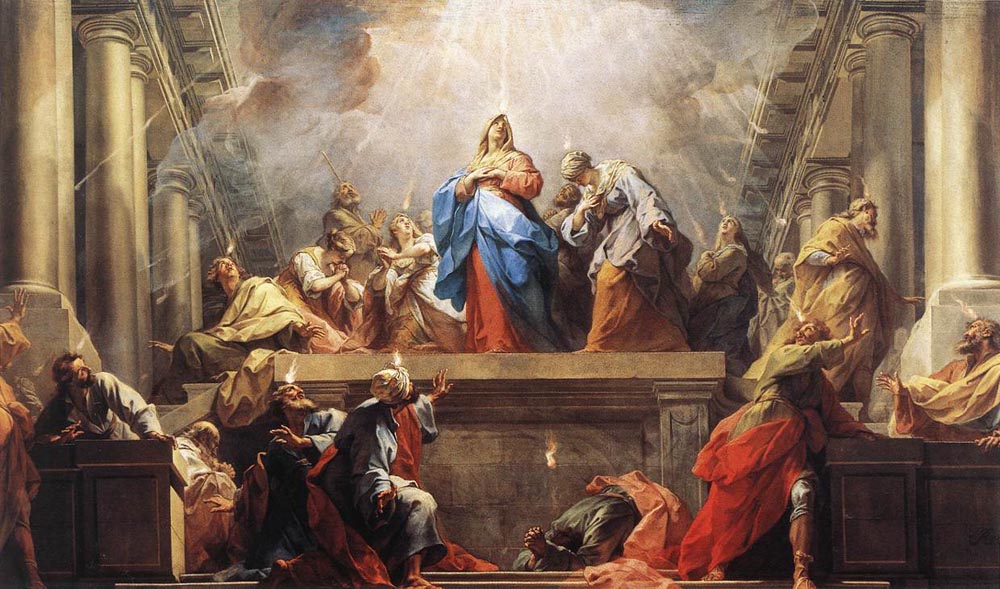
The disciples were there, all assembled in one place, and divided tongues of fire were seen over their heads, indicating the presence of the Holy Spirit.  And immediately, all those who were in attendance heard them speaking in their own language.  Parthians and Medes and Elamites, and residents of Mesopotamia, Judea and Cappadocia, Pontus and Asia, Phrygia, and Pamphylia, Egypt and the parts of Libya belonging to Cyrene, and visitors from Rome both Jews and proselytes, all heard the word of God in their own language.

This is one of the best readings in the entire Bible to hear from the front of the church, because it's always a terrifying time to have to read it.  I mean no disrespect to any of our most excellent readers in our congregation, but it's a matter of incredibly difficult, unfamiliar words.  Now, in the church, there are a great number of things that are unfamiliar, tunes that are hard to sing, names that don't come too easily, but the idea is to work through them until our weaknesses become our strengths.  This doesn't work with the goodness that is the Pentecost readings, though.  The pentecost readings are a different beast, given that they are words that sort of come up once and once only.  And good luck getting used to those.


But the sheer difficulty with the words in the pentecost reading is ironic, given that the disciples' words were heard by everyone in their own language, presumably with the words not being overly complicated either.  And this barrier being broken down is something that is of key importance for us as Christians, especially as Lutheran Christians.

You see, for a long time, the Bible wasn't in the hands of the people.  It was only in the hands of the elite.  It resided in the hands of the clergy, the rich, the powerful, and nobody else could get a hold of it, but that wasn't always the way.  I was speaking with a member of the youth group not too long ago who (rightly) pointed out that a long time ago, the Bible was only available in Latin, which nobody spoke.  Of course, we continued our conversation to work out why it would be that the Bible was in Latin in the first place.  Here's a clue - the Latin Bible is called the Vulgate.

Vulgate.  As in vulgar.  As in common, everyday, base.  The Vulgate was an attempt to get the Bible out of Greek into the language that more people would have been speaking and reading at the time. And the New Testament being in Greek was itself an attempt to get the Bible into a language that more people would have been speaking and reading at the time. Jesus would have been speaking Aramaic, but outside of his immediate environs, there wouldn't have been much call for it.

So, Greek was used to get the Bible out there as far as possible.  And when Greek waned, the Bible was Jeromed into Latin, so that more people all over the Roman empire could read, mark, learn and inwardly digest it.  No problem so far, right? Well, here we go, because after a while, the common language of the people changed.  People were speaking English, Dutch, German, Portuguese and Spanish, but the Bible remained stubbornly Latin.  The Bible was so stubbornly Latin, actually, that people were incinerated to keep it that way, instead of having it be translated into more commonly spoken languages.  So what was the point?

We, in the church, we have a way of forgetting, and of applying an element of righteousness to something that was supposed to be utilitarian.  The Bible was in Greek to make it more legibile, but the good people determined that it was intended by almighty God to be in Greek forever.  Then in Latin forever.  And all sorts of things that we do in the church, the things that we hold onto as being relatively important, a lot of those are things that were once for a good reason, a good purpose, that now we hold onto sort of just because.  And that leads to a whole bunch of sound and fury signifying nothing.

It's the duty of those in the church to have our own new Pentecost every once in a while.  It's our duty to look at where we are, at what we are doing, and to ask ourselves 'does this make things better, or does it make it worse?  Are we getting our point across better, or have we been missing the mark a whole lot?  And why?

For sure, some things will be a matter of scripture, about which Paul warns us in Galatians 'if anyone, even an angel from Heaven, gives you a gospel different from that which you have received, let him be accursed.'  Okay, good to know.  But that lets us change all the other things instead.

And here is the snag.  We are under semi specific instructions to remove all the barriers to the Christian message as possible.  We are charged to be 'all things to all people that we might win some.'  To be a Jew to the Jews, a Greek to the Greek, to be all things to all people, but to keep the Gospel of the Lord intact.  And yet, it is entirely our temptation to do the opposite.  It's our temptation to keep the wrapper and to toss out the gift.

In this way, we're a little like children.   You know how it is to raise kids, right?  To have a teeny tiny one year old obsess over the wrapping paper, the ribbon, and completely discard the gift?  You know what that's like.  Well, that's us, not to put too fine a point on it.  We're entirely like that.  We love, we adore, the things that come along with the Gospel, the trappings, the ribbon, the outfits, the music, all that stuff, and we love it more than we love the core, the content of the scripture.  Why is that?  well, it's actually not that hard to figure out, you know.  We love it because we made it.  Unlike the Gospel, which was written by the Lord our God himself, the trappings, the bits and bobs that make up the service, or the church structure, or any of that, we claim ownership of that.  That's ours.  We made it, and we place it alongside the Gospel of God, and we say to the world 'these are your gods who brought you out of slavery!'  Yes indeed.


Idolatry, at its source, always seems to end up with the person making the idol as the god that the idol represents.  That's why idols aren't actually all that hard to work out.  When it comes to gods, to the gods of the world, ask yourself how closely they reflect the character of the person who worships them.  Interesting, isn't it.

But you stop me and say 'pastor Jim, surely most Christians would do the same, right?  Most Christians would present to you a version of Jesus that looks an awful lot like them, right?  Well, yes, they likely would.  Now, that doesn't mean that Jesus, the God of the Bible, is an idol, far from it.  That just means that we turn him into one.

Remember the great gift of Pentecost, where the Holy Spirit smashed through the masses of layers that the people of God had placed around themselves, the layers that they had made over the years, and reminded them, through whatever means that he had to, that the kingdom of God wasn't all about the things that they had made themselves, but was instead about the word of God.  Smashing through those layers is awfully difficult, can be horrendously complicated, it's  minefield where teasing out what you've added to it from what was there to begin with is a process fraught with problems, but that's what we are called to do, to present the word of God whole and unviolate, to present the word of God exactly as it was given, show it to the world, to all nations, and say to them 'here is where forgiveness of sins, life everlasting, here is where comfort for your conscience and blessed assurance are to be found, in Christ Jesus.  He is the way, the truth and the life.'

That's all.  No idols, no layers, no insistance on language or culture, no insistance on coming to me before you come to Christ, just Jesus, and nothing but.  Paul says that he purposed to know nothing but Christ and him crucified, that the people may not see Paul, may not meditate on Paul (was Paul crucified for you?) but that they may see Christ, and know him only.  It takes a lot to get out of the way of the Gospel, it's a heady dose of humility to be able to handle it, but that's what we are called to do.  To echo the words of John in the wilderness.

He must increase, and I must decrease.

Monday, May 9, 2016

Up with mothers!

The Ascension of our Lord is a curious matter, don't you think?

I'll elaborate, because it's one of those things that we celebrate, that we have a festival about in the church, which doesn't seem to make a lot of sense on the surface, given that it's a day in which our Lord Jesus Christ ascended into the clouds and left us all alone on earth.

I suppose something analogous to that would be to celebrate the day that your two loving parents broke up, and your father moved away to Zaire and only sent you money in an envelope once a year on your birthday.  This is not a happy day.  Jesus ascends into the clouds, and vanishes from their sight.  The man who was God in the flesh, he who had been working on their behalf, the man who had been healing the sick and raising the dead, the man who had been curing diseases, performing miracles, the man who had been doing all these amazing and wondrous things, he ascended into the sky and was gone.

And then, as it tells us in the book of Luke, "They worshiped him and returned to Jerusalem with great joy."

That doesn't make a whole lot of sense, you know.  It doesn't make a whole lot of sense for the disciples to be filled with great joy while they think about Jesus, the lamb of God, being taken from their eyes.

Now, this is a problem until you consider what's happening here on a bigger scale.  Consider this. Consider the ascension less like a loving parent moving out from you, and more like a loving parent helping you move out.  Now, if you're reading this, there's a good chance that you moved out at some point, and got a place of your own.  There's a good chance that you have a spot to call your own, your own apartment, condo or house where you live quite contentedly.  If that is the case, who cooks for you?  Who cleans for you, who irons your shirts, who does your laundry?  If I were to guess, and I am guessing, there's a great chance that you do that yourself.  Your mother doesn't still come in twice a week to do your laundry for you, I'll wager. 

But cast your mind back to a time when your mother did do everything for you, and I'm sure there was one.  Cast your mind back to a time when your mother tied your shoes, cleaned for you, cooked for you, tucked you in, kissed you goodnight, and did all those other things that had to be done.  And if your mother did that forever, what would happen to you?  Well, you've seen it a thousand times, parents who did everything for their kids for far too long, parents who stepped in and insisted on looking after their children to such a degree that their children became helpless eventually. 

Now, there's a certain degree of tension that comes along with this.  When you first start to learn to cook, you get an awful lot of stuff wrong.  You make a few key mistakes that a veteran chef wouldn't.  You substitute baking powder for baking soda, you get salt and sugar mixed up, since they look so similar.  You forget to turn the slow cooker on before leaving for the day. You know, all this stuff that leads to ruined dinners and wasted food that becomes inedible.  There is a learning curve that will never be overcome if someone else keeps on doing it all for you.  One of the great things that my mother gave to me was the task to cook for the family, to learn to work with food and ingredients, to get a grip on what it means to assemble meals from scratch. I'm still rubbish at baking, but cooking I can do, but that never would have happened if my mother had assembled my meals for me all the time.  I would, by now, still be incapable of working with food, as many of us are (I'm still bad at laundry, so don't think that I'm talking myself up too much).


Here's the point - if someone else makes the meals all the time, then they always turn out fine, but I never improve, even a little bit.  If I am to learn how to make the food, then it won't always be great, but both the food and I will improve over time.  This only ever happens if I am taught, and if I'm allowed to learn.

The various things that Jesus asks us to do in the scriptures, there are some unexpected benefits to them that we might not see until we actually go about accomplishing them.  In all the things that Jesus sets out for us to do, there are two things that happen with each and every one.  First of all, if we go about and do the thing that Jesus asks us to do, then the thing gets done.  This is a good thing.  It doesn't get done quite as well as it would if Jesus himself were to do it, but that's how it is with letting someone imperfect tackle a job.  Your grandmother could bake circles around you, but you'll never learn her recipes if you just let her do the job for you forever.  But the second thing that happens is the important bit that we don't see until we accomlish the task at hand.  We become changed by it too. 


We are God's workmanship, says the scriptures, created by him to do good works which he has prepared in advance for us to do.  Good news indeed.  Good news indeed for us, we people who view good works, charity, acts of love for those near as well as far, as just something we do and accomplish for other people.  It's not just for other people.  It's for us, too.  By doing the things that Christ has set out for us to do, by loving each other by caring for each other by doing works of charity and courage, two people benefit - the subject as well as the object.

This is partially why the Lord our God has chosen to work on earth in this capacity.  This is part of what church, a community of faith offers, which is to aid us to see the grit and challenge that comes along with being an active participant in the work of God in the world.  For you see around you the people who don't know how to do anything, how to manage a household, how to cook or clean, and if someone else does it for them forever, then they care less about that work, and become lazy and indolent.  They become spoiled man-children who just wait around for someone to do this sort of work for them. 

Jesus doesn't have that in mind for us.  We're not supposed to have that spirit of timidity.  2 Timothy tells us that God has not given us a spirit of timidity, but of power, love and self-control.  We are supposed to get on with the kingdom work, even though Christ our Lord could accomplish it just fine without us, but then who would we be? 

Something happens when you get invested in things.  Something happens when you get involved, invested, when you take ownership, is that stuff gets done, and that you yourself are changed in the process.  This is something that is incredibily simple, yet maddeningly elusive, for some reason.  It is so straightforward to say that we should be able to see this, but in reality, the connexion between them is often lost on us. 

And this, this is why we need Christ. We need Christ's counsel for when we'd rather not do what must be done, when we'd rather step to one side and shirk our responsibilities.  It's a simple matter of us understanding that the work that must be done is for our benefit as well as for the benefit of those we do the work for.  And a large part of what happens in the church is understanding the words that Paul gives to us, where he says 'be imitators of me, as I am an imitator of Christ.'  Paul, the apostle called by Jesus Christ after his ascension.  Paul, called into active service by Jesus after he had gone away, and called into really serious evangelism work that took all the energy he had.  And what happened ?  Well, Galatians tells us that because of the work Paul was doing, and because of who he was, they glorified God because of him.  Could this have worked otherwise?  Possibly.  But Jesus was able to use the imperfect tool that was Paul to great effect, he was able to work with this limitation, to turn a weakness into a strength to get his work done.  Many many times in the Bible, people called by God have had excuses: I stutter, I'm too young, I'm too old, I'm not one much for talking, I am afraid, and so on and so on, and God cuts through them all, saying only this much.

I haven't chosen to work through other means.  I've chosen to work through you.  And your weakness will be made strength in me.  Because your sins are forgiven, you will be able to forgive others.  Because you have been loved, you can love.  Freely you have received, now freely give.  And when you do, you will change other, and you yourself will likewise be changed.  That doesn't happen if I do everything for you always.  That happens when you become a spiritual adult, when you exchange milk for meat, when you take ownership of your faith, your church, the rich legacy that has been passed down to you, and realize that if there is a future, part of it is yours.  And you must be invested in it, or it will lapse and wane.  Muscles only work as long as they are used.  Languages can be forgotten unless they are spoken by those who have learned them.  Cars won't start up if they are just left sitting forever.  Exchange milk for meat, grow strong in your faith, and remember that as Christ's workmanship, you have been created to do these good works.