The musings of the Pastor from Good Shepherd Lutheran Church, Regina SK

Welcome. If you're a member at Good Shepherd, welcome to more thoughts and discussion of the week that was, and some bonus thoughts throughout the week. If you're not a member, welcome, and enjoy your stay. We are happy that you're here.

If you like what you see here, consider joining us for worship at Good Shepherd Lutheran Church. Sunday mornings, at 8:30 and 11:00. You can also follow us on Facebook.

Tuesday, July 18, 2023

Sow what?

 The parable of the sower is one of those interesting parables which you don't have to work too hard to interpret. Why, you may ask? Because unlike a lot of other parables, the interpretation is in the text. It's one of those passages where the meaning isn't up to a whole lot of quibbling. The text tells you what the text is about.

So why do we act as though the text is complicated?

We do this because we do not wish for the text to mean what it says. This is part of what it means when Jesus says 'anyone who will not receive the kingdom of God like a little child will never enter it.' As children, when God forbids, we fearfully consider the consequences of breaking his word. When God commands, we consider what he prompts us to do, and try to act accordingly. And when God tells you what his parables mean, children tend to take that meaning as it is printed. But eventually you grow up, you put childish things away, and you begin to look at the scriptures in a new light. 

And what you find yourself doing is being too smart for the scriptures to mean what they say. You do the thing where you say 'oh gosh. Jesus Can't POSSIBLY have meant that.' You reasons for doing so are rarely because you've gotten deep into the text. Your reasons are almost always that Jesus tells you not to do what you want to do, and therefore you have a choice. Change what you do, or try to change what Jesus says. As children, we are encouraged to change our behavior. As adults, we tend to change what Jesus said. That's the automatic response.


So when it comes to the parable of the sower, it clearly says that some of the ground is inhospitable to the seed that is scattered. Some of the ground is too trodden down, or full of weeds, or rocky or what have you. Jesus bothers to explain why that is, what those various things mean, but it seems strange for us to say that all this ground is clearly hospitable to germination. It isn't.

It's very difficult to be universalist when considering this readings, given that some of the soil just isn't conducive for the growth of the seed that is scattered. Jesus clearly says that there are people, that there is soil, that will not be up for the word of God to take root and grow. You can wish that wasn't true, and I wish it wasn't true either. But that doesn't stop it from being there. 

So what to do? I'm not prepared to surrender the point, given that I know that "God desires all men to be saved and to come to a knowledge of the truth." If that's the case, then what do we do with the unfertile ground?

Think about any field you've ever seen, either one that is filled with crops and is being fruitful, or one that is lying fallow for a while. Think of your garden outside of your house, or even something as simple as a window box. Think of it, and ask yourself how maintenance free it actually is. Is that space something that can be left completely alone? Or is it something that requires work? And even more than that, is work that has to be done on that garden plot something that you do once only, or do you have to do it multiple times? 

If you weed your garden plot, you don't just weed it once ever. And you can't respond to criticisms of weeds being in your plot by saying 'I weeded it last year!' Weeds come back. New stones get revealed. The quality of the soil ebbs and flows, but cannot be left to its own devices. Bad soil must be improved. Good soil must be maintained. 

Anyone who would read the parable and say that it is unfair, given how there seems to be some soil that is good and some bad, seems to forget that Christ is not just an arbiter of right and wrong. His primary work is not judge, but redeemer, and sanctifier. It's not as though he arrives on the earth as he who scatters the word then leaves the soil to its own devices. He's not just the sower. He's the gardener too.

We see in another parable how there is a question about a tree that is not bearing any fruit. The request from the landowner is to chop it down - why should it use up the ground? But the gardener doesn't spring into action and chop the tree down, no no. Instead, he says 'let's tend it, let's water it, let's fertilize it, and give it another year.' 

In the divine service, part of what happens is that we confess, and are forgiven. And we're confessing our cares, our worries, our lack of depth or seriousness, that kind of thing. And Christ forgives. He makes new. He breaks up the path, picks the rocks, pulls the weeds, all that sort of thing. You're not good soil based on you hearing the word, you are made and kept as good soil by the work of Christ. That's his work, friends, that's what he does. To scatter the seed, and tend the soil. Sure, it goes bad, goes fallow, but that's why we go back and confess over and over again. To be restored. 

Tuesday, June 6, 2023

Who is the Trinity?

 Who is God?

A classic question, and one that the Christian answers (hopefully) by saying that God is Father, Son and Holy Spirit, the Holy Trinity. Yes, that's a correct answer, but it's also a slightly confusing answer for someone who didn't grow up swimming in that water.


What I mean by that is that a fish doesn't know it's wet. And a lifelong Christian doesn't know that he or she is a Christian. They know that they're a Christian, yes, obviously, but they don't conceive properly of a universe where Christian principles aren't taken for granted. Thus, they sort of sputter when asked to explain the Trinity. Three in one and one in three, yes, but what does that mean? It's very difficult for anyone to explain this without using analogies that fall apart. The shamrock, the egg, the person who can be at the same time father son and employee, all that. They all break down, because, well, the Trinity is something completely external to us. Not just external to us, external to the observable universe.

Given that the Trinity is external to us, and to the universe, the most useful place to start talking about it is where it intersects with the reality that we can observe. And what is that most pronounced space? 

Who is God?

Well, who are you?

You're someone who exists, if you're reading this. If you're looking at this page, we can agree that you're here. And thanks for reading, by the way. So how'd you get here? One may say that we are a product of our times, we're a product of things that happened by accident, whatever. Whether you believe that we are a product of natural processes, or a product of God's infinite creation process, you're here. Now, in the church, we would say that we were made, and made by God. We tend to respond well to the notion that we were created by the majesty of God. too. There is a principle in philosophy called the 'anthropic principle.' It simply suggests that not only does the universe exist, but that we are in a position to see, observe, and catalogue it. Something happened.

Something. Could be anything, but at this point, given a lack of abiogenesis, a lack of proof of aliens from space seeding life and so on, given the lack of anything like that, the proposition of creation by the Lord God makes as much sense as anything else, so why not? We would say we are created, we would say that we are fearfully and wonderfully made. That's good so far. If you're here, let's just say that the something that brought you here could be God. Why not. 

So you were made. But something went wrong. You were made with a conscience, a moral compass if you will. And forgetting the Bible, or your religion or anything like that, just your own standards of how people should behave, you break those standards that you would set for other people fairly regularly. That is, you know what you should do, and you don't do it. Even according to your own principles. And you also have things that you should do that you aren't. On a regular basis. Again, according to your own principles. That's a problem for the long term, as well as the short. And if you don't believe me, then go out into the world and witness a world full of graffiti and locked doors and security systems and guards designed to keep things on lockdown because, well, people can't be trusted. Good thing too, because if people were allowed free roam to look at and take whatever they wanted, well, they'd take everything. And you know this, given that you lock your house and car and garage and bicycle and everything else. You don't leave any of those things unsupervised, because you know that someone would take them. The people that might take them aren't monsters though. They are thieves, but they don't think of themselves as being bad people. Think of the thief on the cross, who insisted that Jesus should save himself and them. And understand that in the same way as these people don't think of themselves as bad people, so too do you not think of yourself as a bad person. You were short with your wife, but you're not an angry person. You didn't return that wallet, but finders keepers. You scanned the nectarines as though they were bananas at WalMart, but they factor that sort of thing into the prices right? 

But those are all things you wouldn't want someone to do to you. Those are things that you would be very offended if they happened to you. You'd be affronted, bothered and angry. As you should be. But those things that you do are transgressing the moral law of the universe, of God, and of your own standards. That's the bad news. But you have a curious way of thinking of yourself - you don't behave the way people should behave, but you think of yourself as being a basically good person. The only way to square that circle is to release the misdeeds you've done, so that although you do bad things, you can still be seen to be a good person. Which is how you see yourself, and how you want to be seen by everyone. You're a person who has been made, and now you're a person who has done bad things but is still a good person. That's the work of the second person of the Trinity, Jesus, the word of God made flesh. The word of God that takes the law of God, and gives you his salvation. 

But of course, that's all esoteric philosophy right? The problem by and large with philosophy is that it exists in textbooks and theory. It's not really all that practical, or to quote Aliens 'it's very pretty, but it doesn't really get us anywhere now does it?' The human condition is by default to be 'spiritual but not religious.' That is, to have an idea about a God out there somewhere, but to have no real conception of him as a person or as personal. But through the Holy Spirit, you can actually believe. You can believe the most important words that are spoken in scripture, in the liturgy, certainly by your pastor "For You." Without that work of the Holy Spirit, the Bible's just a book, God is unknown and it's all closed down. But you're probably a person who believes, so there's something that happened to make that book real, those words real, all that. And that's the work of the Holy Spirit.

So who is God? Who are you? You're someone who has been created, was redeemed, and believes in that. If you wonder about the Trinity being too complicated, don't start with God. Start with you.

Tuesday, May 23, 2023

Like a roaring lion

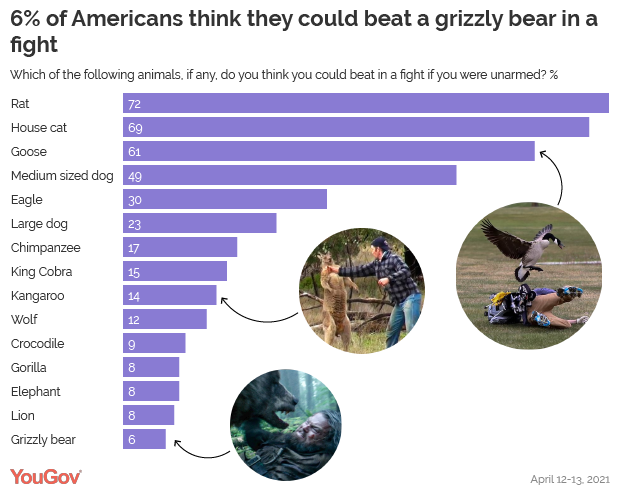
Not too terribly long ago, a YouGov poll came out which asked the big questions. It asked, reasonably enough, which of the following animals you think you could beat in a fight.  An unarmed fight, Mano a Mano, so to speak. The animals are : Kangaroo, Eagle, Grizzly Bear, Wolf, Lion, gorilla, chimpanzee, king cobra, elephant, crocodile, goose, rat, house cat, medium sized dog, large dog. As you may guess, most people were confident in their chances against a rat. That size difference would come into play really early, I guess. But things fall apart a bit as you continue to read, where you find that 61% of American men think they could beat a goose (still believable), 30% of American men think they could beat an eagle (highly unlikely), and 17% of American men think they could beat a chimpanzee. Unarmed.


No you can't.

Those 17% of men are delusional. There isn't one man in a thousand, possibly one man in a million who would stand a chance against a chimpanzee unarmed. The injuries they cause are immediate and horrific, and anyone thinking that he can just go toe to toe with one is delusional. Shockingly, only 14% of men believe they could beat a kangaroo, which is odd, given that we have literal video evidence of a regular guy winning in a fist fight with a Kangaroo, and as far as I can tell, no evidence whatsoever of a human being winning a bare knuckle brawl against a chimpanzee. 

So what would lead these gentlemen to this conclusion? Truly, a lack of humility. You overestimate your abilities, and you way way underestimate the abilities of a chimpanzee, which is perfectly capable of tying your neck in a knot. I'm not even going to include a link to chimpanzee caused injuries, but they're not pretty.

In that survey, 8% of american men and 2% of British men believe that they could beat a lion in an unarmed fight. That number is really zero percent. But you know who would be happy with that overconfidence? The lion would. 

Truly, the lion would relish the idea of easily killed food showing up and posturing, trying to start something. The lion would be thrilled if you showed up and started swinging at it. After all, most prey runs, hides, swims or flies away, and the lion has to chase it. Most prey has worked out by now that a lion will make you go away pretty quickly, and you don't really want to try tangling with it. But that 8% is a godsend. A very tasty godsend. 

We are enjoined by the reading from 1 Peter to humble ourselves, and to be realistic with ourselves. We are told to humble ourselves in the presence of the great shepherd of the sheep, for good reason. The reason given is that there is a roaring lion prowling around seeking whom he may devour. Friend, do you fancy your chances in an unarmed fight against a roaring lion? Sure, you don't. Hopefully you're not in that 8%. Hopefully you're in the 92% of people who know that a lion would devastate you very very quickly indeed. That's why you take precautions, of being where lions aren't, of avoiding them and arming yourself. That's why you, if you were to be in the area where they are, would travel with someone experienced and armed themselves. If you go out into the savanna with chest puffed out daring the lion to fight you, it'll destroy you right away. 

If you know that about the lions, you should also know that about the devil. The devil is a roaring lion, prowling around, seeking whom he may devour. He's very interested in dragging you away, and removing all trace of you. If you are full of yourself, if you believe that you are the 8%, the devil is happy for you to try your luck. And I would wager that the numbers for people who believe that they could take on the devil is far far higher than those who believe they could take on a lion. Lion numbers are 8%, devil numbers have got to be around 40%, or even higher. Humans vs the prince of darkness, and humans believe that  they can win. Part of the reason that church attendance is down, that observance is reduced, is because people legitimately don't believe that there is a risk. They believe that they can overcome the devil and all his works and all his ways with their own force of will. 

But a great deal of what we acknowledge is that from the beginning until now, the serpent, the dragon, the lion are things that overwhelm us when we fight them alone. When it's just us, with our plucky attitudes and dismissal of any danger at all, we get destroyed rapidly. And that hubris and overconfidence is what the devil wants. What he doesn't want is for you to be careful, cautious, prudent, and humble. He doesn't want you humbling yourself and being obedient to the great shepherd of the sheep. He would much rather that you trust you own strength. But humble yourself, understand who you are, who the devil is, and who Christ is, and you will find yourself, rapidly, in a space of protection. Why do we get baptized, why do we take the Lord's Supper, why are we in worship at all except to acknowledge that we are people who cannot free ourselves, who cannot protect ourselves, and who are incapable of fighting against the one who wants to destroy us. But Jesus has overcome the devil already. He insists on calling himself the shepherd because he knows how much we need his help and assistance, and how helpless we are on our own. But with Christ, with his weapons and experience, with his skill and strength, we can make a stand against the evil one. 

Monday, May 1, 2023

Rank communism

When our reading from Acts comes up, as it does every few years, it's time to talk about communism. For when you read through the pericopes from Acts, communism rears its red head. 

Now, there are a lot (and I do mean a lot) of generally conservative Christians who will be opposed to communism in all its forms, which is a big ask, given what is contained within the readings. When it says that the disciples were distributing all the proceeds of all the property that people had as any had need, it's hard for anyone to say that the principle 'from each according to his ability, to each according to its needs' is against God and scripture. It's not. Like it's really not. But if you have a knee-jerk reaction against communism, you'll find that you're rejecting, you know, something that the disciples directly did in scripture. The foundation of the community that the disciples led in the first century was communistic, plain and simple. You may not like the label, but it was exactly that.

So why does communism fail, if it's in scripture, and is part of the first community of believers? Well, it's all about the base assumptions, and we'll move on from there.

You essentially have to start out from realistic principles before you can go any further.  If you don't, then you literally can propose a universe in which chimpanzees will be likely to be observant communists. Which they won't. They'll be far more likely to be good cannibals than good communists. But they won't all work, combine all their resources and so on and so on. It won't come together. If we're going to look at communism, and to discuss why it won't work, the reason for it is that it's based on a lack of understanding in human nature. The idea was that people would work, and work collectively for the good of everyone, and would be content to socialize profits and so on. But any conception of communism sort of falls apart at the first hurdle of human nature. 

In the church, we understand that human beings are by nature sinful and unclean. That is, they cannot be trusted to share and distribute properly without the idea that they might very well steal and keep for themselves. The essential problem with communism isn't that the individual workers would be bad at being communists - in many ways they'd be okay. If you're working in a factory, it doesn't matter to you too much who owns it. But the real rot settles in at the top. 

The criticism of communism from the 20th century and beyond was always that those on the top, the commissars, the politburo, would always have a world that was unequal to the max. All animals, as they say, are equal, but some are more equal than others. The ordinary soviet was expected to be a good hard worker, and expected to give his labor to the society and so on, but those in charge would get awfully comfy. It became very quickly caviar and champagne for the politburo on the top, but nothing but grinding labor and breadlines for those on the bottom, and that didn't change much over the course of the soviet union. Essentially, if you're counting on someone to distribute goods and resources equitably, you're going to have to count on them to be good, well meaning people. Which they probably aren't. 

That's not fair. They probably start out with the absolute best of intentions, but the world has a habit of getting in the way. And what that means is that things start out well enough, but when you give people power and authority over others, there's a good chance that they'll fall apart, as they do. They literally can't be trusted not to take all those goods and services, and funnel them to themselves. 

The only real prescription is to understand from the beginning that even the people who you have in charge to help out with everything won't be doing a very trustworthy job with it. You have to start understand that literally everyone is a flawed human who is essentially up to no good.

Once you figure that out, then everything else makes more sense. If communism is built up off of the idea that a utopia is possible, and that you will one day not have the poor with you, then you'll be disappointed very rapidly, given how the ideals run smack into the reality of humanity. Your utopia runs aground because it doesn't deal with the harsh world of humans as they are.

But the scriptures do. Which is why the Bible, and the disciples, will tell you that it's very unlikely indeed that people will do things out of the goodness of their hearts. People are sinful, and that's why they need the governance that they get. They literally cannot be relied on to do the right thing, which is a fact of life, and the sooner we work that out, the sooner we can get past the communism vs capitalism idea, and get back to the idea from scripture: that you are called upon to do what you have to do with those who are around you. In reality, the Christian faith is less concerned with capitalism vs communism, and more concerned with what you do as an individual person. That is, you have a chance in this world to do the right thing, to be a neighbor to those who are directly around you. At any moment you have been placed in an environment where helpful, important things are right in front of you to do, and you can do them, or not. But you know that it's not up to the politburo or the commissars to take care of all utopia for you, but rather for you to step boldly into the world that you have been placed into. Whether a communist or capitalist society, your neighbor will need you regardless. Don't wait for all things to be made right. If you believe that resources should be distributed, you have resources to distribute. If you believe that the poor should be fed, you have food. If you believe that things should be more equitable, then make things more equitable .If you don't want that to be your problem, then you'll understand how the very very rich feel. But they have the same responsibility that you do, just on a larger scale. To provide for the needs that they see.

Tuesday, March 28, 2023

Come out

 I heard a sermon about the raising of Lazarus that talked about how even though Jesus of Nazareth called Lazarus out of the tomb, Lazarus still had to decide how to react to such a command.

Which is wrong.  I'll explain why.

I'd wager that you haven't heard of this movie outside of me talking about it, but there was a movie from the 1980s called 'return to horror high.' This movie had in it a very young George Clooney who, before he was a big star, got written out of the film first. The film is all about the making of a film, a film within a film, as it were. In this film, while the cast are being horribly murdered, the cast are still trying to make a movie, and do so with the usual director / cast interplay. And this interplay is at its most interesting in a discussion between the director and a cast member who is portraying a corpse in the scene.

Corpse: What's my motivation in this scene?

Director (Exasperated): You're dead. Dead people have no motivation. They don't do anything! They just lie there!

Fin.


I'm sure I have now spoken more about 'return to horror high' more than any of the cast or crew in the last two decades. But be that as it may, the content of the conversation is very important to talk about Lazarus in relation to it. What do dead people do? Nothing. They don't do anything. Importantly, they have no motivation. When we talk about Lazarus and his decision to respond to the call of Jesus, you have to think about his status as a corpse before we think about anything else. If he is incapable of motivation on account of being dead, then he is also incapable of responding to any kind of call. Go ahead, give commands to the pork chops on your table, and see what transpires. Pretty much nothing, right? Being dead meat, they don't get to decide how to respond to your commands. In order for the decision to be made, the individual must first be able to decide, which necessitates them being alive in the first place. In other words, you're going to have to be alive to make any choices, including the choice to listen to Christ or not. He literally can't make any decisions about how to react to Jesus before Jesus makes a key decision for him - to make him alive. 

That is the choice upon which every other choice depends, and in reality, it is the choice that none of us can make. Oh sure, we can decide to stay alive, to avoid death and thereby to continue making choices, but the choice to be alive is a choice that only someone else can make for us. In the first birth, that was our parents, as we were all born by the will of parents, but in the case of the second birth (being born again), it's of the will of God. You see, the scriptures talk about us as being dead in our trespasses, and there being no health in us. That may seem like bad news, but it's surprisingly good news. 

It's good news because it takes the responsibility for salvation away from you and your responses, and places it where it belongs. With God. The Lord doesn't have a reasoned discussion with Lazarus, allowing him to decide where he falls on the life or death equation, rather Jesus grants him life, and then all further decisions from Christ will proceed from that one. When we're talking about our Christian life, we're talking about a life that begins with Baptism, with us being called out of our death in trespasses and to new life in Christ. Once we have been awakened to Christ, then any excellent decision we make can flow from that first one. Not without it. Any decision that we can make that is good and God pleasing flows from that in the same way as Lazarus walking from the tomb is predicated on being alive in the first place. 

Once you work that out, then the grace of God carries a lot of weight - it is the difference between death and life, you know. The reality is that you're not going to make a lot of decisions if you're dead, and you're not going to make a lot of decisions for Christ if you're dead in your trespasses. That's why Jesus calls it a new birth, being born again. That means that your life in Christ is his will not yours. So you don't have to worry about if you did it right, or decided correctly. You did not choose him, he chose you. That's why the rest of the decisions you can possibly make all flow from that. 

Monday, March 20, 2023

Adding

 Okay, remember how I mentioned Pierre Berton's 'the comfortable pew' on Sunday? If you don't remember that, I'd like to mention that in his recollection of what he didn't like about going to church as a child was that he was hungry in church. Not that unusual, of course, but what was unusual was that he was hungry because he wasn't allowed to eat anything before he had Holy Communion that day. That is, Holy Communion had to be the first thing to pass his lips that day. 

Okay, but why?


Who asked you to do that? It wasn't God, you know. And so too, we have seen twitter users recently claiming that for Lent they're going to stop using twitter, and then when they inevitably get on and tweet more than they ever did before, they remind everyone that lent isn't about giving something up, guys. It's about spiritual discipline, and so on and so on.

Okay, but why? And who asked you to give up twitter? Or anything?

The thing is, as a Christian, you have to think about what it is Paul wrote in our Epistle reading from Sunday - you have to discern what is pleasing to God. It's tough to do, you know, to work out what it is that God wants, and it's all the harder when you are listening to two voices on the topic. And it's not necessarily the devil on one shoulder and the angel on the other. In fact, frequently, it's God on one shoulder, and you on the other. You may very well conflict with God based not on what the devil wants, but based on what you want. And that's tougher. 

By and large, that gets so conflated that you end up evangelizing not with the pure Christian gospel, but instead the Gospel as filtered through you. And that ends up being a major problem, given that you are going to present to the world a Christian faith that is very particular to yourself, and likely not as particular for the person to whom you are presenting it. And that makes it a very difficult sell. The reason it's such a hard sell is that if the faith that you are bringing to someone is the faith about you not the faith about Christ, then you're asking people to believe in the idol that you've made for yourself.

It's so easy to fall into as well, these extra steps that seem so good and so necessary. Don't drink any wine, don't dance, no playing cards, no staying out too late, no dating, all this stuff that seems so good and helpful but in reality is a barrier to the faith. You will find, over and over again, that people will disagree not so much with the faith of the scriptures, but with the extra steps that you show to them. You will show them that Jesus loves them, he cares for them, he dies to forgive their sins, but then you add to it with your cool fun political takes that don't belong. And that's the hard part. It's hard to admit sometimes that the thing you add is what actually subtracts from the appeal, but we all have to understand that sometimes things are just right, and that if you add anything to it, it can only get worse.

This is evident in film, of course, where you have a classic film, like Ghostbusters or Psycho or whatever, and someone decides to remake it. Some films are so good that nothing can be added to them without making them worse. The only question in making those films is to ask 'if it is different, then your changes made it worse. If it is the same, your film was unnecessary.' Even the original filmmakers come back and work on their projects again, if the project was any good in the first place, it will almost always turn out worse.

Part of what you have to understand, and it's hard, is that you are an ambassador of Christ. You are there to represent him as your savior. And if you represent him as your savior but with certain strings attached, all you'll do is to hold him back. You won't make it good or better for everyone if the Lord exclusively works within your paradigm. Instead, you will present to them a very small God indeed. A God that is exclusive to you.

One of the things that the Israelites learned was that unlike the nations around them who worshiped very small gods, the Israelites worshiped a God who seemed to know that other nations existed. A God who made moral pronouncements that affected the nation within as well as the nations without. A God who was truly and genuinely concerned about the welfare not just of one people, but of all people. And every time they tried to put strings on that, the story got worse, the same that we do. But God does call them back, to repentance, to clarity, and to his word, so that they can see that in its purity, the grace of God is sufficient.

Tuesday, March 7, 2023

It's all been done

 Yeah, today we have John 3:16. It's one of those readings that, as a pastor, you sort of dread, because what kind of new and fun spin can you put on John 3:16? What more are you going to say about the reading that pretty much everyone knows to death? In reality, there's not too much you can do with it, you know? Not much that you can say that everyone doesn't already know about. This isn't an obscure story about a judge who accidentally promised to kill his daughter, or a story about a king being so fat that when he got stabbed in the bathroom, his fat closed over the dagger. No, this is John 3:16, the 'Bible in a nutshell.' Everyone knows it. It's on tea towels, stickers, hats and jelly bracelets. You can find it on absolutely everything, and it's the one verse that everyone seems to know. 


But let's take a quick peek at how it shows up in the overall readings for Sunday. Because the readings have Abram being called by God, and being told that God was going to make of him a great nation, and that his descendants would be like the sand on the beach or the stars in the sky. All good news so far. And Abram, as an old man, does eventually have a couple of kids. Ishmael, and Isaac. Through Isaac comes the lineage of Israel, and eventually the birth of Jesus Christ, the messiah. That means that the words that God spoke came through, that through Abram all the would would be blessed.

But spare a thought for your friend and mine Nicodemus. We like to get a bit smug about this, as people who live in a baptism world, but it's easy for us to look at Nicodemus who asks a reasonable question like he's just a bozo. He asks 'how can a man be born again? Can he go back into his mother's womb when he is old?' Ha ha, doesn't he know about baptism? 

Well, no. 

Not only does he not know about baptism, which he doesn't, but he also has a realistic reaction. Think about the crowds gathered around Jesus who say 'we are children of Abraham, and we have never been slaves to anyone.' Think about the accusations towards Peter in the New Testament, that he ate with gentiles. The people of Israel were set apart by God for a reason. They were set apart to ensure that they would not mingle with the Gentiles. Not just as a matter of decorum, but as a matter of holiness. The people of Israel saw themselves as distinct, and not just worthy due to their faith, but due to their genes. They could trace their line back to Abraham, and so when they thought of themselves, it was as being of the house of Israel conferred special status according to the flesh that spilled over into the spirit. Paul puts it this way:

If someone else thinks they have reasons to put confidence in the flesh, I have more: circumcised on the eighth day, of the people of Israel, of the tribe of Benjamin, a Hebrew of Hebrews; in regard to the law, a Pharisee; as for zeal, persecuting the church; as for righteousness based on the law, faultless.


When Paul writes this, he is tapping into a reality, you know. A reality that the people of Israel assumed was 100% there. Because of passages that talked about Abram's seed being a very big deal according to God, the people of Israel assumed that their lineage was evidence of being blessed and chosen by God. This has continued to this day with the phenomenon of secular Jews, who identify as Jews, though not believing in God at all. Because of the ethnic and cultural aspects of Judaism, it is possible for someone born to a Jewish mother to be considered as fully Jewish whether or not they even believe that God exists.  So what does that mean? It means that due to a lack of defined faith being required, just as God breathed life into Adam, he would be able to raise up from the stones children for Abraham. And Nicodemus, who knows that Jesus is 'from God' as he says, he's going to want to work out which is the right house and line to be born in. From his perspective, it makes perfect sense. God has blessed the world through one family, but Jesus says you have to be born again. How you gonna pull that trick off when it's clearly too late for you, as you had one shot to be born, and you were born wrong.

But there is a new birth. Every bit as valid as the first, but the new birth is one that absolutely anyone can partake in. There is still a family, you know, and the family of Abram is still the one through which all the world will be blessed. But there is an important, non-genetic component that goes along with this.

Abram believed, and God credited it to him as righteousness.


So let's say that's true. Which is more important after all? Is the story of the Bible a story in which God just happens to like one group of people more than literally anyone else? Is it the story of God arbitrarily choosing one people and saying to them and of them 'these are my people and I love them best' the same way you would do with a dog? Or is it the story of God saving the entire world, and wanting all men to be saved and to come to a knowledge of the truth?  It seems that it's a key aspect of the teaching of Christ that you have to be born again, not born of the flesh, which you have been, but born of the spirit. Born not into a family of skin and bone, but born into a family of faith, where you believe and it gets credited to you as righteousness.